Loading...
Murong Chui vs Napoleon Bonaparte
Napoleon Bonaparte leads by 12.7 pts · 2 figures compared
…
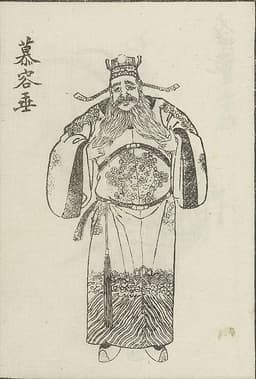
Murong Chui
Emperor · Ancient
58.2Total

Napoleon Bonaparte
General · Modern
70.9Total
Basic Information
Born
326
1769
Died
396
1821
Era
Ancient
Modern
Nationality
China
France
Occupation
Emperor
General
Civilization
Eastern
Western
Score Comparison
Military (10%)
65.0
94.0
Political (20%)
45.0
72.0
Influence (20%)
58.0
40.0
Legacy (20%)
50.0
80.0
Leadership (15%)
72.0
78.0
Strategy (15%)
72.0
90.0
TOTAL
58.2
70.9
Murong Chui — Complete Timeline
384 AD
Founded the Later Yan dynastyPolitical Action◆ Major
Murong Chui declared himself Prince of Yan, founding the Later Yan dynasty after breaking away from the Former Qin. He established his capital at Zhongshan (modern Dingzhou, Hebei) and began consolidating power in northern China.
Dynasty FoundingXianbeiNorthern China
Impact: regionalconstructive
395 AD
Battle of Canhe SlopeWar◆ Major
Murong Chui led a campaign against the Northern Wei dynasty. His forces were defeated at Canhe Slope by the Wei army under Tuoba Gui, a major setback that weakened Later Yan and led to its decline.
BattleDefeatNorthern Wei
Impact: regionaldestructive
396 AD
Death from illnessOther◆ Major
Murong Chui died of illness while on campaign against Northern Wei. His death left the Later Yan dynasty in a weakened state, and it soon collapsed under pressure from the Northern Wei.
DeathDynastic Decline
Impact: regionaltragic
Napoleon Bonaparte — Complete Timeline
1799 AD
Coup of 18 BrumaireOther◆ Major
Napoleon Bonaparte, with support from his brother Lucien and key political figures, overthrew the Directory in a bloodless coup. He established the Consulate with himself as First Consul, effectively becoming the ruler of France. This event ended the French Revolution's most unstable period.
French RevolutionCoupRise to Power
Impact: regional
1804 AD
Promulgation of the Napoleonic CodeOther◆ Major
Napoleon enacted the Civil Code of the French, known as the Napoleonic Code, a comprehensive set of laws that replaced the fragmented feudal legal systems. The code established legal equality, protected property rights, and secularized law. It became the basis for legal systems in many European and world countries.
Legal ReformNapoleonic CodeCivil Law
Impact: globalconstructive
1805 AD
Battle of AusterlitzWar◆ Major
Napoleon's Grande Arm
Napoleonic WarsBattleDecisive Victory
Impact: global
1812 AD
Invasion of RussiaWar◆ Major
Napoleon led the Grande Arm
Napoleonic WarsInvasionDisaster
Impact: globaldestructive
1815 AD
Battle of WaterlooWar◆ Major
Napoleon's French army was defeated by the combined forces of the Duke of Wellington's Anglo-Allied army and Gebhard Leberecht von Bl
Napoleonic WarsBattleFinal Defeat
Impact: globaldestructive
Expert Analysis
murong-chui-vs-napoleon-bonaparte
# The Emperor of Europe and the Prince of Yan: Two Lives on the Edge of Empire
In the spring of 1815, Napoleon Bonaparte stood before his assembled troops at Grenoble, a man who had been emperor of France, master of Europe, and now, improbably, a returning exile. The soldiers sent to arrest him instead fell to their knees. Twelve centuries earlier and half a world away, another military genius—Murong Chui of the Xianbei people—found himself in a different kind of exile, fleeing from the collapsing Former Qin dynasty with little more than his reputation and a handful of loyal followers. Both men had tasted power, lost it, and would fight to reclaim it. But their paths diverged in ways that reveal not just the gulf between East and West, but the cruel arithmetic of history itself.
Origins
Napoleon was born in 1769 on the island of Corsica, a Mediterranean backwater that France had acquired only a year earlier. His family were minor Italian nobility, scraping by on modest incomes and resentful of French rule. The boy who would conquer Europe grew up speaking Italian, not French, and his first heroes were not French kings but Corsican patriots who fought against French occupation. This outsider's perspective would shape him: he saw the French Revolution not as a catastrophe but as an opportunity, a ladder for talent to climb.
Murong Chui, born in 326, came from the opposite end of the social spectrum. He was a prince of the Xianbei people, a nomadic confederation that had carved out kingdoms in northern China after the fall of the Western Jin dynasty. His father was a king, his brothers were generals, and his childhood was steeped in the saddle and the sword. Where Napoleon learned strategy from books and artillery manuals, Murong Chui learned it from the steppe—from hunting parties that were really military exercises, from tribal raids that taught him the value of speed and surprise.
The eras that shaped them were equally different. Napoleon came of age in revolutionary France, where the old order had collapsed and a man of talent could rise to the top in a decade. Murong Chui came of age in the Sixteen Kingdoms period, a brutal era of constant warfare where no dynasty lasted more than a generation and betrayal was the only reliable currency.
Rise to Power
Napoleon's ascent was meteoric. At twenty-four, he cleared the streets of Paris of royalist rebels with a "whiff of grapeshot." At twenty-seven, he was commanding the Army of Italy, winning battles that forced Austria to sue for peace. By thirty, he was First Consul of France; by thirty-five, Emperor. Each step was a gamble, and each gamble paid off—until they didn't.
Murong Chui's rise was slower and more painful. He served under his brother, the emperor of the Former Yan dynasty, but his successes bred jealousy. When the dynasty fell to the Former Qin in 370, Murong Chui was forced into service under his conqueror, Fu Jiān. For fourteen years, he served a man who had destroyed his kingdom, waiting. He fought for the Former Qin, winning battles that expanded their empire, all while nursing a private ambition. In 384, when Fu Jiān's empire began to crack under the strain of its own expansion, Murong Chui seized his moment. He declared himself Prince of Yan, founding the Later Yan dynasty at the age of fifty-eight—an age at which Napoleon had already been dead for three years.
Leadership & Governance
As a ruler, Napoleon was a revolutionary in emperor's clothing. His Napoleonic Code reformed French law, establishing principles of equality before the law and merit-based advancement that would influence legal systems from Europe to Latin America. He built schools, roads, and a centralized bureaucracy. He made peace with the Catholic Church, stabilized the currency, and gave France a sense of national purpose it had lacked since the Revolution descended into terror.
Murong Chui ruled as a Xianbei chieftain first and a Chinese emperor second. His Later Yan dynasty was a military state, built on the loyalty of his fellow tribesmen and the fear of his Chinese subjects. He reformed the administration of his domain, but his core identity remained that of a war leader. Where Napoleon governed through laws and institutions, Murong Chui governed through personal relationships and military might.
Their military genius, however, was comparable. Napoleon's campaigns in Italy, Egypt, and central Europe were masterpieces of speed, deception, and concentration of force. His 1805 victory at Austerlitz remains a textbook example of how to destroy a larger army through superior positioning and timing. Murong Chui's campaigns against the Former Qin and the Northern Wei showed similar brilliance. He understood the art of the feigned retreat, the ambush, and the decisive strike. But where Napoleon fought with professional armies armed with cannon and musket, Murong Chui fought with tribal cavalry armed with bows and sabers—a difference that reflected not just technology but the entire structure of their societies.
Triumph & Tragedy
Napoleon's greatest triumph was also the beginning of his end. In 1812, he invaded Russia with the largest army Europe had ever seen—over 600,000 men. He reached Moscow, but the Russians refused to surrender, and the Russian winter refused to compromise. By the time the Grand Army limped back to France, only 100,000 men remained. It was a defeat from which he never fully recovered. His 1815 return from exile—the Hundred Days—was a brilliant gamble that ended at Waterloo, where the Duke of Wellington and Gebhard Leberecht von Blücher finally broke him.
Murong Chui's tragedy came in 395, at the Battle of Canhe Slope. He led a campaign against the rising Northern Wei dynasty, but his forces were caught in a trap. The Wei army, led by the young Tuoba Gui, used the same tactics Murong Chui had perfected: feigned retreat followed by a devastating counterattack. The Later Yan army was annihilated. Murong Chui died of illness the following year, in 396, while trying to regroup. His dynasty, already weakened, would not survive his death.
Character & Destiny
Napoleon was driven by an insatiable hunger for glory. "What is the throne?" he once asked. "A piece of wood covered with velvet." What mattered was the achievement, the legacy, the name that would echo through history. This ambition made him unstoppable in victory but unable to stop while he was ahead. He could not accept a Europe that did not bow to him, and so he kept fighting until the continent united against him.
Murong Chui was driven by a different kind of hunger: the need to restore what had been taken. He had seen his kingdom destroyed, his family scattered, his people humiliated. His ambition was not to conquer the world but to reclaim his birthright. This made him cautious where Napoleon was reckless, patient where Napoleon was impulsive. But it also made him unable to build something new—only to rebuild what had been lost.
Legacy
Napoleon's legacy is global. His legal code, his administrative reforms, his military tactics—these things outlasted his empire by two centuries. He is remembered as both a liberator and a tyrant, a genius and a megalomaniac. The debate over his legacy continues because his impact continues.
Murong Chui's legacy is local. He is remembered in Chinese history as one of the great generals of the Sixteen Kingdoms period, but his dynasty crumbled, his reforms faded, and his name is known only to scholars of the period. His Legacy score of 67.9 reflects this—a brilliant military mind who could not build a lasting state.
Conclusion
What separates these two men is not talent—both were extraordinary—but context. Napoleon rose in a Europe that was hungry for order and unity, a continent that was ready to be remade. The forces he unleashed—nationalism, meritocracy, legal reform—were forces that would shape the next two centuries. Murong Chui rose in a China that was fragmenting, a world of warring states where no single vision could hold. He fought to restore a kingdom, not to create a new order.
In the end, Napoleon's tragedy was that he could not stop conquering. Murong Chui's tragedy was that he started too late. One was consumed by his own ambition; the other was consumed by a world that had no room for his ambitions. Both were great men. Only one was great at the right time.
Rankings
🥇
Napoleon BonaparteLeader
Mil: 94.0Pol: 72.0Inf: 40.0
70.9
🥈
Murong Chui
Mil: 65.0Pol: 45.0Inf: 58.0
58.2
+12.7 behind
How This Comparison Works
Algorithm
Each figure is scored on 6 dimensions (0—100 scale) based on structured historical data: Military (10%), Political (20%), Influence (20%), Legacy (20%), Leadership (15%), Strategy (15%). The weighted total produces the final ranking.
Data Sources
Scores are computed from structured sub-indicators in the database. Scale factors adjust for era (Ancient ×0.85, Modern ×1.0) and civilization size (Eastern ×1.05, Other ×0.80) to account for differences in population and military scale.
Maximum 3 Figures
Comparisons are limited to 2—3 figures to ensure readability and statistical meaningfulness.
Error Margins
±5 points per dimension — Sub-scores are derived from historical records with inherent uncertainty. Two figures within 5 points on a dimension should be considered roughly equivalent in that area.
Total Score Accuracy
±3 points overall — The weighted combination of 6 dimensions produces a total score with approximately ±3 points of uncertainty. Differences of less than 3 points are not statistically significant— the figures are effectively tied.
Known Limitations
- Historical records are incomplete and uneven across civilizations
- Figures from oral-tradition societies may be underrepresented
- Occupation labels can misclassify multi-role figures
- Scores measure capability and impact, not moral character
- Quantitative scoring is a comparison tool, not absolute truth
Capability Radar
Military (10%) — Battles & Warfare
Battles
85
95
Win Rate
90
90
Expansion
85
95
Political (20%) — Governance & Reform
Reform
65
95
Diplomacy
70
80
Economy
60
85
Influence (20%) — Cultural & Global Reach
Cultural
50
85
Global
40
90
Legacy (20%) — Historical Impact
Historical
65
95
Longevity
45
90
Leadership (15%) — Power & Stability
Tenure
75
85
Stability
55
70
Strategy (15%) — Tactics & Innovation
Strategy
88
95
Tactics
92
98
Reform
70
92
Similar Comparisons
Comments & Discussion
No comments yet. Be the first to share your thoughts!