Loading...
This comparison has not been analyzed yet.
One-time AI generation (~1 minute). Scores and timeline are already available below.
Musa II vs Sigebert I
Sigebert I leads by 7.6 pts · 2 figures compared
…
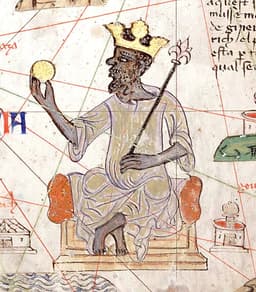
Musa II
Emperor · Medieval
38.3Total
Sigebert I
Emperor · Medieval
45.9Total
Basic Information
Born
1360
535
Died
1387
575
Era
Medieval
Medieval
Nationality
Mali Empire
Frankish Empire
Occupation
Emperor
Emperor
Civilization
Other
Western
Score Comparison
Military (10%)
20.0
55.0
Political (20%)
33.6
37.9
Influence (20%)
45.5
50.2
Legacy (20%)
35.0
41.7
Leadership (15%)
44.5
48.4
Strategy (15%)
45.0
45.0
TOTAL
38.3
45.9
Musa II — Complete Timeline
1374 AD
Reign as Mansa of MaliPolitical Action◆ Major
Musa II became mansa of the Mali Empire but was a figurehead controlled by his powerful vizier, Mari Djata. The vizier effectively ruled the empire, making decisions on military, economic, and administrative matters. This period saw further decline of central authority.
ReignMali EmpireVizierDecline
Impact: nationaldestructive
Sigebert I — Complete Timeline
566 AD
Marriage to BrunhildaPolitical Action◆ Major
Sigebert I married Brunhilda, daughter of the Visigothic king Athanagild. This marriage brought a substantial dowry and a prestigious alliance with the Visigoths, strengthening Austrasia's position against Neustria and enhancing Sigebert's prestige.
MerovingianMarriageAlliance
Impact: regionalconstructive
568 AD
Campaign Against the AvarsWar
Sigebert I led a Frankish army against the Avars, who had invaded Austrasian territory. The campaign was initially successful, but Sigebert was eventually captured by the Avars. He secured his release through negotiations and payment of tribute.
MerovingianAvarsCampaign
Impact: regional
575 AD
Defeat of Chilperic I at TournaiWar◆ Major
Sigebert I's forces defeated Chilperic I's army near Tournai, forcing Chilperic to flee. Sigebert was on the verge of capturing Chilperic and unifying the Frankish kingdoms when he was assassinated by agents of Fredegund.
MerovingianBattleCivil War
Impact: regional
Assassination of Sigebert IPolitical Action◆ Major
Sigebert I was assassinated at Vitry-en-Artois by two slaves wielding poisoned daggers, allegedly on the orders of Fredegund, wife of Chilperic I. His death ended his campaign against Neustria and left his young son Childebert II as king under Brunhilda's regency.
MerovingianAssassinationFredegund
Impact: regionaltragic
This comparison has not been analyzed yet.
One-time AI generation (~1 minute). Scores and timeline are already available below.
Rankings
🥇
Sigebert ILeader
Mil: 55.0Pol: 37.9Inf: 50.2
45.9
🥈
Musa II
Mil: 20.0Pol: 33.6Inf: 45.5
38.3
+7.6 behind
How This Comparison Works
Algorithm
Each figure is scored on 6 dimensions (0—100 scale) based on structured historical data: Military (10%), Political (20%), Influence (20%), Legacy (20%), Leadership (15%), Strategy (15%). The weighted total produces the final ranking.
Data Sources
Scores are computed from structured sub-indicators in the database. Scale factors adjust for era (Ancient ×0.85, Modern ×1.0) and civilization size (Eastern ×1.05, Other ×0.80) to account for differences in population and military scale.
Maximum 3 Figures
Comparisons are limited to 2—3 figures to ensure readability and statistical meaningfulness.
Error Margins
±5 points per dimension — Sub-scores are derived from historical records with inherent uncertainty. Two figures within 5 points on a dimension should be considered roughly equivalent in that area.
Total Score Accuracy
±3 points overall — The weighted combination of 6 dimensions produces a total score with approximately ±3 points of uncertainty. Differences of less than 3 points are not statistically significant— the figures are effectively tied.
Known Limitations
- Historical records are incomplete and uneven across civilizations
- Figures from oral-tradition societies may be underrepresented
- Occupation labels can misclassify multi-role figures
- Scores measure capability and impact, not moral character
- Quantitative scoring is a comparison tool, not absolute truth
Capability Radar
Military (10%) — Battles & Warfare
Battles
5
35
Win Rate
5
40
Expansion
5
30
Political (20%) — Governance & Reform
Reform
5
25
Diplomacy
10
45
Economy
10
30
Influence (20%) — Cultural & Global Reach
Cultural
5
25
Global
5
15
Legacy (20%) — Historical Impact
Historical
5
30
Longevity
5
20
Leadership (15%) — Power & Stability
Tenure
10
40
Stability
10
20
Strategy (15%) — Tactics & Innovation
Strategy
5
35
Tactics
5
30
Reform
5
20
Similar Comparisons
Comments & Discussion
No comments yet. Be the first to share your thoughts!