Loading...
This comparison has not been analyzed yet.
One-time AI generation (~1 minute). Scores and timeline are already available below.
Narasimhavarman II vs Wanyan Liang
Narasimhavarman II leads by 6.5 pts · 2 figures compared
…

Narasimhavarman II
Emperor · Medieval
55.6Total
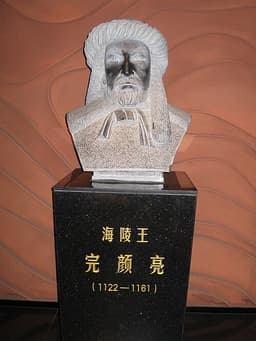
Wanyan Liang
Emperor · Medieval
49.1Total
Basic Information
Born
695
1122
Died
728
1161
Era
Medieval
Medieval
Nationality
India
Jin dynasty
Occupation
Emperor
Emperor
Civilization
Indian
Eastern
Score Comparison
Military (10%)
40.0
67.5
Political (20%)
53.8
40.8
Influence (20%)
55.0
51.8
Legacy (20%)
52.0
44.2
Leadership (15%)
72.0
48.4
Strategy (15%)
60.0
50.0
TOTAL
55.6
49.1
Narasimhavarman II — Complete Timeline
700 AD
Construction of the Shore Temple at MamallapuramCultural◆ Major
Narasimhavarman II built the Shore Temple at Mamallapuram, a structural granite temple complex dedicated to Shiva and Vishnu. This temple is a UNESCO World Heritage site and a landmark of Dravidian architecture, featuring intricate carvings and a seaside location.
Temple BuildingDravidian ArchitectureUNESCO Heritage
Impact: regionalconstructive
Patronage of Sanskrit and Tamil LiteratureCultural
Narasimhavarman II patronized scholars and poets, including the Sanskrit poet Dandin, who is said to have visited his court. This patronage fostered literary production in both Sanskrit and Tamil, contributing to the cultural efflorescence of the Pallava period.
Literary PatronageSanskritTamil
Impact: regionalconstructive
710 AD
Construction of the Kailasanathar Temple at KanchipuramCultural◆ Major
Narasimhavarman II built the Kailasanathar Temple in Kanchipuram, a large sandstone temple dedicated to Shiva. This temple is one of the finest examples of early Pallava architecture, with a vimana (tower) and numerous sculptures, influencing later Chola temples.
Temple BuildingPallava ArchitectureKanchipuram
Impact: regionalconstructive
720 AD
Diplomatic Mission to ChinaPolitical Action◆ Major
Narasimhavarman II sent an embassy to the Tang court of China, as recorded in Chinese historical sources. This diplomatic mission strengthened trade and cultural ties between the Pallava kingdom and China, facilitating the exchange of goods and ideas.
DiplomacyChina TradeTang Dynasty
Impact: globalconstructive
Wanyan Liang — Complete Timeline
1150 AD
Usurped the thronePolitical Action◆ Major
Wanyan Liang assassinated his cousin Emperor Wanyan Dan and declared himself emperor. He purged many members of the imperial clan and their supporters to consolidate his rule, establishing a reign of terror.
UsurpationAssassinationPurge
Impact: nationaldestructive
1153 AD
Moved the capital to ZhongduPolitical Action◆ Major
Wanyan Liang ordered the relocation of the Jin capital from Shangjing (Harbin) to Zhongdu (Beijing). He constructed a new palace complex and moved the imperial court south to better control the conquered Chinese territories.
Capital moveZhongduBeijing
Impact: nationalconstructive
1161 AD
Invasion of the Southern SongWar◆ Major
Wanyan Liang launched a massive invasion of the Southern Song dynasty with a large army and navy. The campaign failed after the Jin fleet was defeated at the Battle of Caishi on the Yangtze River.
InvasionSong-Jin warBattle of Caishi
Impact: regionaldestructive
Killed by his own officersWar◆ Major
After the failure of the Southern Song invasion, Wanyan Liang's own generals mutinied and assassinated him at his camp. His death ended the war and led to a reversal of his policies by his successor Wanyan Yong.
AssassinationMutinyEnd of reign
Impact: nationaltragic
This comparison has not been analyzed yet.
One-time AI generation (~1 minute). Scores and timeline are already available below.
Rankings
🥇
Narasimhavarman IILeader
Mil: 40.0Pol: 53.8Inf: 55.0
55.6
🥈
Wanyan Liang
Mil: 67.5Pol: 40.8Inf: 51.8
49.1
+6.5 behind
How This Comparison Works
Algorithm
Each figure is scored on 6 dimensions (0—100 scale) based on structured historical data: Military (10%), Political (20%), Influence (20%), Legacy (20%), Leadership (15%), Strategy (15%). The weighted total produces the final ranking.
Data Sources
Scores are computed from structured sub-indicators in the database. Scale factors adjust for era (Ancient ×0.85, Modern ×1.0) and civilization size (Eastern ×1.05, Other ×0.80) to account for differences in population and military scale.
Maximum 3 Figures
Comparisons are limited to 2—3 figures to ensure readability and statistical meaningfulness.
Error Margins
±5 points per dimension — Sub-scores are derived from historical records with inherent uncertainty. Two figures within 5 points on a dimension should be considered roughly equivalent in that area.
Total Score Accuracy
±3 points overall — The weighted combination of 6 dimensions produces a total score with approximately ±3 points of uncertainty. Differences of less than 3 points are not statistically significant— the figures are effectively tied.
Known Limitations
- Historical records are incomplete and uneven across civilizations
- Figures from oral-tradition societies may be underrepresented
- Occupation labels can misclassify multi-role figures
- Scores measure capability and impact, not moral character
- Quantitative scoring is a comparison tool, not absolute truth
Capability Radar
Military (10%) — Battles & Warfare
Battles
35
65
Win Rate
40
55
Expansion
35
70
Political (20%) — Governance & Reform
Reform
65
45
Diplomacy
60
30
Economy
65
35
Influence (20%) — Cultural & Global Reach
Cultural
75
30
Global
55
20
Legacy (20%) — Historical Impact
Historical
70
40
Longevity
65
25
Leadership (15%) — Power & Stability
Tenure
70
40
Stability
70
20
Strategy (15%) — Tactics & Innovation
Strategy
40
55
Tactics
45
60
Reform
30
50
Similar Comparisons
Comments & Discussion
No comments yet. Be the first to share your thoughts!