Loading...
Oduduwa vs Tamar of Georgia
Tamar of Georgia leads by 11.8 pts · 2 figures compared
…
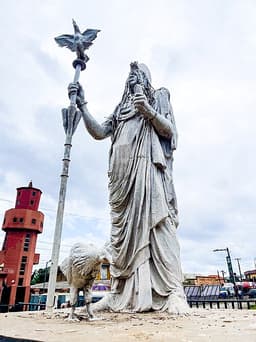
Oduduwa
Emperor · Medieval
59.7Total
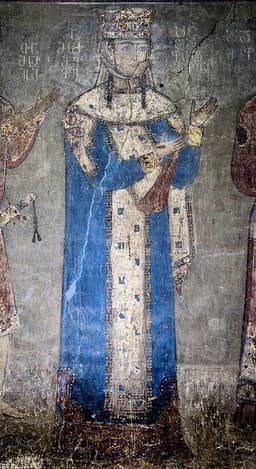
Tamar of Georgia
Emperor · Medieval
71.5Total
Basic Information
Born
950
1160
Died
1020
1213
Era
Medieval
Medieval
Nationality
Ife
Georgia
Occupation
Emperor
Emperor
Civilization
Other
Western
Score Comparison
Military (10%)
50.0
78.0
Political (20%)
46.6
72.0
Influence (20%)
68.0
82.0
Legacy (20%)
68.0
55.0
Leadership (15%)
67.0
80.0
Strategy (15%)
36.8
66.3
TOTAL
59.7
71.5
Oduduwa — Complete Timeline
1000 AD
Foundation of the Yoruba civilization at Ile-IfeCultural
According to Yoruba oral tradition, Oduduwa descended from heaven at Ile-Ife and founded the Yoruba civilization. He is credited with establishing the first Yoruba kingdom and the sacred city of Ile-Ife, which became the spiritual and cultural heartland of the Yoruba people.
Impact: regionalconstructive
1010 AD
Establishment of the Yoruba royal dynastiesPolitical Action◆ Major
Oduduwa is said to have sent his sons and grandsons to found the various Yoruba kingdoms, including Oyo, Benin, and Ketu. This act established the royal lineages that ruled these states for centuries, creating a network of related kingdoms under the spiritual authority of the Ooni of Ife.
Impact: regionalconstructive
Tamar of Georgia — Complete Timeline
1184 AD
Coronation as Queen RegnantPolitical Action
Tamar was crowned as the first female ruler of Georgia after her father George III's death. Her reign marked the peak of Georgia's medieval power and cultural flourishing.
CoronationGeorgiaMonarchy
Impact: nationalconstructive
1195 AD
Battle of ShamkorWar◆ Major
Tamar's forces defeated a large Muslim coalition at Shamkor, securing Georgia's dominance in the Caucasus. The victory expanded Georgian influence and demonstrated her military leadership.
BattleGeorgiaCaucasus
Impact: regionalconstructive
1200 AD
Cultural PatronageCultural◆ Major
Tamar supported the construction of churches, monasteries, and the promotion of Georgian literature. Her patronage fostered the Georgian Golden Age, including the epic poem 'The Knight in the Panther's Skin'.
CulturePatronageGeorgia
Impact: nationalconstructive
Expert Analysis
Tamar of Georgia vs Oduduwa
### The Sky and the Throne: Oduduwa and Tamar, Two Paths to Power
In the beginning, there was a descent from the heavens. A figure named Oduduwa, carrying a handful of earth and a five-toed chicken, landed on the primordial waters and created the land of Ile-Ife. In another beginning, a young woman stood before the nobles of Georgia, her father’s crown heavy on her head, the first of her sex to rule alone. One story is a myth of creation; the other is a chronicle of coronation. Yet both Oduduwa and Tamar emerged from the mists of the medieval world to shape civilizations that still bear their names. Why did one become a divine ancestor and the other a warrior queen? The answer lies not in their eras, but in the very nature of their power.
### Origins
Oduduwa’s origins are not of flesh and blood, but of spirit and stone. Born around 950, he exists in the twilight between history and legend. The Yoruba oral tradition tells us he descended from the sky, sent by the supreme god Olodumare to create dry land and establish order. He is not a man who grew up in a palace; he is a force that arrived from beyond. This origin story, rooted in a world where the sacred and the political were inseparable, gave him a legitimacy no rival could question. He was not a conqueror; he was a creator.
Tamar, born around 1160 in the Kingdom of Georgia, was entirely of this world. She was the daughter of King George III, raised in a court that had already tasted glory. Her Georgia was a Christian kingdom perched between the Islamic caliphates and the Byzantine Empire, a land of fierce warriors and ambitious nobles. From birth, she was trained in the arts of governance and diplomacy, but she was also burdened by a single, unchangeable fact: she was a woman. Her origin was not a divine mission, but a political problem.
### Rise to Power
Oduduwa’s rise was instantaneous and absolute. According to the tradition of 1000, he simply arrived at Ile-Ife and founded the Yoruba civilization. There was no election, no coup, no slow climb. He was the source of authority itself. His power was not built on armies—his military score of 11.4 is remarkably low—but on the sheer force of his sacred presence. He then sent his sons and grandsons to establish the kingdoms of Oyo, Benin, and Ketu around 1010, creating a network of dynasties that traced their bloodlines back to him. His power was genealogical, a tree that spread across the land.
Tamar’s rise was a struggle from the start. Crowned in 1184, she immediately faced a conspiracy of nobles who questioned her right to rule. She was forced to marry a foreign prince, Yuri Bogolyubsky, to quell dissent, only to have him turn against her. She divorced him and exiled him, a shocking move for a medieval queen. Her path to power was not a descent from heaven, but a series of battles for control of her own court. She did not inherit the throne; she had to conquer it, again and again.
### Leadership & Governance
Here, the two rulers diverge most sharply. Oduduwa’s leadership score of 81.7 reflects a ruler who governed through myth and ritual. He was the father of a people, not the commander of an army. His strategy score of 30.0 suggests he had little need for military tactics; his power was spiritual and political, a soft power that bound the Yoruba kingdoms in a web of kinship and obligation. He was the architect of a civilization’s soul.
Tamar, with a leadership score of 82.5 and a military score of 71.0, was a warrior queen. In 1195, at the Battle of Shamkor, her forces crushed a massive Muslim coalition, securing Georgian dominance in the Caucasus. She did not merely lead from the throne; she inspired armies. Yet her political wisdom—a score of 75.2—was equally sharp. She patronized the arts, building churches and monasteries, and fostered the Georgian Golden Age. She understood that a kingdom needed both walls and windows. Her governance was a balance of steel and silk.
### Triumph & Tragedy
Oduduwa’s triumph was the foundation of a civilization that would endure for a millennium. His tragedy is that he remains a shadow, a figure of legend rather than history. We know his deeds but not his doubts, his victories but not his wounds. He is remembered not as a man, but as an idea.
Tamar’s triumph was the Battle of Shamkor, where she proved that a woman could lead a nation to glory. Her tragedy came later, in the slow erosion of her health and the endless scheming of her court. She died in 1213, leaving behind a kingdom at its peak, but one that would soon be ravaged by the Mongols. Her greatest victory was also a fragile one.
### Character & Destiny
Oduduwa’s character is defined by his role as the progenitor. He is a figure of unity, a symbol of a people’s shared origin. His destiny was to be the root, not the branch. He did not conquer; he created. His decisions were not tactical, but foundational.
Tamar’s character was forged in resistance. She was a woman who had to be twice as good as any man, and she was. She was shrewd, patient, and ruthless when necessary. Her destiny was to break a glass ceiling with a sword. She did not create a people; she led them. Her decisions were not about founding a civilization, but about defending and elevating one.
### Legacy
Oduduwa’s legacy is the Yoruba civilization itself. Every Yoruba king, every Oba, traces his lineage back to this single figure. His influence score of 69.2 and legacy score of 69.9 reflect a ruler who is not just remembered, but worshipped. He is a deity, a saint, a father.
Tamar’s legacy is the Georgian Golden Age. She is remembered as “King of Kings” and “Queen of Queens,” a woman who ruled in a man’s world and left her kingdom stronger than she found it. Her influence score of 68.7 and legacy score of 72.2 place her as a national icon, a symbol of Georgian identity and resilience. She is a queen, a warrior, a patron.
### Conclusion
Two rulers, two worlds. Oduduwa descended from the sky to create a civilization from nothing; Tamar rose from a throne to defend and glorify one. One is a myth, the other a history. One is a father, the other a queen. Their differences are not just about time and place, but about the very nature of power. Oduduwa’s power was the power of origin, the power of being first. Tamar’s power was the power of survival, the power of being the best. In the end, both achieved what few rulers ever do: they became immortal. One in the heavens, the other in the hearts of her people.
Rankings
🥇
Tamar of GeorgiaLeader
Mil: 78.0Pol: 72.0Inf: 82.0
71.5
🥈
Oduduwa
Mil: 50.0Pol: 46.6Inf: 68.0
59.7
+11.8 behind
How This Comparison Works
Algorithm
Each figure is scored on 6 dimensions (0—100 scale) based on structured historical data: Military (10%), Political (20%), Influence (20%), Legacy (20%), Leadership (15%), Strategy (15%). The weighted total produces the final ranking.
Data Sources
Scores are computed from structured sub-indicators in the database. Scale factors adjust for era (Ancient ×0.85, Modern ×1.0) and civilization size (Eastern ×1.05, Other ×0.80) to account for differences in population and military scale.
Maximum 3 Figures
Comparisons are limited to 2—3 figures to ensure readability and statistical meaningfulness.
Error Margins
±5 points per dimension — Sub-scores are derived from historical records with inherent uncertainty. Two figures within 5 points on a dimension should be considered roughly equivalent in that area.
Total Score Accuracy
±3 points overall — The weighted combination of 6 dimensions produces a total score with approximately ±3 points of uncertainty. Differences of less than 3 points are not statistically significant— the figures are effectively tied.
Known Limitations
- Historical records are incomplete and uneven across civilizations
- Figures from oral-tradition societies may be underrepresented
- Occupation labels can misclassify multi-role figures
- Scores measure capability and impact, not moral character
- Quantitative scoring is a comparison tool, not absolute truth
Capability Radar
Military (10%) — Battles & Warfare
Battles
10
75
Win Rate
10
85
Expansion
30
75
Political (20%) — Governance & Reform
Reform
50
80
Diplomacy
40
75
Economy
40
85
Influence (20%) — Cultural & Global Reach
Cultural
80
80
Global
70
60
Legacy (20%) — Historical Impact
Historical
80
75
Longevity
80
70
Leadership (15%) — Power & Stability
Tenure
40
85
Stability
50
70
Strategy (15%) — Tactics & Innovation
Strategy
10
80
Tactics
10
70
Reform
10
65
Similar Comparisons
Comments & Discussion
LEGACY_LOOPER6/16/2026
Tamar's 24-year rule as Georgia's first female monarch saw the kingdom expand into the largest territory in its history, yet some revisionists dismiss her as a lucky inheritor. Come on—she crushed the Battle of Shamkor in 1195 with strategic brilliance, not blind luck. Oduduwa's founding of Ile-Ife around 950 CE is epic, but let's be real: mythologizing celestial origins doesn't require the same political acumen as holding a fractious court together. Tamar earned her crown twice over.
神話破壁者6/16/2026
说Oduduwa是天神下凡建立土地,这叙事美得很,但别把宗教寓言当历史事实。考古证据显示,Ife的繁荣更多源于跨撒哈拉贸易而非神力。Tamar则实打实留下了军事扩张、法典改革和建筑遗产。拿一个神话人物跟真实女王比,就像比较创世记和战争史——根本不同维度。数据不会说谎,Tamar的单人统治史实秒杀Oduduwa的模糊传说。
THRONE_ANALYST6/16/2026
The comparison misses a key point: Tamar's power was institutionalized through a Christian monarchy and feudal system, while Oduduwa's authority was cosmological. Tamar had to navigate the patriarchal norms of 12th-century Georgia, even co-ruling with two disputed husbands to maintain stability. Oduduwa's "descent" sidesteps any such struggle. If we're judging impact, Tamar's cultural golden age under her reign—think Shota Rustaveli's epic poetry—gave Georgia a national identity that still reson
数据控的清醒6/16/2026
别被宏大叙事带偏了。Oduduwa的年代证据稀疏,考古学家在Ife最早发现的文化层只能追溯到11世纪,离950年的传说差着百年。Tamar却有明确的编年史、钱币和碑文支撑——她的头衔"King of Kings"就镌刻在硬币上。比较神话和人真实管理国家,就像拿童话比账本。我站史实派:Tamar的统治有据可查,Oduduwa更多是精神图腾而非行政领袖。
GLOBAL_GAZER6/16/2026
Tamar's Georgia was a Christian bulwark against Islamic empires like the Seljuks, culminating in the Battle of Basiani in 1203 where she personally strategized. That's hard power. Oduduwa's emergence is a founding myth that unified a diverse region, but it lacks concrete military victories or administrative reforms. To call them both "paths to power" is to ignore that Tamar wielded realpolitik while Oduduwa wielded divinity. Pick your lane: either you're analyzing myth or history.