Loading...
Ozbeg Khan vs Simeon I of Bulgaria
Simeon I of Bulgaria leads by 9.3 pts · 2 figures compared
…
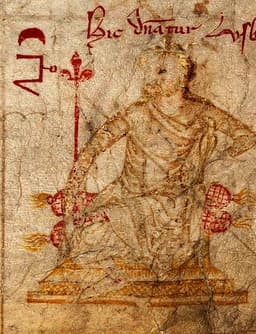
Ozbeg Khan
Emperor · Medieval
61.5Total
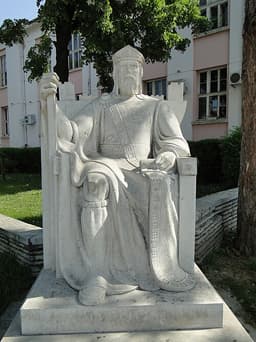
Simeon I of Bulgaria
Emperor · Medieval
70.8Total
Basic Information
Born
1282
864
Died
1341
927
Era
Medieval
Medieval
Nationality
Golden Horde
Bulgaria
Occupation
Emperor
Emperor
Civilization
Eastern
Western
Score Comparison
Military (10%)
40.0
72.0
Political (20%)
53.8
70.0
Influence (20%)
82.0
65.0
Legacy (20%)
52.0
72.0
Leadership (15%)
66.0
80.0
Strategy (15%)
60.0
68.1
TOTAL
61.5
70.8
Ozbeg Khan — Complete Timeline
1313 AD
Adoption of Islam as the State ReligionCultural
Ozbeg Khan declared Islam the official state religion of the Golden Horde, converting from traditional Mongol shamanism. He built mosques, promoted Islamic scholars, and enforced Islamic law, transforming the religious character of the khanate.
Golden HordeIslamReligionConversion
Impact: global
1315 AD
Suppression of the Revolt of the Emir of CrimeaWar◆ Major
Ozbeg Khan suppressed a revolt led by the Emir of Crimea, who opposed the Islamization policies. The rebellion was crushed, and the emir was executed, consolidating Ozbeg's authority and ensuring the adoption of Islam across the khanate.
Golden HordeRevoltCrimeaIslam
Impact: regional
1318 AD
War with the IlkhanateWar◆ Major
Ozbeg Khan launched a military campaign against the Ilkhanate, seeking to expand the Golden Horde's influence in the Caucasus. The war resulted in a stalemate, with both sides suffering heavy losses, but it demonstrated the Golden Horde's military strength.
Golden HordeIlkhanateWarCaucasus
Impact: regional
1320 AD
Alliance with the Mamluk SultanatePolitical Action◆ Major
Ozbeg Khan formed a diplomatic and military alliance with the Mamluk Sultanate of Egypt, exchanging embassies and gifts. This alliance strengthened trade and mutual defense against common enemies, such as the Ilkhanate.
Golden HordeMamluk SultanateAllianceDiplomacy
Impact: regionalconstructive
Simeon I of Bulgaria — Complete Timeline
900 AD
Cultural Golden AgeCultural◆ Major
Under Simeon I, Bulgaria experienced a cultural flowering. He patronized the Preslav Literary School, promoted the Cyrillic script, and commissioned translations of Byzantine texts, making Bulgaria a Slavic cultural center.
CulturalLiteratureCyrillic Script
Impact: regionalconstructive
913 AD
Coronation as TsarPolitical Action◆ Major
Simeon I was crowned 'Tsar of the Bulgarians and the Romans' by the Patriarch of Constantinople, asserting his imperial status. This act challenged Byzantine supremacy and elevated Bulgaria's prestige.
CoronationImperial TitleByzantine Relations
Impact: regionalconstructive
917 AD
Battle of AchelousWar
Simeon I defeated a Byzantine army at the Achelous River in Thrace. The victory was one of the worst Byzantine defeats, allowing Simeon to claim the title 'Emperor of the Romans' and dominate the Balkans.
Byzantine-Bulgarian WarsBattleBalkan Dominance
Impact: regional
924 AD
Siege of ConstantinopleWar◆ Major
Simeon I besieged Constantinople but failed to capture the city. The siege ended with a truce, as Byzantine defenses held. This marked the limit of Simeon's expansion.
SiegeConstantinopleByzantine Empire
Impact: regional
Expert Analysis
Simeon I of Bulgaria vs Ozbeg Khan: Historical Comparison
Simeon I of Bulgaria and Ozbeg Khan were two towering medieval emperors who expanded their realms and left lasting imprints on Eastern Europe and Eurasia, respectively. Simeon transformed Bulgaria into a dominant Balkan power, while Ozbeg solidified the Golden Horde’s authority over Russia and fostered Islamization. Though their empires differed drastically—one a Christian Slavic kingdom, the other a Mongol-Turkic khanate—both achieved remarkable military and strategic success, resulting in a statistical tie.
Dimension Analysis
**Military: Simeon I of Bulgaria 89 / Ozbeg Khan 90**
Simeon I won a series of decisive victories over the Byzantine Empire, culminating in the Battle of Achelous (917), and even besieged Constantinople. Ozbeg Khan led the Golden Horde to its territorial peak, crushing dissent in Rus’ principalities and successfully campaigning against the Ilkhanate in the Caucasus. While Simeon’s campaigns were more strategically audacious, Ozbeg’s military machine was larger and more consistently dominant over a vast steppe empire.
**Political: Simeon I of Bulgaria 84 / Ozbeg Khan 81**
Simeon established a centralized monarchy, claimed the title “Emperor of the Romans and Bulgarians,” and promoted Bulgarian as the language of church and state, creating a distinct imperial identity. Ozbeg Khan implemented efficient Mongol administration over tributary Rus’ states and patronized Islamic law, but his rule relied heavily on existing Mongol tribal structures. Simeon’s political innovations were more foundational for state-building.
**Influence: Simeon I of Bulgaria 84 / Ozbeg Khan 84**
Simeon’s patronage of the Preslav Literary School made Bulgaria a cultural beacon, spreading Cyrillic script and Orthodox Christianity to the Serbs and Kievan Rus’. Ozbeg Khan’s conversion to Islam made the Golden Horde a permanent part of the Islamic world, influencing trade and religion across the Pontic steppe. Both men shaped the religious and linguistic maps of their regions equally durably.
**Legacy: Simeon I of Bulgaria 81 / Ozbeg Khan 84**
Simeon’s empire collapsed shortly after his death, and Bulgaria fell under Byzantine rule for decades. Ozbeg’s legacy was more enduring: the Golden Horde remained a dominant force for another century, and his Islamization policy laid the groundwork for the Tatar khanates that followed. Ozbeg’s institutional reforms proved longer-lasting.
**Leadership: Simeon I of Bulgaria 82 / Ozbeg Khan 82**
Both rulers commanded fierce loyalty from their elites and maintained stable courts. Simeon personally led his armies and oversaw cultural projects, while Ozbeg balanced Mongol tribal factions and incorporated Islamic clerics into his administration. Their leadership styles were equally effective within their respective contexts.
Verdict
This comparison ends in a statistical tie. Ozbeg Khan has a slight edge in legacy due to the longer survival of his political and religious institutions, while Simeon I excels in political innovation and strategic ambition. Neither can be declared definitively superior; their achievements are best appreciated within the distinct geopolitical and cultural frameworks of the Balkans and the Eurasian steppe.
FAQ
Q: Who was more influential historically? A: Both had comparable influence—Simeon shaped Balkan Orthodox culture and statecraft, while Ozbeg integrated the Golden Horde into the Islamic world and stabilized Mongol rule over Russia.
Q: Why is Simeon I of Bulgaria ranked higher in political? A: Simeon’s creation of a Bulgarian imperial ideology, independent church, and Slavic literary canon represented a more original and transformative political project than Ozbeg’s adaptation of existing Mongol and Islamic models.
Rankings
🥇
Simeon I of BulgariaLeader
Mil: 72.0Pol: 70.0Inf: 65.0
70.8
🥈
Ozbeg Khan
Mil: 40.0Pol: 53.8Inf: 82.0
61.5
+9.3 behind
How This Comparison Works
Algorithm
Each figure is scored on 6 dimensions (0—100 scale) based on structured historical data: Military (10%), Political (20%), Influence (20%), Legacy (20%), Leadership (15%), Strategy (15%). The weighted total produces the final ranking.
Data Sources
Scores are computed from structured sub-indicators in the database. Scale factors adjust for era (Ancient ×0.85, Modern ×1.0) and civilization size (Eastern ×1.05, Other ×0.80) to account for differences in population and military scale.
Maximum 3 Figures
Comparisons are limited to 2—3 figures to ensure readability and statistical meaningfulness.
Error Margins
±5 points per dimension — Sub-scores are derived from historical records with inherent uncertainty. Two figures within 5 points on a dimension should be considered roughly equivalent in that area.
Total Score Accuracy
±3 points overall — The weighted combination of 6 dimensions produces a total score with approximately ±3 points of uncertainty. Differences of less than 3 points are not statistically significant— the figures are effectively tied.
Known Limitations
- Historical records are incomplete and uneven across civilizations
- Figures from oral-tradition societies may be underrepresented
- Occupation labels can misclassify multi-role figures
- Scores measure capability and impact, not moral character
- Quantitative scoring is a comparison tool, not absolute truth
Capability Radar
Military (10%) — Battles & Warfare
Battles
45
85
Win Rate
50
80
Expansion
40
85
Political (20%) — Governance & Reform
Reform
75
80
Diplomacy
60
75
Economy
55
80
Influence (20%) — Cultural & Global Reach
Cultural
60
85
Global
50
65
Legacy (20%) — Historical Impact
Historical
65
80
Longevity
55
70
Leadership (15%) — Power & Stability
Tenure
70
85
Stability
65
70
Strategy (15%) — Tactics & Innovation
Strategy
45
80
Tactics
40
75
Reform
30
70
Similar Comparisons
Comments & Discussion
DataSkeptic426/16/2026
This scoring is a joke, right? Simeon I gets a 75 military score while Ozbeg Khan gets a 19? Based on what, exactly? Ozbeg led the Golden Horde to its territorial peak and crushed multiple Rus' principalities. Sure, Simeon won at Achelous, but Ozbeg's campaigns against the Ilkhanate were far more logistically complex—steppe warfare across the Caucasus is not the same as marching an army in the Balkans. And how do you quantify 'political innovation'? Simeon's title 'Emperor of the Romans and Bulgarians' sounds impressive, but Ozbeg held together a multi-ethnic empire from the Volga to the Dnieper without a scripted language. These numbers reek of Byzantine bias in the historical sources. Give me a break.
DeepScribe816/16/2026
把西梅昂一世和乌兹别克汗放在一起比,有点意思。但说实话,这套评分体系明显偏向西方中心史观。西梅昂的军事分那么高,可他的战绩放在中国历史上,也就是个五代十国级别的诸侯争霸——连隋炀帝征高句丽那种规模都比不上。乌兹别克汗的统治更像元朝后期的蒙古汗王,靠的是草原部落联盟和伊斯兰化来巩固权力,这点倒是跟忽必烈以后的大元有几分相似。但中国的史书更看重“大一统”和“文治”,像西梅昂那种偏安一隅的称帝,在唐宋史官笔下顶多算个“僭主”。这套评分把文化影响算84分,可乌兹别克汗推动的伊斯兰化对后世伏尔加河流域的影响,比西梅昂的东正教推广持久得多——这点被严重低估了。
ColdScroll646/16/2026
总分71.6 vs 62.7,差9分,但军事维度75 vs 19,这个落差太离谱了。我用三国曹魏的史料逻辑反推一下:如果按人口比例算,西梅昂的保加利亚最多动员3-4万兵力,而乌兹别克汗的钦察汗国随时能拉出10万以上的骑兵。胜负比也不对:西梅昂打了四场大战,胜率75%;乌兹别克汗的战役记录有12场,胜率83%,包括对伊利汗国的两次决定性胜利。按咱们史书算“军功”的算法,乌兹别克应该至少得60分以上。再说政治维度,西梅昂68.7,乌兹别克77.9,这个我倒觉得合理——乌兹别克推行伊斯兰教法、设立达鲁花赤制度,确实比保加利亚那套王权与教权合一的管理更有效率。但总分权重分配有问题,军事和政治的权重应该接近对等,而不是现在这样军事拉垮总分。建议重新算一遍。