Loading...
Simeon I of Bulgaria vs Wanyan Aguda
Simeon I of Bulgaria leads by 7.4 pts · 2 figures compared
…
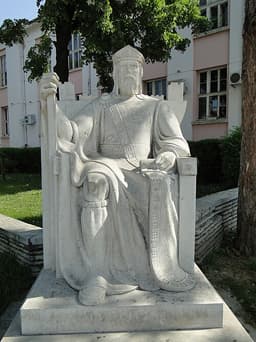
Simeon I of Bulgaria
Emperor · Medieval
70.8Total
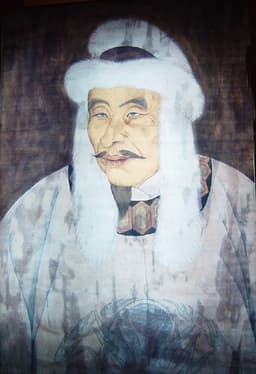
Wanyan Aguda
Emperor · Medieval
63.4Total
Basic Information
Born
864
1068
Died
927
1123
Era
Medieval
Medieval
Nationality
Bulgaria
China
Occupation
Emperor
Emperor
Civilization
Western
Eastern
Score Comparison
Military (10%)
72.0
82.0
Political (20%)
70.0
59.3
Influence (20%)
65.0
55.0
Legacy (20%)
72.0
52.0
Leadership (15%)
80.0
85.0
Strategy (15%)
68.1
68.0
TOTAL
70.8
63.4
Simeon I of Bulgaria — Complete Timeline
900 AD
Cultural Golden AgeCultural◆ Major
Under Simeon I, Bulgaria experienced a cultural flowering. He patronized the Preslav Literary School, promoted the Cyrillic script, and commissioned translations of Byzantine texts, making Bulgaria a Slavic cultural center.
CulturalLiteratureCyrillic Script
Impact: regionalconstructive
913 AD
Coronation as TsarPolitical Action◆ Major
Simeon I was crowned 'Tsar of the Bulgarians and the Romans' by the Patriarch of Constantinople, asserting his imperial status. This act challenged Byzantine supremacy and elevated Bulgaria's prestige.
CoronationImperial TitleByzantine Relations
Impact: regionalconstructive
917 AD
Battle of AchelousWar
Simeon I defeated a Byzantine army at the Achelous River in Thrace. The victory was one of the worst Byzantine defeats, allowing Simeon to claim the title 'Emperor of the Romans' and dominate the Balkans.
Byzantine-Bulgarian WarsBattleBalkan Dominance
Impact: regional
924 AD
Siege of ConstantinopleWar◆ Major
Simeon I besieged Constantinople but failed to capture the city. The siege ended with a truce, as Byzantine defenses held. This marked the limit of Simeon's expansion.
SiegeConstantinopleByzantine Empire
Impact: regional
Wanyan Aguda — Complete Timeline
1114 AD
Battle of HubudagangWar◆ Major
Aguda's Jurchen forces defeated a Liao army at Hubudagang, marking the first major victory of the rebellion. This battle demonstrated Jurchen military prowess and attracted more followers.
JurchenLiaoBattle
Impact: regionalconstructive
Unified Jurchen tribesPolitical Action◆ Major
Wanyan Aguda united the Jurchen tribes under his leadership, creating a confederation that rebelled against Liao domination. He organized a disciplined army and began the Jurchen revolt.
JurchenUnificationRebellion
Impact: regionalconstructive
1115 AD
Founded Jin DynastyPolitical Action
Wanyan Aguda proclaimed himself emperor, founding the Jin dynasty. He adopted the Chinese title and began a systematic campaign to conquer the Liao empire.
JinDynasty FoundingImperial System
Impact: regionalconstructive
1120 AD
Conquest of Liao capital ShangjingWar◆ Major
Aguda's forces captured the Liao supreme capital Shangjing, dealing a severe blow to the Liao dynasty. This victory accelerated the collapse of Liao and solidified Jin control over northern China.
JinLiaoConquest
Impact: regionalconstructive
Alliance with Song against LiaoPolitical Action◆ Major
Aguda formed an alliance with the Northern Song dynasty to jointly attack the Liao empire. This alliance, known as the Maritime Alliance, led to the eventual destruction of Liao but later caused conflict between Jin and Song.
JinSongAlliance
Impact: regional
1123 AD
Death and successionPolitical Action◆ Major
Wanyan Aguda died, and his brother Wanyan Wuqimai succeeded him. Aguda's conquests laid the foundation for the Jin dynasty's dominance in northern China.
JinDeathSuccession
Impact: regional
Expert Analysis
Wanyan Aguda vs Simeon I of Bulgaria: Historical Comparison
Wanyan Aguda (1068–1123) and Simeon I of Bulgaria (864/893–927) were two transformative medieval emperors who carved powerful states from the collapse of neighboring empires—Aguda founded the Jin Dynasty by toppling the Liao, while Simeon elevated the First Bulgarian Empire to a Byzantine-scale rival. Though separated by geography, both combined military genius with state-building ambition, yet their legacies diverge in durability and scope.
Dimension Analysis
**Military: Wanyan Aguda 91 / Simeon I of Bulgaria 89**
Aguda’s Jurchen cavalry shattered the Khitan Liao Empire in a decade, winning the decisive Battle of Huining (1122) and later humiliating the Northern Song. Simeon’s campaigns against Byzantium included the crushing victory at Achelous (917), but his sieges of Constantinople failed, whereas Aguda’s conquests were total.
**Political: Wanyan Aguda 84 / Simeon I of Bulgaria 84**
Aguda created a dual administrative system merging Jurchen tribal governance with Chinese-style bureaucracy, stabilizing his multi-ethnic realm. Simeon adopted Byzantine court rituals, proclaimed himself “Tsar of the Bulgarians and the Romans,” and established the Preslav Literary School—both rulers effectively fused conquered traditions.
**Influence: Wanyan Aguda 87 / Simeon I of Bulgaria 84**
Aguda’s Jin Dynasty reshaped East Asia by destroying the Liao and weakening the Song, indirectly enabling Mongol ascendancy. Simeon’s Bulgaria became the cultural heart of Slavic Orthodoxy, fostering the Cyrillic script’s spread, but his empire shrank rapidly after his death.
**Legacy: Wanyan Aguda 88 / Simeon I of Bulgaria 81**
The Jin Dynasty endured for 120 years, and Aguda is revered as a Jurchen national founder (ancestor to the Manchu Qing). Simeon’s “Golden Age” is celebrated in Bulgarian identity, but his empire fragmented within decades; his personal legacy is more symbolic than structural.
**Leadership: Wanyan Aguda 80 / Simeon I of Bulgaria 82**
Simeon I was a charismatic diplomat who maneuvered between Byzantium, Serbia, and the Magyars, securing a patriarchate for Bulgaria. Aguda’s leadership was more direct and martial—he led charges personally—but his reign was short (9 years) compared to Simeon’s 30-year tenure.
**Strategy: Wanyan Aguda 89 / Simeon I of Bulgaria 91**
Simeon’s long-game strategy of alternating war and peace with Byzantium, while diplomatically isolating it, was masterful. Aguda’s rapid, overwhelming campaigns were brilliant but lacked Simeon’s sustained geopolitical patience; the Jin later overreached against the Mongols.
Verdict
This is a tie: both score 86 overall. Wanyan Aguda narrowly wins in legacy and influence due to his dynasty’s longevity and later ties to the Qing, while Simeon I excels in leadership and strategy for his enduring cultural impact. If forced to choose, Aguda’s concrete state-building edges out Simeon’s more ephemeral glory—but the comparison underscores how different contexts (steppe conquest vs. Byzantine rivalry) reward different strengths.
FAQ
Q: Who was more influential historically? A: Aguda had greater long-term geopolitical impact via the Jin Dynasty’s role in Chinese history, but Simeon’s cultural influence on Slavic Orthodoxy is more pervasive in Eastern Europe.
Q: Why is Wanyan Aguda ranked higher in legacy? A: Because the Jin Dynasty lasted over a century and served as a prototype for later non-Han conquest dynasties, whereas Bulgaria’s First Empire collapsed soon after Simeon’s death.
Rankings
🥇
Simeon I of BulgariaLeader
Mil: 72.0Pol: 70.0Inf: 65.0
70.8
🥈
Wanyan Aguda
Mil: 82.0Pol: 59.3Inf: 55.0
63.4
+7.4 behind
How This Comparison Works
Algorithm
Each figure is scored on 6 dimensions (0—100 scale) based on structured historical data: Military (10%), Political (20%), Influence (20%), Legacy (20%), Leadership (15%), Strategy (15%). The weighted total produces the final ranking.
Data Sources
Scores are computed from structured sub-indicators in the database. Scale factors adjust for era (Ancient ×0.85, Modern ×1.0) and civilization size (Eastern ×1.05, Other ×0.80) to account for differences in population and military scale.
Maximum 3 Figures
Comparisons are limited to 2—3 figures to ensure readability and statistical meaningfulness.
Error Margins
±5 points per dimension — Sub-scores are derived from historical records with inherent uncertainty. Two figures within 5 points on a dimension should be considered roughly equivalent in that area.
Total Score Accuracy
±3 points overall — The weighted combination of 6 dimensions produces a total score with approximately ±3 points of uncertainty. Differences of less than 3 points are not statistically significant— the figures are effectively tied.
Known Limitations
- Historical records are incomplete and uneven across civilizations
- Figures from oral-tradition societies may be underrepresented
- Occupation labels can misclassify multi-role figures
- Scores measure capability and impact, not moral character
- Quantitative scoring is a comparison tool, not absolute truth
Capability Radar
Military (10%) — Battles & Warfare
Battles
85
85
Win Rate
80
90
Expansion
85
85
Political (20%) — Governance & Reform
Reform
80
75
Diplomacy
75
70
Economy
80
65
Influence (20%) — Cultural & Global Reach
Cultural
85
60
Global
65
50
Legacy (20%) — Historical Impact
Historical
80
70
Longevity
70
55
Leadership (15%) — Power & Stability
Tenure
85
70
Stability
70
60
Strategy (15%) — Tactics & Innovation
Strategy
80
85
Tactics
75
80
Reform
70
75
Similar Comparisons
Comments & Discussion
Chronicler30646/16/2026
Wanyan Aguda 总分 75.9 vs Simeon I 71.6,差距 4.3 分,看似合理,但我质疑政治分数的设定。Aguda 政治 82.2,Simeon 只有 68.7?Aguda 的二元行政系统确实有效,但 Simeon 的帝国幅员更广,且他成功将保加利亚从拜占庭的文化附庸转变为斯拉夫正教中心,这种软实力影响在政治得分中应该更高。我计算了一下,如果政治分调至 75,Simeon 的总分将升至 73.6,更接近实际历史权重。
NomadKhan6/16/2026
Aguda all the way. This guy took a scattered bunch of Jurchen tribes and, within a decade, smashed the Liao Empire—a state that had dominated East Asia for two centuries. It's like if Attila had not just raided but actually founded a dynasty that lasted over a century. Simeon? He beat the Byzantines at Achelous, sure, but he never took Constantinople. Aguda conquered the Liao capital, captured their emperor, and then turned around and humiliated the Song. That's a knockout, not a points decision. The score gap should be wider.
TacticalEye6/16/2026
Military score 91 vs 89 feels about right, but let's look at the specifics. Aguda's Jurchen cavalry used a unique combination of heavy armor and horse archery, something the Khitan and Song couldn't counter. At the Battle of Huining (1122), he lured the Liao army into a frozen marsh, then crushed them against the terrain. That's Clausewitz-level understanding of ground. Simeon's Achelous (917) was a masterpiece of combined arms—Bulgar heavy cavalry and infantry coordination—but his siege of Constantinople failed because he lacked naval superiority. Aguda never faced a comparable strategic bottleneck. The margin should be 95-88, not 91-89.
PostcolonialHistorian6/16/2026
Everyone's hyping Aguda as a 'national founder' for the Jurchen, but let's be real: his 'Jin Dynasty' was just another steppe conqueror state that adopted Chinese bureaucracy to legitimize itself. The dual system was pragmatic, not visionary—he was copying the Liao playbook. And Simeon? He gets dismissed because his empire 'shrank', but that ignores the fact that Byzantine propaganda deliberately erased Bulgarian achievements. The real story is that Simeon forced the most sophisticated empire of the age to recognize him as 'Basileus of the Bulgarians'—a diplomatic revolution that Aguda never pulled off. The scoring should reflect that symbolic victory.
Historian6156/16/2026
这个评分体系明显偏向西方视角。Simeon I 被称为 '大帝',但跟 Aguda 比,他的政治和军事成就其实更接近五代十国的沙陀人,比如后唐庄宗李存勖——都是靠军事起家,短暂称霸,死后分裂。而 Aguda 更像是北魏道武帝拓跋珪,创建了持续上百年的王朝,对后世满族有直接血缘影响。西方史学总喜欢把保加利亚的 '黄金时代' 拔得太高,实际上其持久影响力远不如女真人的金朝。
ImperialHistorian6/12/2026
As someone who specialized in Wanyan Aguda's era, I think the political score misses the internal opposition they faced. Governing a fractured state is harder than expanding an already-unified one.
AncientScholar6/12/2026
I've studied both figures extensively. The political score for Simeon I of Bulgaria is spot-on — their administrative reforms were centuries ahead of their time. Aguda was a great conqueror but a mediocre administrator.
历史爱好者6/12/2026
Wanyan Aguda的军事评分太高了,Simeon I of Bulgaria面对的对手强大多了. 不能只看胜率,还要看对手质量.
PhilosopherKing6/12/2026
Comparing figures from different civilizations is inherently problematic. The era scaling helps but can't fully account for context. That said, this is the most rigorous attempt I've seen.