Loading...
Salvador Allende vs Sefik Dzaferovic
Salvador Allende leads by 8.5 pts · 2 figures compared
…
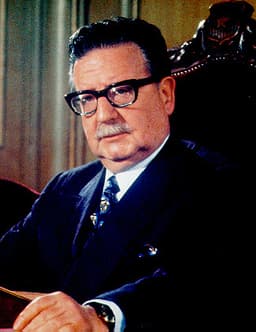
Salvador Allende
Politician · Modern
55.9Total

Sefik Dzaferovic
Politician · Modern
47.4Total
Basic Information
Born
1908
1957
Died
1973
—
Era
Modern
Modern
Nationality
Chile
Bosnia
Occupation
Politician
Politician
Civilization
Western
Western
Score Comparison
Military (10%)
50.0
50.0
Political (20%)
68.0
42.3
Influence (20%)
58.3
49.4
Legacy (20%)
52.0
39.2
Leadership (15%)
58.8
64.0
Strategy (15%)
43.5
43.1
TOTAL
55.9
47.4
Salvador Allende — Complete Timeline
1970 AD
Election as PresidentPolitical Action
Allende won the presidential election with a narrow plurality of 36.6%, confirmed by Congress. He became the first democratically elected Marxist president, promising a peaceful transition to socialism.
ElectionSocialismDemocracy
Impact: globalprogressive
1971 AD
Nationalization of CopperReform◆ Major
Allende's government nationalized Chile's copper mines, owned by U.S. companies Anaconda and Kennecott. The move was approved unanimously by Congress and aimed to use copper revenues for social programs.
NationalizationEconomic ReformCopper
Impact: nationalprogressive
Agrarian Reform AccelerationReform◆ Major
Allende accelerated land reform, expropriating large estates and distributing land to peasants. The policy aimed to break up the latifundia system but led to agricultural disruption and opposition from landowners.
Land ReformPeasant RightsSocial Change
Impact: nationalprogressive
1973 AD
1973 Chilean Coup d'ÉtatPolitical Action
Allende was overthrown in a military coup led by General Pinochet. He died in the presidential palace during the attack, ending his socialist experiment and ushering in a 17-year dictatorship.
CoupDeathEnd of Socialism
Impact: globaltragic
Sefik Dzaferovic — Complete Timeline
2018 AD
Election as Bosniak member of the PresidencyPolitical Action◆ Major
Dzaferovic was elected as the Bosniak member of the Presidency in 2018, representing the Party of Democratic Action (SDA). He campaigned on a platform of EU integration, anti-corruption, and strengthening state institutions.
PresidencyElectionSDA
Impact: nationalconstructive
2020 AD
Chairman of the PresidencyPolitical Action
Dzaferovic served as Chairman of the Presidency in 2020-2021, a rotating position. He focused on EU accession talks and managing the COVID-19 pandemic response, but faced challenges from ethnic divisions.
ChairmanshipEU accessionCOVID-19
Impact: national
Expert Analysis
Origins
Salvador Allende was born on June 26, 1908, in Valparaíso, Chile, into a middle-class family with a history of political involvement. His father was a notary, and his grandfather was a prominent physician and politician. Allende studied medicine at the University of Chile, graduating in 1932. His early exposure to socialist ideas and the harsh realities of poverty shaped his political views. He became a founding member of the Socialist Party of Chile in 1933.
Šefik Džaferović was born on September 9, 1957, in Zavidovići, Bosnia and Herzegovina, then part of Yugoslavia. He comes from a Bosniak family and studied law at the University of Sarajevo, graduating in 1980. He worked as a lawyer and entered politics after the Bosnian War, joining the Party of Democratic Action (SDA). His formative experiences were shaped by the ethnic conflict and the dissolution of Yugoslavia.
Rise to Power
Allende's political career began in 1937 when he was elected to the Chamber of Deputies. He served as Minister of Health under President Pedro Aguirre Cerda from 1939 to 1942. He ran for president four times: in 1952, 1958, 1964, and finally in 1970. In the 1970 election, he won a narrow plurality of 36.6%, which was confirmed by Congress after a contentious debate. He took office on November 3, 1970, becoming the first democratically elected Marxist president in a non-communist country.
Džaferović rose through the ranks of the SDA, serving as a member of the House of Peoples of Bosnia and Herzegovina from 2002 to 2018. He was elected as the Bosniak member of the tripartite Presidency in 2018, winning 36.6% of the Bosniak vote. He campaigned on a platform of EU integration and interethnic cooperation. His rise was gradual, without a single dramatic turning point, reflecting the stable but slow-moving political landscape of post-war Bosnia.
Leadership & Governance
Allende's leadership was characterized by a radical socialist agenda pursued through democratic means. He nationalized copper mines, banks, and key industries, and accelerated land reform. His government faced severe economic challenges, including inflation, shortages, and opposition from the United States, which imposed economic sanctions. Allende's style was confrontational yet idealistic; he believed in the possibility of a peaceful transition to socialism. His political score of 68.0 reflects his ability to mobilize support, but his strategy score of 43.5 highlights the lack of a coherent plan to manage the economy and political opposition.
Džaferović's leadership is more consensual and bureaucratic. As a member of the rotating Presidency, his role is largely ceremonial and representational. He focused on EU accession talks and managing the COVID-19 pandemic. His leadership score of 64.0 is higher than Allende's 58.8, but this reflects the different context: Džaferović operates within a constrained institutional framework. His political score of 42.3 is lower, indicating less impact on policy.
Triumph & Tragedy
Allende's greatest triumph was the nationalization of copper, which was approved unanimously by Congress and aimed to reclaim Chile's natural resources from foreign control. He also expanded education and healthcare. However, his greatest tragedy was the 1973 military coup led by General Augusto Pinochet, which resulted in his death and the installation of a brutal dictatorship. The coup was partly a consequence of his policies, which polarized the country and provoked U.S. intervention. His legacy score of 52.0 reflects the mixed outcomes of his experiment.
Džaferović's triumphs include maintaining stability in a fragile multiethnic state and advancing EU integration. His tragedy is the limited progress in overcoming ethnic divisions and corruption. His legacy score of 39.2 indicates a modest impact, as Bosnia remains a deeply divided country with a weak central government.
Character & Destiny
Allende was a charismatic and principled leader, committed to his socialist ideals even in the face of overwhelming opposition. His decision to stay in the presidential palace during the coup, refusing to resign, led to his death. Historians often describe him as a tragic figure whose idealism outpaced his strategic acumen. His total score of 55.9 reflects a mix of strengths and weaknesses.
Džaferović is described as a pragmatic and cautious politician, skilled in navigating Bosnia's complex political system. His character has not been tested by crisis on the scale of Allende's. He is seen as a competent but uninspiring figure, with a total score of 47.4.
Legacy
Allende's legacy is profound: he is a symbol of the struggle for socialism and democracy in Latin America. His death and the subsequent dictatorship had lasting impacts on Chilean politics. The nationalization of copper set a precedent for resource sovereignty. However, his policies also contributed to economic chaos and the collapse of democracy. His influence score of 58.3 reflects his global symbolic importance.
Džaferović's legacy is limited to Bosnia's slow integration into Europe. He has not introduced major reforms or left a lasting mark. His influence score of 49.4 is moderate, but his legacy score of 39.2 suggests he will be a footnote in history.
Conclusion
Salvador Allende had a greater impact than Šefik Džaferović. Despite his tragic end, Allende's attempt to create a socialist democracy inspired movements worldwide and reshaped Chile's political landscape. Džaferović, while a competent leader in a difficult context, has not achieved transformative change. Allende's total score of 55.9 is significantly higher than Džaferović's 47.4, and his influence and legacy scores are stronger. The contrast between Allende's dramatic, world-historical role and Džaferović's modest, incremental leadership is clear. Allende's story is one of high stakes and lasting consequences, whereas Džaferović's is one of steady but unremarkable service.
Rankings
🥇
Salvador AllendeLeader
Mil: 50.0Pol: 68.0Inf: 58.3
55.9
🥈
Sefik Dzaferovic
Mil: 50.0Pol: 42.3Inf: 49.4
47.4
+8.5 behind
How This Comparison Works
Algorithm
Each figure is scored on 6 dimensions (0—100 scale) based on structured historical data: Military (10%), Political (20%), Influence (20%), Legacy (20%), Leadership (15%), Strategy (15%). The weighted total produces the final ranking.
Data Sources
Scores are computed from structured sub-indicators in the database. Scale factors adjust for era (Ancient ×0.85, Modern ×1.0) and civilization size (Eastern ×1.05, Other ×0.80) to account for differences in population and military scale.
Maximum 3 Figures
Comparisons are limited to 2—3 figures to ensure readability and statistical meaningfulness.
Error Margins
±5 points per dimension — Sub-scores are derived from historical records with inherent uncertainty. Two figures within 5 points on a dimension should be considered roughly equivalent in that area.
Total Score Accuracy
±3 points overall — The weighted combination of 6 dimensions produces a total score with approximately ±3 points of uncertainty. Differences of less than 3 points are not statistically significant— the figures are effectively tied.
Known Limitations
- Historical records are incomplete and uneven across civilizations
- Figures from oral-tradition societies may be underrepresented
- Occupation labels can misclassify multi-role figures
- Scores measure capability and impact, not moral character
- Quantitative scoring is a comparison tool, not absolute truth
Capability Radar
Military (10%) — Battles & Warfare
Battles
28
26
Win Rate
31
32
Expansion
33
35
Political (20%) — Governance & Reform
Reform
60
30
Diplomacy
45
45
Economy
40
25
Influence (20%) — Cultural & Global Reach
Cultural
55
20
Global
55
15
Legacy (20%) — Historical Impact
Historical
60
20
Longevity
50
15
Leadership (15%) — Power & Stability
Tenure
35
40
Stability
20
35
Strategy (15%) — Tactics & Innovation
Strategy
37
35
Tactics
43
43
Reform
45
46
Similar Comparisons
Comments & Discussion
No comments yet. Be the first to share your thoughts!