Loading...
Salvador Allende vs Siddaramaiah
Salvador Allende leads by 0.5 pts · 2 figures compared
…
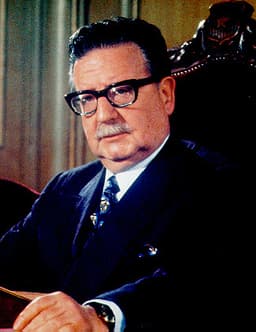
Salvador Allende
Politician · Modern
55.9Total

Siddaramaiah
Politician · Modern
55.4Total
Basic Information
Born
1908
1947
Died
1973
—
Era
Modern
Modern
Nationality
Chile
India
Occupation
Politician
Politician
Civilization
Western
Indian
Score Comparison
Military (10%)
50.0
46.6
Political (20%)
68.0
62.7
Influence (20%)
58.3
54.1
Legacy (20%)
52.0
47.5
Leadership (15%)
58.8
66.0
Strategy (15%)
43.5
60.0
TOTAL
55.9
55.4
Salvador Allende — Complete Timeline
1970 AD
Election as PresidentPolitical Action
Allende won the presidential election with a narrow plurality of 36.6%, confirmed by Congress. He became the first democratically elected Marxist president, promising a peaceful transition to socialism.
ElectionSocialismDemocracy
Impact: globalprogressive
1971 AD
Nationalization of CopperReform◆ Major
Allende's government nationalized Chile's copper mines, owned by U.S. companies Anaconda and Kennecott. The move was approved unanimously by Congress and aimed to use copper revenues for social programs.
NationalizationEconomic ReformCopper
Impact: nationalprogressive
Agrarian Reform AccelerationReform◆ Major
Allende accelerated land reform, expropriating large estates and distributing land to peasants. The policy aimed to break up the latifundia system but led to agricultural disruption and opposition from landowners.
Land ReformPeasant RightsSocial Change
Impact: nationalprogressive
1973 AD
1973 Chilean Coup d'ÉtatPolitical Action
Allende was overthrown in a military coup led by General Pinochet. He died in the presidential palace during the attack, ending his socialist experiment and ushering in a 17-year dictatorship.
CoupDeathEnd of Socialism
Impact: globaltragic
Siddaramaiah — Complete Timeline
2006 AD
Architected the AHINDA CoalitionPolitical Action◆ Major
Siddaramaiah formulated the AHINDA (Kannada acronym for minorities, backward classes, and Dalits) political strategy to consolidate non-dominant caste and religious groups. This coalition became the electoral backbone of his political career in Karnataka.
Coalition BuildingSocial JusticeKarnataka
Impact: regionalconstructive
2013 AD
First Term as Chief Minister of KarnatakaPolitical Action◆ Major
Siddaramaiah led the Indian National Congress to victory in the 2013 Karnataka Legislative Assembly election. He served as Chief Minister from 2013 to 2018, implementing welfare schemes such as the Anna Bhagya food subsidy and the Ksheera Bhagya milk program.
Chief MinisterWelfare SchemesKarnataka
Impact: regionalconstructive
2023 AD
Introduced the 'Gruha Lakshmi' SchemeReform
Siddaramaiah's government launched the Gruha Lakshmi scheme, providing monthly financial assistance of Rs. 2,000 to the female head of each Below Poverty Line family in Karnataka. This was one of five major guarantee schemes aimed at social welfare.
Welfare SchemeWomen EmpowermentKarnataka
Impact: regionalconstructive
Second Term as Chief Minister of KarnatakaPolitical Action◆ Major
Siddaramaiah became Chief Minister of Karnataka for a second time in May 2023 after the Congress won the state assembly elections. His government focused on implementing five guarantee schemes, including free bus travel for women and 200 units of free electricity.
Chief MinisterElection VictoryKarnataka
Impact: regionalconstructive
Expert Analysis
Origins
Salvador Allende was born on June 26, 1908, in Valparaíso, Chile, into a middle-class family with a tradition of political and medical service. His father was a lawyer and notary, and his grandfather was a prominent physician. Allende studied medicine at the University of Chile, graduating in 1932. His early exposure to social inequality and his participation in student politics shaped his Marxist views.
Siddaramaiah was born on August 3, 1947, in Sidramahalli, a village in the Mysore district of Karnataka, India. He came from a poor farming family belonging to the Kuruba (shepherd) caste, a backward community. He earned a law degree from the Government Law College in Mysore. His early life was marked by caste discrimination and poverty, which later influenced his political focus on social justice.
Rise to Power
Allende entered politics in the 1930s, co-founding the Socialist Party of Chile in 1933. He was elected to the Chamber of Deputies in 1937 and became a senator in 1945. He ran for president four times: 1952, 1958, 1964, and finally 1970. In the 1970 election, he won a narrow plurality of 36.6%, and after a contentious congressional runoff, he was confirmed president on October 24, 1970. His rise was marked by his ability to unite leftist parties under the Popular Unity coalition.
Siddaramaiah began his political career in the Janata Dal, winning a seat in the Karnataka Legislative Assembly in 1983. He served as Deputy Chief Minister and held various portfolios. In 2006, he became the Deputy Chief Minister under H.D. Kumaraswamy. After a split in the Janata Dal, he joined the Indian National Congress in 2008. He architected the AHINDA coalition (Kannada acronym for minorities, backward classes, and Dalits), which became a powerful electoral strategy. In 2013, he led the Congress to victory and became Chief Minister of Karnataka, serving from 2013 to 2018. He returned as Chief Minister in 2023.
Leadership & Governance
Allende's leadership was characterized by his commitment to democratic socialism. He nationalized copper mines (approved unanimously by Congress in 1971), accelerated land reform, and expanded social welfare. However, his policies faced fierce opposition from landowners, the middle class, and the United States. The economy suffered from inflation, shortages, and strikes. Allende's score for political leadership is 68.0, but his strategy score is only 43.5, reflecting his inability to manage the economic crisis and political polarization.
Siddaramaiah's governance focused on social justice and welfare. He introduced schemes like "Gruha Lakshmi" (monthly financial assistance of Rs. 2,000 to female heads of BPL families), "Anna Bhagya" (free rice), and "Ksheera Bhagya" (free milk for schoolchildren). His leadership score is 66.0, with a strategy score of 60.0, indicating a more pragmatic approach. However, his tenure faced allegations of corruption and fiscal strain.
Triumph & Tragedy
Allende's greatest triumph was implementing the first peaceful transition to socialism in a liberal democracy. The nationalization of copper was a landmark achievement, asserting sovereignty over natural resources. His tragedy was the 1973 coup d'état, where he died in the presidential palace during the military assault led by General Augusto Pinochet. The coup ended his socialist experiment and led to a brutal dictatorship. Allende's influence score is 58.3, reflecting his symbolic importance.
Siddaramaiah's triumph is the successful implementation of the AHINDA strategy, which consolidated non-dominant caste votes and brought him to power twice. His welfare schemes have improved living standards for millions. His tragedy includes his party's defeat in the 2018 state elections and allegations of corruption in his first term. His legacy score is 47.5, lower than Allende's 52.0, partly due to the limited scope of his impact.
Character & Destiny
Allende was a principled idealist, dedicated to democratic socialism even in the face of extreme opposition. His character was marked by a firm belief in constitutional processes, which may have prevented him from taking more radical steps to secure his government. His destiny was shaped by Cold War geopolitics and internal polarization. Historians often view his downfall as a result of both his own strategic errors and external interference.
Siddaramaiah is a pragmatic and strategic politician, skilled in coalition-building and caste arithmetic. He is known for his oratory and his focus on social justice. His character is more adaptable, allowing him to switch parties and form alliances. His destiny is tied to the politics of Karnataka and the Congress party's fortunes. He remains a key figure in Indian state politics.
Legacy
Allende's legacy is that of a martyr for socialism and democracy. He is remembered as a symbol of resistance against imperialism and dictatorship. His policies inspired leftist movements in Latin America. The Allende years are studied as a case study of the challenges of democratic socialism. His score for legacy is 52.0.
Siddaramaiah's legacy is the AHINDA coalition, which has reshaped Karnataka's political landscape. His welfare schemes have set a template for other states. However, his impact is largely regional, and his long-term influence depends on future electoral success. His legacy score is 47.5.
Conclusion
Salvador Allende had a greater historical impact than Siddaramaiah. Allende's presidency was a watershed moment in global politics, demonstrating both the possibilities and perils of democratic socialism. His death symbolized the struggle against authoritarianism. Siddaramaiah, while effective in state politics and social engineering, operated within the stable framework of Indian democracy. Allende's total score of 55.9 versus Siddaramaiah's 55.4 reflects a narrow edge, but the global significance of Allende's experiment and his martyrdom give him a more profound legacy. Allende changed the course of Chilean history and influenced leftist movements worldwide, whereas Siddaramaiah's impact is confined to Karnataka. Therefore, Salvador Allende is the more consequential figure.
Rankings
🥇
Salvador AllendeLeader
Mil: 50.0Pol: 68.0Inf: 58.3
55.9
🥈
Siddaramaiah
Mil: 46.6Pol: 62.7Inf: 54.1
55.4
+0.5 behind
How This Comparison Works
Algorithm
Each figure is scored on 6 dimensions (0—100 scale) based on structured historical data: Military (10%), Political (20%), Influence (20%), Legacy (20%), Leadership (15%), Strategy (15%). The weighted total produces the final ranking.
Data Sources
Scores are computed from structured sub-indicators in the database. Scale factors adjust for era (Ancient ×0.85, Modern ×1.0) and civilization size (Eastern ×1.05, Other ×0.80) to account for differences in population and military scale.
Maximum 3 Figures
Comparisons are limited to 2—3 figures to ensure readability and statistical meaningfulness.
Error Margins
±5 points per dimension — Sub-scores are derived from historical records with inherent uncertainty. Two figures within 5 points on a dimension should be considered roughly equivalent in that area.
Total Score Accuracy
±3 points overall — The weighted combination of 6 dimensions produces a total score with approximately ±3 points of uncertainty. Differences of less than 3 points are not statistically significant— the figures are effectively tied.
Known Limitations
- Historical records are incomplete and uneven across civilizations
- Figures from oral-tradition societies may be underrepresented
- Occupation labels can misclassify multi-role figures
- Scores measure capability and impact, not moral character
- Quantitative scoring is a comparison tool, not absolute truth
Capability Radar
Military (10%) — Battles & Warfare
Battles
28
42
Win Rate
31
49
Expansion
33
47
Political (20%) — Governance & Reform
Reform
60
60
Diplomacy
45
55
Economy
40
55
Influence (20%) — Cultural & Global Reach
Cultural
55
45
Global
55
20
Legacy (20%) — Historical Impact
Historical
60
45
Longevity
50
40
Leadership (15%) — Power & Stability
Tenure
35
65
Stability
20
50
Strategy (15%) — Tactics & Innovation
Strategy
37
52
Tactics
43
55
Reform
45
56
Similar Comparisons
Comments & Discussion
No comments yet. Be the first to share your thoughts!