Loading...
Salvador Allende vs Ursula von der Leyen
Salvador Allende leads by 0.4 pts · 2 figures compared
…
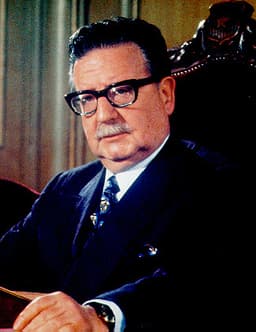
Salvador Allende
Politician · Modern
55.9Total

Ursula von der Leyen
Politician · Modern
55.5Total
Basic Information
Born
1908
1958
Died
1973
—
Era
Modern
Modern
Nationality
Chile
Germany
Occupation
Politician
Politician
Civilization
Western
Western
Score Comparison
Military (10%)
50.0
50.0
Political (20%)
68.0
65.0
Influence (20%)
58.3
55.0
Legacy (20%)
52.0
47.5
Leadership (15%)
58.8
72.0
Strategy (15%)
43.5
43.0
TOTAL
55.9
55.5
Salvador Allende — Complete Timeline
1970 AD
Election as PresidentPolitical Action
Allende won the presidential election with a narrow plurality of 36.6%, confirmed by Congress. He became the first democratically elected Marxist president, promising a peaceful transition to socialism.
ElectionSocialismDemocracy
Impact: globalprogressive
1971 AD
Nationalization of CopperReform◆ Major
Allende's government nationalized Chile's copper mines, owned by U.S. companies Anaconda and Kennecott. The move was approved unanimously by Congress and aimed to use copper revenues for social programs.
NationalizationEconomic ReformCopper
Impact: nationalprogressive
Agrarian Reform AccelerationReform◆ Major
Allende accelerated land reform, expropriating large estates and distributing land to peasants. The policy aimed to break up the latifundia system but led to agricultural disruption and opposition from landowners.
Land ReformPeasant RightsSocial Change
Impact: nationalprogressive
1973 AD
1973 Chilean Coup d'ÉtatPolitical Action
Allende was overthrown in a military coup led by General Pinochet. He died in the presidential palace during the attack, ending his socialist experiment and ushering in a 17-year dictatorship.
CoupDeathEnd of Socialism
Impact: globaltragic
Ursula von der Leyen — Complete Timeline
2013 AD
Appointed German Minister of DefencePolitical Action◆ Major
Ursula von der Leyen was appointed German Minister of Defence under Chancellor Angela Merkel. She oversaw the Bundeswehr during a period of modernization and increased defense spending, though the ministry faced criticism over equipment shortages and consulting contracts.
German PoliticsDefenceMerkel Cabinet
Impact: national
2019 AD
Launched the European Green DealReform◆ Major
Von der Leyen presented the European Green Deal, a set of policy initiatives aiming to make the EU climate-neutral by 2050. The plan included emissions reduction targets, investment in renewable energy, and a just transition mechanism for affected regions.
Climate PolicyGreen DealEU Environment
Impact: globalprogressive
Elected President of the European CommissionPolitical Action
Von der Leyen was elected President of the European Commission by the European Parliament, becoming the first woman to hold the office. Her election followed a contentious process involving the Spitzenkandidat system and a narrow parliamentary majority.
EU LeadershipFirst WomanEuropean Commission
Impact: globalconstructive
2020 AD
Proposed the NextGenerationEU Recovery FundReform
Von der Leyen proposed a
EU BudgetRecovery FundFiscal Integration
Impact: regionalconstructive
Oversaw EU COVID-19 Vaccine ProcurementPolitical Action◆ Major
Von der Leyen led the EU's joint procurement of COVID-19 vaccines, negotiating contracts with pharmaceutical companies. The program faced early delays and criticism over slow rollout compared to the UK and US, but eventually vaccinated a majority of EU adults.
COVID-19VaccineEU Health
Impact: regional
2022 AD
Imposed Sanctions on Russia over Ukraine InvasionPolitical Action◆ Major
Following Russia's full-scale invasion of Ukraine, von der Leyen led the EU in imposing multiple rounds of sanctions targeting Russian finance, energy, and individuals. The sanctions aimed to weaken Russia's war capacity, with effects on global energy markets.
Russia-Ukraine WarSanctionsEU Foreign Policy
Impact: global
Expert Analysis
Origins
Salvador Allende was born in 1908 in Valparaíso, Chile, into a middle-class family with a tradition of political activism. He studied medicine at the University of Chile, where he became involved in socialist politics. Allende's early career included serving as a physician and later as a deputy in the Chilean Congress, representing the Socialist Party. His formative years were shaped by the Great Depression and the rise of leftist movements in Latin America.
Ursula von der Leyen was born in 1958 in Brussels, Belgium, to a prominent German political family. Her father, Ernst Albrecht, was a senior EU official and later state premier. She studied economics at the University of Göttingen and later earned a medical degree from Hannover Medical School. Von der Leyen's early life was marked by a peripatetic childhood across Europe, fostering a strong European identity. She worked as a physician before entering politics.
Rise to Power
Allende rose through the Chilean Socialist Party, serving as a senator and minister. He ran for president four times, finally winning in 1970 with a narrow plurality of 36.6% of the vote, confirmed by Congress after a contentious debate. His victory was a turning point, as he became the first democratically elected Marxist president. He immediately pursued socialist reforms, nationalizing key industries and redistributing land.
Von der Leyen's political ascent began in 2003 when she was elected to the state parliament of Lower Saxony. She quickly rose in the Christian Democratic Union (CDU), becoming federal minister for family affairs in 2005 under Chancellor Angela Merkel. She later served as minister of labour and social affairs, and then as minister of defence from 2013 to 2019. In 2019, she was elected President of the European Commission, the first woman to hold the office, after a contentious nomination process.
Leadership & Governance
Allende's governance was characterized by a rapid implementation of socialist policies. He nationalized copper mines, banks, and major industries, and accelerated land reform. His government faced severe economic challenges, including inflation, shortages, and strikes. Allende's leadership style was ideological and committed to democratic socialism, but he struggled to maintain coalition support and manage opposition from the right and the United States. His political score of 68.0 reflects his ability to implement radical change but also his strategic weaknesses (score 43.5).
Von der Leyen leads the European Commission with a pragmatic, consensus-building approach. She proposed the European Green Deal, aiming for climate neutrality by 2050, and oversaw the largest EU recovery fund, NextGenerationEU (€750 billion). Her leadership score of 72.0 indicates strong management during crises, such as the COVID-19 pandemic vaccine procurement. However, her strategic score of 43.0 suggests challenges in long-term planning, especially regarding vaccine contract transparency.
Triumph & Tragedy
Allende's greatest success was the nationalization of copper, approved unanimously by Congress, which symbolized Chile's economic sovereignty. He also expanded healthcare and education access. However, his tragic failure was the economic collapse and political polarization that led to the 1973 coup. He died in the presidential palace during the military attack, ending his socialist experiment. His legacy score of 52.0 reflects profound impact but mixed outcomes.
Von der Leyen's triumph includes launching the Green Deal and the recovery fund, which marked a shift toward EU fiscal solidarity. She also navigated Brexit negotiations. Her failure includes the early delays in vaccine delivery and criticisms of opaque contracts, which damaged trust. Her legacy score of 47.5 is still evolving, but her influence is substantial.
Character & Destiny
Allende was idealistic and principled, often prioritizing ideology over pragmatism. His determination to pursue socialism within a democratic framework led to his downfall, as he faced relentless opposition from domestic elites and the U.S. His character, as described by historians, was that of a committed democrat who underestimated the forces against him. His total score of 55.9 reflects a leader of conviction but limited strategic flexibility.
Von der Leyen is pragmatic and ambitious, known for her resilience and ability to navigate complex bureaucracies. She is often criticized for being aloof but praised for her crisis management. Her character has shaped her destiny as a key architect of European integration, though her legacy remains contested due to controversies over transparency.
Legacy
Allende's legacy is complex: he is a martyr for the left, inspiring socialist movements in Latin America. His policies were reversed by the Pinochet dictatorship, but his symbolic impact endures. The Allende years remain a reference point for debates on democratic socialism. His influence score of 58.3 shows global reach.
Von der Leyen's legacy is still forming. The Green Deal and NextGenerationEU have reshaped EU policy, setting ambitious climate targets and mutual debt. She has strengthened the Commission's role in crises. Her influence score of 55.0 indicates significant impact, though her long-term legacy will depend on implementation.
Conclusion
While Allende's total score (55.9) edges von der Leyen's (55.5) by 0.4 points, the comparison is not merely numerical. Allende's impact was immediate and dramatic, but his failures led to a brutal dictatorship. Von der Leyen's influence is more incremental but structurally transformative for the European Union. In terms of long-term systemic change, von der Leyen's policies—especially the Green Deal and EU debt mutualization—are likely to have a more enduring effect on global governance. Therefore, Ursula von der Leyen has had greater impact due to the scale and durability of her institutional reforms.
Rankings
🥇
Salvador AllendeLeader
Mil: 50.0Pol: 68.0Inf: 58.3
55.9
🥈
Ursula von der Leyen
Mil: 50.0Pol: 65.0Inf: 55.0
55.5
+0.4 behind
How This Comparison Works
Algorithm
Each figure is scored on 6 dimensions (0—100 scale) based on structured historical data: Military (10%), Political (20%), Influence (20%), Legacy (20%), Leadership (15%), Strategy (15%). The weighted total produces the final ranking.
Data Sources
Scores are computed from structured sub-indicators in the database. Scale factors adjust for era (Ancient ×0.85, Modern ×1.0) and civilization size (Eastern ×1.05, Other ×0.80) to account for differences in population and military scale.
Maximum 3 Figures
Comparisons are limited to 2—3 figures to ensure readability and statistical meaningfulness.
Error Margins
±5 points per dimension — Sub-scores are derived from historical records with inherent uncertainty. Two figures within 5 points on a dimension should be considered roughly equivalent in that area.
Total Score Accuracy
±3 points overall — The weighted combination of 6 dimensions produces a total score with approximately ±3 points of uncertainty. Differences of less than 3 points are not statistically significant— the figures are effectively tied.
Known Limitations
- Historical records are incomplete and uneven across civilizations
- Figures from oral-tradition societies may be underrepresented
- Occupation labels can misclassify multi-role figures
- Scores measure capability and impact, not moral character
- Quantitative scoring is a comparison tool, not absolute truth
Capability Radar
Military (10%) — Battles & Warfare
Battles
28
26
Win Rate
31
32
Expansion
33
33
Political (20%) — Governance & Reform
Reform
60
70
Diplomacy
45
75
Economy
40
60
Influence (20%) — Cultural & Global Reach
Cultural
55
40
Global
55
65
Legacy (20%) — Historical Impact
Historical
60
45
Longevity
50
30
Leadership (15%) — Power & Stability
Tenure
35
65
Stability
20
55
Strategy (15%) — Tactics & Innovation
Strategy
37
38
Tactics
43
43
Reform
45
43
Similar Comparisons
Comments & Discussion
No comments yet. Be the first to share your thoughts!