Loading...
Samudragupta vs Sun Quan
Samudragupta leads by 0.7 pts · 2 figures compared
…

Samudragupta
Emperor · Ancient
65.1Total
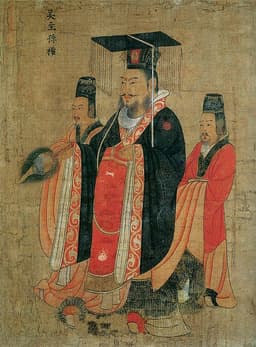
Sun Quan
Emperor · Ancient
64.4Total
Basic Information
Born
335
182
Died
375
252
Era
Ancient
Ancient
Nationality
India
China
Occupation
Emperor
Emperor
Civilization
Indian
Eastern
Score Comparison
Military (10%)
65.0
67.3
Political (20%)
59.3
65.0
Influence (20%)
68.0
59.0
Legacy (20%)
55.0
58.0
Leadership (15%)
80.0
80.0
Strategy (15%)
70.0
66.3
TOTAL
65.1
64.4
Samudragupta — Complete Timeline
335 AD
Accession to the Gupta ThronePolitical Action
Samudragupta succeeded his father Chandragupta I as ruler of the Gupta Empire. He inherited a kingdom in the Ganges basin and soon embarked on a series of military campaigns that would vastly expand Gupta territory.
Gupta EmpireSuccessionExpansion
Impact: regional
340 AD
Conquest of the Northern KingdomsWar◆ Major
Samudragupta launched a campaign across northern India, defeating nine kings and annexing their territories. He conquered the kingdoms of the Ganges-Yamuna doab, including the Naga and Kushana remnants, extending Gupta rule to the Punjab and Bengal.
Northern IndiaConquestGupta Empire
Impact: regional
350 AD
Southern ExpeditionWar◆ Major
Samudragupta led a military campaign into the Deccan and southern India, defeating twelve kings. He did not annex these southern territories but forced them to pay tribute and acknowledge Gupta suzerainty, extending Gupta influence to the Tamil region.
DeccanSouthern IndiaTribute
Impact: regional
Patronage of Arts and LiteratureCultural
Samudragupta was a patron of poets and scholars, including the poet Harisena who composed the Allahabad Pillar inscription. His court fostered the Gupta classical culture, though his reign is less known for literary output than his successors.
PatronageLiteratureGupta Culture
Impact: regionalconstructive
360 AD
Performance of the Ashvamedha YajnaCultural
Samudragupta performed the Ashvamedha (horse sacrifice) ritual, a Vedic ceremony symbolizing imperial sovereignty. He issued gold coins commemorating the event, which reinforced his status as a paramount ruler and patron of Brahmanical traditions.
AshvamedhaVedic RitualImperial Symbolism
Impact: regionalconstructive
Sun Quan — Complete Timeline
208 AD
Battle of Red CliffsWar
Sun Quan allied with Liu Bei to defeat Cao Cao's invasion at Red Cliffs. Zhou Yu commanded Sun Quan's fleet, using fire ships to destroy Cao Cao's larger navy. This victory preserved Sun Quan's independence and established the tripartite division of China.
Three KingdomsNaval battleAlliance
Impact: regional
213 AD
Battle of RuxuWar◆ Major
Cao Cao launched a naval invasion against Sun Quan's fortress at Ruxu. Sun Quan personally led a small reconnaissance force that was surrounded, but he broke out. The battle ended in a stalemate, with Cao Cao withdrawing, securing Sun Quan's control of the Yangtze.
Three KingdomsBattleDefense
Impact: regional
222 AD
Proclamation of Eastern WuPolitical Action◆ Major
Sun Quan declared himself Emperor of Wu, establishing the Eastern Wu dynasty. This formalized the Three Kingdoms period, with Wu controlling the Yangtze River basin. Sun Quan's reign lasted until 252, making him the longest-ruling of the three founding emperors.
Three KingdomsDynasty foundingImperial proclamation
Impact: regionalconstructive
Expert Analysis
Origins
Samudragupta (c. 335–375 CE) was born into the Gupta dynasty, likely the son of Chandragupta I and princess Kumaradevi of the Licchavi clan. He inherited a kingdom centered on the Ganges basin in present-day Uttar Pradesh. His early life is obscure, but he was groomed for rule in a period of expanding Gupta influence. Sun Quan (182–252 CE) was born in the late Eastern Han dynasty, the son of Sun Jian, a minor warlord, and the younger brother of Sun Ce. His family hailed from Fuchun (modern Hangzhou). Sun Quan's formative years were marked by the chaos of the Han collapse, and he learned statecraft under his brother's tutelage.
Rise to Power
Samudragupta's rise began with his accession around 335 CE, after his father's death. He quickly launched a series of campaigns: first, he conquered nine kingdoms in the Ganges-Yamuna doab, annexing their territories. His Allahabad Pillar inscription, composed by court poet Harisena, lists these conquests. He then turned south, defeating twelve kings in the Deccan and forcing them to pay tribute, but he did not annex their lands. His military score of 65.0 reflects his effective but not overwhelming campaigns. Sun Quan's rise was more gradual. After Sun Ce's death in 200 CE, Sun Quan took control of the Jiangdong territories at age 18. He consolidated power by suppressing local rebellions and securing the Yangtze River. His turning point came in 208 CE at the Battle of Red Cliffs, where he allied with Liu Bei to defeat Cao Cao's invasion. Zhou Yu, Sun Quan's commander, used fire ships to destroy Cao Cao's larger fleet, securing Sun Quan's hold on the south. He later declared himself Emperor of Wu in 229 CE, formalizing the Three Kingdoms.
Leadership & Governance
Samudragupta ruled as a warrior-king, personally leading campaigns and performing the Ashvamedha (horse sacrifice) to assert imperial sovereignty. He issued gold coins depicting him playing the veena, highlighting his patronage of arts. His administration relied on local rulers as vassals, with a centralized tribute system. He scored 80.0 in leadership and 59.3 in political governance, indicating a focus on military expansion over bureaucratic reform. Sun Quan's leadership was more diplomatic and administrative. He built a stable state in Wu by balancing powerful clans and appointing capable officials like Lu Xun. He scored 80.0 in leadership and 65.0 in political governance. Sun Quan's governance emphasized naval defense and economic development in the Yangtze region, including irrigation projects and trade. His strategy score of 66.3 reflects his effective use of alliances and defensive tactics.
Triumph & Tragedy
Samudragupta's greatest triumph was the expansion of the Gupta Empire to cover most of northern India, establishing a period of peace and cultural flourishing. His patronage of arts led to the Gupta Golden Age, with advancements in literature, sculpture, and astronomy. His tragedy lies in the lack of detailed records; his conquests are known primarily from one inscription, leaving his personal life obscure. Also, his southern campaigns did not lead to lasting integration. Sun Quan's triumph was the creation of a durable state that lasted over 50 years, successfully resisting Cao Cao's northern forces. His victory at Red Cliffs is legendary. However, his later years were marred by succession crises and the execution of his heir Sun He, leading to instability. He failed to expand beyond the Yangtze, and his state eventually fell to the Jin dynasty in 280 CE.
Character & Destiny
Samudragupta was ambitious and culturally refined, as shown by his coins depicting him as both warrior and musician. His character combined military aggression with artistic patronage, shaping a legacy of conquest and culture. His destiny was to be remembered as the "Napoleon of India" for his swift campaigns. Sun Quan was pragmatic and cautious, known for his ability to delegate and build alliances. He survived longer than his rivals Cao Cao and Liu Bei, but his indecision in succession led to internal strife. Historians note his skill in maintaining power but criticize his harsh treatment of officials. His character of patience and cunning allowed him to outlast enemies but also fostered a court of intrigue.
Legacy
Samudragupta's legacy is foundational to the Gupta Empire's reputation as a golden age. His military campaigns set the stage for his son Chandragupta II to expand further. The Gupta period's art and science influenced Indian civilization for centuries. He scored 55.0 in legacy, reflecting the later overshadowing of his individual role. Sun Quan's legacy is as the founder of Eastern Wu, one of the Three Kingdoms. His state preserved Chinese culture in the south during the turbulent period. The Romance of the Three Kingdoms immortalized him as a clever ruler. He scored 58.0 in legacy, but his influence on Chinese history is significant through the enduring tales of the era.
Conclusion
While Samudragupta and Sun Quan both scored 80.0 in leadership, their impacts differ. Samudragupta's conquests unified a vast region and sparked a cultural renaissance, whereas Sun Quan's defensive strategy created a stable state but did not transform China's trajectory as profoundly. Samudragupta's total score of 65.1 edges Sun Quan's 64.4, but more importantly, his legacy of the Gupta Golden Age had a more enduring influence on civilization. Sun Quan's achievements are notable, but Samudragupta's military and cultural expansion gives him greater historical weight.
Rankings
🥇
SamudraguptaLeader
Mil: 65.0Pol: 59.3Inf: 68.0
65.1
🥈
Sun Quan
Mil: 67.3Pol: 65.0Inf: 59.0
64.4
+0.7 behind
How This Comparison Works
Algorithm
Each figure is scored on 6 dimensions (0—100 scale) based on structured historical data: Military (10%), Political (20%), Influence (20%), Legacy (20%), Leadership (15%), Strategy (15%). The weighted total produces the final ranking.
Data Sources
Scores are computed from structured sub-indicators in the database. Scale factors adjust for era (Ancient ×0.85, Modern ×1.0) and civilization size (Eastern ×1.05, Other ×0.80) to account for differences in population and military scale.
Maximum 3 Figures
Comparisons are limited to 2—3 figures to ensure readability and statistical meaningfulness.
Error Margins
±5 points per dimension — Sub-scores are derived from historical records with inherent uncertainty. Two figures within 5 points on a dimension should be considered roughly equivalent in that area.
Total Score Accuracy
±3 points overall — The weighted combination of 6 dimensions produces a total score with approximately ±3 points of uncertainty. Differences of less than 3 points are not statistically significant— the figures are effectively tied.
Known Limitations
- Historical records are incomplete and uneven across civilizations
- Figures from oral-tradition societies may be underrepresented
- Occupation labels can misclassify multi-role figures
- Scores measure capability and impact, not moral character
- Quantitative scoring is a comparison tool, not absolute truth
Capability Radar
Military (10%) — Battles & Warfare
Battles
85
70
Win Rate
90
65
Expansion
85
70
Political (20%) — Governance & Reform
Reform
70
65
Diplomacy
75
80
Economy
80
75
Influence (20%) — Cultural & Global Reach
Cultural
85
65
Global
60
60
Legacy (20%) — Historical Impact
Historical
80
75
Longevity
70
70
Leadership (15%) — Power & Stability
Tenure
75
85
Stability
80
70
Strategy (15%) — Tactics & Innovation
Strategy
85
80
Tactics
80
75
Reform
70
60
Similar Comparisons
Comments & Discussion
No comments yet. Be the first to share your thoughts!