Loading...
Shabaka vs Sun Quan
Sun Quan leads by 8.3 pts · 2 figures compared
…

Shabaka
Emperor · Ancient
56.1Total
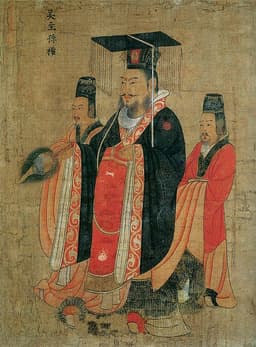
Sun Quan
Emperor · Ancient
64.4Total
Basic Information
Born
-714
182
Died
-702
252
Era
Ancient
Ancient
Nationality
Third Intermediate Egypt
China
Occupation
Emperor
Emperor
Civilization
Other
Eastern
Score Comparison
Military (10%)
55.0
67.3
Political (20%)
68.0
65.0
Influence (20%)
56.4
59.0
Legacy (20%)
47.5
58.0
Leadership (15%)
67.0
80.0
Strategy (15%)
43.3
66.3
TOTAL
56.1
64.4
Shabaka — Complete Timeline
714 BC
Conquest of EgyptWar
Shabaka, a Kushite king from Napata, invaded Egypt and defeated the fragmented 22nd and 23rd Dynasties, unifying the Nile Valley under the 25th Dynasty. He established his capital at Memphis, ruling as pharaoh.
Kushite Conquest25th DynastyUnification
Impact: regional
710 BC
Commission of the Shabaka StoneCultural◆ Major
Shabaka ordered the inscription of the Memphite Theology on a basalt stone, preserving an ancient creation myth centered on the god Ptah. This artifact became a key source for Egyptian religious thought.
Shabaka StoneMemphite TheologyReligion
Impact: regionalconstructive
Restoration of Egyptian templesCultural
Shabaka initiated a program of temple restoration across Egypt, particularly at Karnak and Luxor, reviving traditional religious practices after the fragmentation of the preceding dynasties.
Temple RestorationKarnakLuxor
Impact: nationalconstructive
702 BC
Death and successionPolitical Action
Shabaka died after a reign of about 12 years, succeeded by his nephew Shebitku. His death marked the end of the initial Kushite consolidation, but his dynasty continued to rule Egypt.
DeathSuccession25th Dynasty
Impact: national
Sun Quan — Complete Timeline
208 AD
Battle of Red CliffsWar
Sun Quan allied with Liu Bei to defeat Cao Cao's invasion at Red Cliffs. Zhou Yu commanded Sun Quan's fleet, using fire ships to destroy Cao Cao's larger navy. This victory preserved Sun Quan's independence and established the tripartite division of China.
Three KingdomsNaval battleAlliance
Impact: regional
213 AD
Battle of RuxuWar◆ Major
Cao Cao launched a naval invasion against Sun Quan's fortress at Ruxu. Sun Quan personally led a small reconnaissance force that was surrounded, but he broke out. The battle ended in a stalemate, with Cao Cao withdrawing, securing Sun Quan's control of the Yangtze.
Three KingdomsBattleDefense
Impact: regional
222 AD
Proclamation of Eastern WuPolitical Action◆ Major
Sun Quan declared himself Emperor of Wu, establishing the Eastern Wu dynasty. This formalized the Three Kingdoms period, with Wu controlling the Yangtze River basin. Sun Quan's reign lasted until 252, making him the longest-ruling of the three founding emperors.
Three KingdomsDynasty foundingImperial proclamation
Impact: regionalconstructive
Expert Analysis
Origins
Shabaka was a Kushite king from Napata (modern Sudan), born around 750 BCE. He was the son of Kashta and brother of Piye, who had already conquered Upper Egypt. Shabaka grew up in the Kushite court, where he was trained in military and religious traditions. His family had ruled the Kingdom of Kush for generations, and they viewed themselves as the rightful heirs to Egyptian civilization. Shabaka's education included the Memphite theology, which later influenced his famous stone inscription.
Sun Quan was born in 182 CE in Xiapi (modern Jiangsu), during the declining Han dynasty. His father Sun Jian was a warlord, and his older brother Sun Ce established control over the Jiangdong region. After Sun Ce's assassination in 200 CE, Sun Quan inherited the territory at age 18. He was educated in both civil and military arts, but his youth made him dependent on advisors like Zhou Yu and Zhang Zhao. Unlike Shabaka's royal lineage, Sun Quan's rise was based on his family's military conquests.
Rise to Power
Shabaka rose to power after his brother Piye's death around 716 BCE. Piye had already conquered Egypt but returned to Kush, leaving local rulers in place. Shabaka saw that these rulers were reasserting independence, so he launched a full-scale invasion around 712 BCE. He defeated the coalition of Tefnakht of Sais and other Delta princes, capturing Memphis and establishing the 25th Dynasty. His coronation at Thebes legitimized his rule, and he appointed his relatives as governors. The conquest took less than a year, demonstrating political 68.0 and military 55.0 scores.
Sun Quan's rise was more gradual. After inheriting from Sun Ce, he faced challenges from local elites and external threats. In 208 CE, Cao Cao led a massive army south to conquer the Jiangdong region. Sun Quan allied with Liu Bei and, with Zhou Yu commanding his navy, won the Battle of Red Cliffs. This victory secured his hold on the Yangtze. Over the next decade, he expanded his territory, defeating Liu Bei at Yiling in 222 CE. In 229 CE, he proclaimed himself Emperor of Wu, formalizing the Three Kingdoms. His military score of 67.3 reflects his success in defensive campaigns.
Leadership & Governance
Shabaka governed as a traditional pharaoh, emphasizing religious restoration. He ordered the Shabaka Stone, which inscribed the Memphite creation myth, as a way to unify Egyptian and Kushite beliefs. He repaired temples at Karnak, Luxor, and other sites, reviving the cult of Amun. His political score of 68.0 reflects his ability to integrate Kushite rule into Egyptian institutions. However, his military score of 55.0 suggests limited expansion; he focused on consolidation rather than conquest. His strategy score of 43.3 indicates a cautious approach.
Sun Quan's leadership score of 80.0 is the highest among his attributes. He delegated military command to capable generals like Zhou Yu, Lu Xun, and Lu Meng, while focusing on administration. He established a bureaucracy based on merit, recruited scholars, and developed the Yangtze economy through agriculture and trade. His political score of 65.0 reflects effective state-building. However, his later years saw purges of officials and a decline in decision-making. His strategy score of 66.3 shows competence but not brilliance.
Triumph & Tragedy
Shabaka's greatest triumph was unifying Egypt under Kushite rule, ending the fragmentation of the Third Intermediate Period. The Shabaka Stone remains a key artifact for understanding Egyptian theology. His temple restorations revived religious practices. His tragedy was that his dynasty lasted only about 60 years; after his death, the Assyrians invaded, and his successors were pushed back to Kush. His legacy score of 47.5 reflects limited lasting impact.
Sun Quan's triumph was establishing Eastern Wu, which lasted from 229 to 280 CE. The Battle of Red Cliffs is one of history's most famous naval engagements. He successfully defended the Yangtze against Cao Cao and later expanded into Vietnam. His tragedy was the internal strife after his death; his successors were weak, leading to Wu's conquest by the Jin dynasty. His legacy score of 58.0 reflects a more enduring historical presence.
Character & Destiny
Shabaka was a religious conservative, using theology to legitimize his rule. His decision to inscribe the Memphite Theology shows a desire to connect with ancient traditions. He was not an aggressive conqueror; his military campaigns were limited. This caution may have contributed to the dynasty's vulnerability when faced with Assyrian aggression. His leadership score of 67.0 reflects competent but not transformative rule.
Sun Quan was pragmatic and adaptable. He knew his limitations and relied on talented subordinates. He was ruthless when necessary, as seen in his purge of officials later in life. His ability to maintain power for 52 years shows political acumen. However, his paranoia in old age damaged his administration. His leadership score of 80.0 is among the highest for Three Kingdoms rulers.
Legacy
Shabaka's legacy is primarily archaeological and religious. The Shabaka Stone provides insights into Memphite theology. He is remembered as a restorer of Egyptian traditions, but his dynasty's collapse limited his impact. His influence score of 56.4 reflects his role in preserving ancient texts.
Sun Quan's legacy is more substantial. Eastern Wu established Chinese control over the south, accelerating the sinicization of regions like Vietnam. The Three Kingdoms period is a cultural touchstone in Chinese history, and Sun Quan is a central figure. His military and political systems influenced later dynasties. His influence score of 59.0 is slightly higher than Shabaka's.
Conclusion
Sun Quan had greater historical impact. His total score of 64.4 surpasses Shabaka's 56.1 by 8.3 points. Sun Quan's Eastern Wu lasted 51 years and shaped the development of southern China, while Shabaka's dynasty was short-lived. Sun Quan's leadership score of 80.0 indicates superior governance. Shabaka's religious contributions are notable, but his political and military achievements were less enduring. Therefore, Sun Quan is the more significant historical figure.
Rankings
🥇
Sun QuanLeader
Mil: 67.3Pol: 65.0Inf: 59.0
64.4
🥈
Shabaka
Mil: 55.0Pol: 68.0Inf: 56.4
56.1
+8.3 behind
How This Comparison Works
Algorithm
Each figure is scored on 6 dimensions (0—100 scale) based on structured historical data: Military (10%), Political (20%), Influence (20%), Legacy (20%), Leadership (15%), Strategy (15%). The weighted total produces the final ranking.
Data Sources
Scores are computed from structured sub-indicators in the database. Scale factors adjust for era (Ancient ×0.85, Modern ×1.0) and civilization size (Eastern ×1.05, Other ×0.80) to account for differences in population and military scale.
Maximum 3 Figures
Comparisons are limited to 2—3 figures to ensure readability and statistical meaningfulness.
Error Margins
±5 points per dimension — Sub-scores are derived from historical records with inherent uncertainty. Two figures within 5 points on a dimension should be considered roughly equivalent in that area.
Total Score Accuracy
±3 points overall — The weighted combination of 6 dimensions produces a total score with approximately ±3 points of uncertainty. Differences of less than 3 points are not statistically significant— the figures are effectively tied.
Known Limitations
- Historical records are incomplete and uneven across civilizations
- Figures from oral-tradition societies may be underrepresented
- Occupation labels can misclassify multi-role figures
- Scores measure capability and impact, not moral character
- Quantitative scoring is a comparison tool, not absolute truth
Capability Radar
Military (10%) — Battles & Warfare
Battles
40
70
Win Rate
45
65
Expansion
50
70
Political (20%) — Governance & Reform
Reform
55
65
Diplomacy
50
80
Economy
45
75
Influence (20%) — Cultural & Global Reach
Cultural
60
65
Global
40
60
Legacy (20%) — Historical Impact
Historical
55
75
Longevity
50
70
Leadership (15%) — Power & Stability
Tenure
40
85
Stability
50
70
Strategy (15%) — Tactics & Innovation
Strategy
40
80
Tactics
35
75
Reform
30
60
Similar Comparisons
Comments & Discussion
No comments yet. Be the first to share your thoughts!