Loading...
Seleucus I Nicator vs Sennacherib
Seleucus I Nicator leads by 4.5 pts · 2 figures compared
…
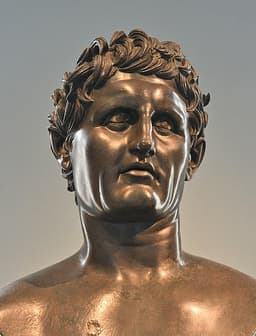
Seleucus I Nicator
Emperor · Ancient
66.5Total

Sennacherib
Emperor · Ancient
62.0Total
Basic Information
Born
-358
-705
Died
-281
-681
Era
Ancient
Ancient
Nationality
Seleucid Empire
Assyria
Occupation
Emperor
Emperor
Civilization
Western
Middle Eastern
Score Comparison
Military (10%)
78.5
85.0
Political (20%)
72.0
45.0
Influence (20%)
62.0
60.0
Legacy (20%)
55.0
54.0
Leadership (15%)
78.0
72.0
Strategy (15%)
69.1
75.0
TOTAL
66.5
62.0
Seleucus I Nicator — Complete Timeline
312 BC
Foundation of the Seleucid EmpirePolitical Action◆ Major
After the death of Alexander, Seleucus established control over Babylon and the eastern satrapies. He founded the Seleucid Empire, which stretched from Anatolia to India, and adopted the title of king. This marked the beginning of the Hellenistic period in the East.
DiadochiEmpireHellenistic
Impact: globalconstructive
301 BC
Battle of IpsusWar
Seleucus I Nicator fought against Antigonus I Monophthalmus at Ipsus. The allied forces of Seleucus, Lysimachus, and Cassander defeated Antigonus, who was killed. This battle solidified the division of Alexander's empire, with Seleucus gaining control of Syria and Mesopotamia.
DiadochiBattleSeleucid Empire
Impact: regionaldestructive
300 BC
Founding of AntiochCultural◆ Major
Seleucus I founded the city of Antioch on the Orontes River, which became the capital of the Seleucid Empire. The city grew into a major center of Hellenistic culture, trade, and politics, rivaling Alexandria in importance.
Seleucid EmpireCity FoundationHellenistic
Impact: regionalconstructive
281 BC
Assassination by Ptolemy CeraunusPolitical Action◆ Major
Seleucus I was assassinated by Ptolemy Ceraunus, a son of Ptolemy I, while campaigning in Thrace. His death ended the last major Diadochi conflict and left the Seleucid Empire to his son Antiochus I, who faced challenges from within and without.
DiadochiAssassinationSeleucid Empire
Impact: regionaltragic
Sennacherib — Complete Timeline
701 BC
Siege of JerusalemWar◆ Major
Sennacherib besieged Jerusalem after Hezekiah of Judah rebelled. The Assyrian army captured many Judean cities but failed to take Jerusalem. Hezekiah paid heavy tribute, and the siege was lifted, possibly due to disease or divine intervention as recorded in the Bible.
JerusalemSiegeHezekiah
Impact: regional
700 BC
Construction of the Southwest Palace at NinevehCultural◆ Major
Sennacherib built the 'Palace Without Rival' at Nineveh, a massive complex with extensive reliefs depicting his campaigns. The palace included advanced water systems and gardens, making Nineveh a grand capital of the Assyrian Empire.
ArchitectureNinevehPalace
Impact: regionalconstructive
689 BC
Sack of BabylonWar◆ Major
Sennacherib ordered the complete destruction of Babylon after a rebellion. The city was flooded, its temples razed, and the statue of Marduk removed. This act shocked the ancient Near East and was later blamed for Sennacherib's assassination.
BabylonDestructionRebellion
Impact: regionaldestructive
681 BC
Assassination of SennacheribPolitical Action◆ Major
Sennacherib was murdered by his sons Arda-Mulissu and Sharezer while praying in the temple of Nisroch. The assassination was likely motivated by his choice of Esarhaddon as heir over his older sons. Esarhaddon then seized the throne.
AssassinationSuccessionEsarhaddon
Impact: regionaltragic
Expert Analysis
Origins
Seleucus I Nicator was born around 358 BCE in Europus, Macedonia, to Antiochus, a general of Philip II. His mother was Laodice. As a Macedonian noble, he received a Greek education and served in Alexander the Great's army. His early military experience came from the campaigns in India and the Persian heartlands. In contrast, Sennacherib was born around 745 BCE in Nimrud, Assyria, to King Sargon II and Queen Atalia. He was raised as a crown prince in the Assyrian court, trained in administration, warfare, and royal rituals. His upbringing was centered on maintaining the Neo-Assyrian Empire's dominance.
Rise to Power
Seleucus rose as a commander in Alexander's army, but after Alexander's death in 323 BCE, he became a key Diadochi. In 321 BCE, he was appointed satrap of Babylon. His power solidified when he fled to Egypt after Antigonus threatened him, then returned in 312 BCE with Ptolemy's support, defeating Antigonus' forces and securing Babylon. The Battle of Ipsus in 301 BCE was his turning point: he allied with Lysimachus and Cassander to defeat Antigonus, gaining Syria and eastern Anatolia. Sennacherib became king in 705 BCE after Sargon II died in battle. He faced immediate revolts, notably from Babylon, which he crushed in 703 BCE. His military campaigns expanded Assyrian control, but his rise was marked by a focus on internal consolidation and punishing rebellious vassals.
Leadership & Governance
Seleucus I founded the Seleucid Empire by blending Macedonian and Persian elements. He established Antioch as his capital, promoting Hellenistic culture while respecting local traditions. He founded over 30 cities, spreading Greek influence. His governance relied on a network of satraps and military colonies. Sennacherib centralized power, moving the capital to Nineveh and building the 'Palace Without Rival'. He implemented administrative reforms, including new tax systems and irrigation projects. His leadership was autocratic, demanding absolute loyalty, and he brutally suppressed dissent, as seen in his destruction of Babylon.
Triumph & Tragedy
Seleucus' greatest triumph was founding a vast empire from the Mediterranean to India, securing his legacy as a major Hellenistic ruler. His tragedy was his assassination in 281 BCE by Ptolemy Ceraunus, just as he was poised to conquer Thrace. This ended his expansion and destabilized the empire. Sennacherib's triumph was his military success, including the sack of Babylon in 689 BCE and the subjugation of Judah. However, his failure to capture Jerusalem in 701 BCE, despite besieging it, and his brutal methods led to widespread hatred. His assassination by his sons in 681 BCE was a direct consequence of his harsh rule.
Character & Destiny
Seleucus was pragmatic and strategic, often forming alliances to achieve goals. His character as a 'victor' (Nicator) reflected his calculated risk-taking. His destiny was shaped by his ability to navigate the chaos after Alexander. Sennacherib was proud, ruthless, and intolerant of dissent. His character led to his downfall: his destruction of Babylon was seen as sacrilege, and his preference for his younger son Esarhaddon over his older sons provoked fratricide. Historical assessments note his military brilliance but also his lack of political finesse.
Legacy
Seleucus' legacy is the Seleucid Empire, which lasted until 63 BCE, spreading Hellenism across the East. His cities, like Antioch, became cultural hubs. He scored 78.5 in military and 72.0 in political, reflecting his empire-building. Sennacherib's legacy is mixed: he strengthened Assyria but his brutality hastened its decline. His palace reliefs are historical treasures. He scored 85.0 in military but only 45.0 in political, showing his weakness in statecraft.
Conclusion
Seleucus I Nicator had a greater overall impact due to his higher total score of 66.5 vs. Sennacherib's 62.0. While Sennacherib was a superior military commander (85.0 vs. 78.5), Seleucus' political acumen (72.0 vs. 45.0) and enduring empire-building gave him a more significant legacy. Seleucus founded a dynasty that shaped Hellenistic civilization, whereas Sennacherib's contributions were largely destructive and short-lived. Therefore, in the long term, Seleucus I Nicator stands above Sennacherib as the more consequential historical figure.
Rankings
🥇
Seleucus I NicatorLeader
Mil: 78.5Pol: 72.0Inf: 62.0
66.5
🥈
Sennacherib
Mil: 85.0Pol: 45.0Inf: 60.0
62.0
+4.5 behind
How This Comparison Works
Algorithm
Each figure is scored on 6 dimensions (0—100 scale) based on structured historical data: Military (10%), Political (20%), Influence (20%), Legacy (20%), Leadership (15%), Strategy (15%). The weighted total produces the final ranking.
Data Sources
Scores are computed from structured sub-indicators in the database. Scale factors adjust for era (Ancient ×0.85, Modern ×1.0) and civilization size (Eastern ×1.05, Other ×0.80) to account for differences in population and military scale.
Maximum 3 Figures
Comparisons are limited to 2—3 figures to ensure readability and statistical meaningfulness.
Error Margins
±5 points per dimension — Sub-scores are derived from historical records with inherent uncertainty. Two figures within 5 points on a dimension should be considered roughly equivalent in that area.
Total Score Accuracy
±3 points overall — The weighted combination of 6 dimensions produces a total score with approximately ±3 points of uncertainty. Differences of less than 3 points are not statistically significant— the figures are effectively tied.
Known Limitations
- Historical records are incomplete and uneven across civilizations
- Figures from oral-tradition societies may be underrepresented
- Occupation labels can misclassify multi-role figures
- Scores measure capability and impact, not moral character
- Quantitative scoring is a comparison tool, not absolute truth
Capability Radar
Military (10%) — Battles & Warfare
Battles
85
85
Win Rate
80
80
Expansion
90
80
Political (20%) — Governance & Reform
Reform
75
65
Diplomacy
80
60
Economy
70
70
Influence (20%) — Cultural & Global Reach
Cultural
60
60
Global
70
60
Legacy (20%) — Historical Impact
Historical
80
70
Longevity
75
65
Leadership (15%) — Power & Stability
Tenure
80
75
Stability
65
55
Strategy (15%) — Tactics & Innovation
Strategy
85
85
Tactics
75
90
Reform
70
70
Similar Comparisons
Comments & Discussion
No comments yet. Be the first to share your thoughts!