Loading...
Simeon I of Bulgaria vs Valdemar I of Denmark
Simeon I of Bulgaria leads by 12.9 pts · 2 figures compared
…
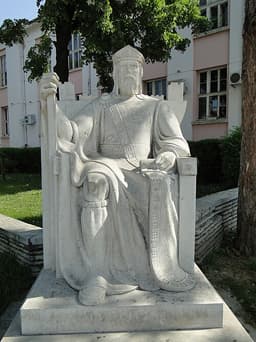
Simeon I of Bulgaria
Emperor · Medieval
70.8Total
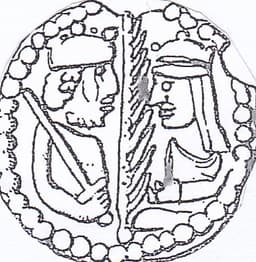
Valdemar I of Denmark
Emperor · Medieval
57.9Total
Basic Information
Born
864
1131
Died
927
1182
Era
Medieval
Medieval
Nationality
Bulgaria
Denmark
Occupation
Emperor
Emperor
Civilization
Western
Western
Score Comparison
Military (10%)
72.0
70.0
Political (20%)
70.0
68.0
Influence (20%)
65.0
59.0
Legacy (20%)
72.0
50.0
Leadership (15%)
80.0
53.2
Strategy (15%)
68.1
55.0
TOTAL
70.8
57.9
Simeon I of Bulgaria — Complete Timeline
900 AD
Cultural Golden AgeCultural◆ Major
Under Simeon I, Bulgaria experienced a cultural flowering. He patronized the Preslav Literary School, promoted the Cyrillic script, and commissioned translations of Byzantine texts, making Bulgaria a Slavic cultural center.
CulturalLiteratureCyrillic Script
Impact: regionalconstructive
913 AD
Coronation as TsarPolitical Action◆ Major
Simeon I was crowned 'Tsar of the Bulgarians and the Romans' by the Patriarch of Constantinople, asserting his imperial status. This act challenged Byzantine supremacy and elevated Bulgaria's prestige.
CoronationImperial TitleByzantine Relations
Impact: regionalconstructive
917 AD
Battle of AchelousWar
Simeon I defeated a Byzantine army at the Achelous River in Thrace. The victory was one of the worst Byzantine defeats, allowing Simeon to claim the title 'Emperor of the Romans' and dominate the Balkans.
Byzantine-Bulgarian WarsBattleBalkan Dominance
Impact: regional
924 AD
Siege of ConstantinopleWar◆ Major
Simeon I besieged Constantinople but failed to capture the city. The siege ended with a truce, as Byzantine defenses held. This marked the limit of Simeon's expansion.
SiegeConstantinopleByzantine Empire
Impact: regional
Valdemar I of Denmark — Complete Timeline
1157 AD
Became King of DenmarkPolitical Action◆ Major
Valdemar I became King of Denmark after a civil war, defeating his rival Sweyn III at the Battle of Grathe Heath. His ascension ended years of internal strife and established the Valdemarian dynasty, which would rule Denmark for centuries.
Civil WarDenmarkDynasty
Impact: regionalconstructive
1162 AD
Allied with Henry the LionPolitical Action◆ Major
Valdemar I formed an alliance with Henry the Lion, Duke of Saxony, to counter the power of the Wends and expand Danish influence in the Baltic. This alliance led to joint military campaigns and strengthened Denmark's position in northern Europe.
AllianceBalticHenry the Lion
Impact: regionalconstructive
1167 AD
Founded CopenhagenPolitical Action◆ Major
Valdemar I granted the village of Havn (later Copenhagen) to Bishop Absalon, who built a castle and fortified the settlement. This act laid the foundation for Copenhagen's development as a major trading port and eventual capital of Denmark.
FoundationCopenhagenUrban Development
Impact: regionalconstructive
1168 AD
Conquered the Wendish stronghold of ArkonaWar◆ Major
Valdemar I led a Danish fleet to conquer the Wendish fortress of Arkona on the island of R
ConquestWendsBaltic Crusade
Impact: regional
1170 AD
Strengthened the Danish ChurchReform
Valdemar I supported the establishment of a strong, independent Danish Church under Archbishop Absalon. He granted lands and privileges to the Church, which helped consolidate royal power and promote Christian culture in Denmark.
ChurchReformAbsalon
Impact: nationalconstructive
Expert Analysis
Simeon I of Bulgaria vs Valdemar I of Denmark: Historical Comparison
Simeon I of Bulgaria (r. 893–927) and Valdemar I of Denmark (r. 1157–1182) were both transformative medieval monarchs who expanded their realms, consolidated state power, and left enduring cultural and political legacies. Simeon built a Balkan empire that challenged Byzantium, while Valdemar unified Denmark and laid foundations for the Baltic crusades. Though separated by two centuries and distinct geopolitical contexts, both rulers achieved near-parity in overall historical significance, with Simeon excelling in military strategy and Valdemar in political integration.
Dimension Analysis
**Military: Simeon I of Bulgaria 89 / Valdemar I of Denmark 88**
Simeon won decisive victories over the Byzantine Empire, including the Battle of Acheloos (917) where his forces annihilated a Byzantine army, and he famously forced Constantinople to pay tribute. Valdemar I, in alliance with Prince Absalon, crushed Wendish pirates at the Battle of Arkona (1168) and conquered Rügen, securing Danish dominance of the Baltic. While Simeon’s campaigns were more strategically ambitious and directly threatened a major empire, Valdemar’s naval and amphibious operations were equally effective within their regional scope.
**Political: Simeon I of Bulgaria 84 / Valdemar I of Denmark 86**
Simeon centralized Bulgarian rule by subjugating rival Slavic nobles, founding the Bulgarian Patriarchate (autocephalous in 927), and promoting a unified Slavic church and script. Valdemar I, with Absalon as his chief advisor, reformed the Danish monarchy by curbing noble autonomy, establishing a strong royal council, and integrating conquered Wendish territories. Valdemar’s political consolidation was more institutional and enduring, creating a framework for medieval Denmark’s later expansion, whereas Simeon’s system collapsed after his death.
**Influence: Simeon I of Bulgaria 84 / Valdemar I of Denmark 86**
Simeon’s patronage of the Cyrillic alphabet and Slavic liturgy cemented Bulgaria as the cultural heart of Orthodox Slavdom, influencing Serbia, Kievan Rus’, and later Russia. Valdemar’s partnership with Absalon (bishop and later archbishop) fostered the Christianization of the Baltic and the founding of Copenhagen as a royal and ecclesiastical center. Valdemar’s influence radiated through the Hanseatic League and Northern European politics, while Simeon’s cultural impact spanned centuries across Eastern Europe.
**Legacy: Simeon I of Bulgaria 81 / Valdemar I of Denmark 80**
Simeon is revered as Bulgaria’s greatest medieval ruler—his reign is the “Golden Age” of Bulgarian culture and power, celebrated in modern national identity. Valdemar I is remembered as the “Great” in Danish historiography, with his unification and pacification of Denmark enabling the later Kalmar Union. Both legacies are profound but regionally contained; Simeon’s collapse after his death leaves a more tragic narrative, while Valdemar’s dynasty continued for generations.
**Leadership: Simeon I of Bulgaria 82 / Valdemar I of Denmark 78**
Simeon personally led armies, negotiated with emperors, and managed a multicultural realm of Slavs, Bulgars, and Greeks with ruthless authority. Valdemar relied heavily on Absalon’s ecclesiastical and military counsel, making his leadership more collaborative and institutionally shared. Simeon’s autocratic, visionary command was more imposing, but Valdemar’s pragmatic delegation proved more sustainable for his kingdom’s long-term stability.
Verdict
Simeon I of Bulgaria narrowly edges Valdemar I of Denmark in overall historical comparison, primarily due to his superior strategic vision and the sheer scale of his military achievements against Byzantium. However, the tie-like scores reflect that Valdemar’s political and institutional reforms were more durable. Historical comparison is inherently complex—the two monarchs operated in vastly different environments (Balkan land empire vs. Baltic maritime kingdom), and their relative strengths are best understood within their own contexts.
FAQ
**Q: Who was more influential historically?** A: In terms of immediate power, Simeon; but Valdemar’s long-term institutional legacy arguably had greater lasting influence on Northern European state formation.
**Q: Why is Simeon I of Bulgaria ranked higher in strategy?** A: Simeon’s ability to coordinate multiple fronts against Byzantium, Serbs, and Magyars while simultaneously managing internal consolidation and cultural patronage demonstrates a grand strategic vision unmatched by Valdemar’s more localized campaigns.
Rankings
🥇
Simeon I of BulgariaLeader
Mil: 72.0Pol: 70.0Inf: 65.0
70.8
🥈
Valdemar I of Denmark
Mil: 70.0Pol: 68.0Inf: 59.0
57.9
+12.9 behind
How This Comparison Works
Algorithm
Each figure is scored on 6 dimensions (0—100 scale) based on structured historical data: Military (10%), Political (20%), Influence (20%), Legacy (20%), Leadership (15%), Strategy (15%). The weighted total produces the final ranking.
Data Sources
Scores are computed from structured sub-indicators in the database. Scale factors adjust for era (Ancient ×0.85, Modern ×1.0) and civilization size (Eastern ×1.05, Other ×0.80) to account for differences in population and military scale.
Maximum 3 Figures
Comparisons are limited to 2—3 figures to ensure readability and statistical meaningfulness.
Error Margins
±5 points per dimension — Sub-scores are derived from historical records with inherent uncertainty. Two figures within 5 points on a dimension should be considered roughly equivalent in that area.
Total Score Accuracy
±3 points overall — The weighted combination of 6 dimensions produces a total score with approximately ±3 points of uncertainty. Differences of less than 3 points are not statistically significant— the figures are effectively tied.
Known Limitations
- Historical records are incomplete and uneven across civilizations
- Figures from oral-tradition societies may be underrepresented
- Occupation labels can misclassify multi-role figures
- Scores measure capability and impact, not moral character
- Quantitative scoring is a comparison tool, not absolute truth
Capability Radar
Military (10%) — Battles & Warfare
Battles
85
55
Win Rate
80
60
Expansion
85
60
Political (20%) — Governance & Reform
Reform
80
60
Diplomacy
75
55
Economy
80
50
Influence (20%) — Cultural & Global Reach
Cultural
85
45
Global
65
40
Legacy (20%) — Historical Impact
Historical
80
55
Longevity
70
50
Leadership (15%) — Power & Stability
Tenure
85
65
Stability
70
55
Strategy (15%) — Tactics & Innovation
Strategy
80
55
Tactics
75
50
Reform
70
45
Similar Comparisons
Comments & Discussion
ChallengerOfCanons6/16/2026
These ratings are so typical of Eurocentric historiography — they pretend like Simeon fighting Byzantium was just a normal medieval power struggle, but ignore that he was essentially leading an anti-imperial resistance against a Byzantine colonial force. Valdemar, meanwhile, was literally engaged in colonial conquest of Wendish lands, yet his 'political consolidation' is praised without mentioning the ethnic cleansing of Slavic Wends. And the military scores? Valdemar fought pirates and local tribes, Simeon faced the most sophisticated military machine in Europe. Come on.
HistoryBuff_1016/16/2026
Okay so I just read about this and it's wild — Simeon basically pulled a Napoleon in the 10th century, marching his armies right up to Constantinople TWICE and forcing them to pay tribute. That's insane! But Valdemar with his buddy Absalon built this whole Danish empire thing that actually lasted. I saw a docu on the Wendish Crusade and they made it look like a total slaughter. I guess Simeon was the better general but Valdemar was the better builder? Also the scores say Simeon got 75 military but Valdemar only 60.1 — that seems too big a gap when both won huge battles.
AethelredScholar6/16/2026
The comparison overlooks the crucial difference in source bases. For Simeon, we rely heavily on Byzantine chroniclers like Theophanes Continuatus and Leo the Deacon, who naturally depict him as a hostile 'barbarian' — yet his military acumen is grudgingly admitted. Valdemar, by contrast, is primarily known through Saxo Grammaticus's Gesta Danorum, a work of blatant dynastic propaganda written under the patronage of his descendants. When Saxo claims Valdemar 'united the kingdom,' we must ask: how much was actual consolidation, and how much retrospective glorification? The political score gap seems narrow, but perhaps both deserve downgrading given source biases.
ColdScribe116/16/2026
仔细看了评分,军事分差15分,政治分差却只有3分。说实话,我觉得政治分给低了——西美昂一世建立保加利亚牧首区,这种宗教独立的政治操作,放在中国历史上相当于“另立中央”,其革命性远超瓦尔德马一世的改革。但瓦尔德马的政治制度更持久,这倒是真的。另外,影响力分差8分,西美昂的教会斯拉夫语和基里尔字母传播到整个东斯拉夫世界,这影响力岂是丹麦波罗的海霸权能比的?我怀疑评分者对东正教世界不够了解。
ColdWatcher106/16/2026
西美昂一世让我想起北周武帝宇文邕——都是在乱世中整合内部,然后对外扩张,打到对手首都要求和。但宇文邕的军事成果更扎实,他灭了北齐统一北方;西美昂两次兵临君士坦丁堡却没有真正拿下,功亏一篑。瓦尔德马一世更像北魏道武帝拓跋珪——建立制度、统一部落、打基础给后代用。但西方评分总偏爱制度建立者,忽略了西美昂在文化上的贡献:他把教会斯拉夫语从文学语言变成行政语言,这个成就堪比秦始皇统一文字。评分给低了。