Loading...
Wanyan Aguda vs Wedem Arad
Wanyan Aguda leads by 14.9 pts · 2 figures compared
…
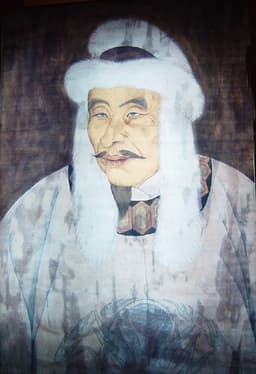
Wanyan Aguda
Emperor · Medieval
63.4Total

Wedem Arad
Emperor · Medieval
48.5Total
Basic Information
Born
1068
1270
Died
1123
1314
Era
Medieval
Medieval
Nationality
China
Ethiopia
Occupation
Emperor
Emperor
Civilization
Eastern
Other
Score Comparison
Military (10%)
82.0
50.0
Political (20%)
59.3
35.1
Influence (20%)
55.0
58.0
Legacy (20%)
52.0
45.8
Leadership (15%)
85.0
55.3
Strategy (15%)
68.0
39.6
TOTAL
63.4
48.5
Wanyan Aguda — Complete Timeline
1114 AD
Battle of HubudagangWar◆ Major
Aguda's Jurchen forces defeated a Liao army at Hubudagang, marking the first major victory of the rebellion. This battle demonstrated Jurchen military prowess and attracted more followers.
JurchenLiaoBattle
Impact: regionalconstructive
Unified Jurchen tribesPolitical Action◆ Major
Wanyan Aguda united the Jurchen tribes under his leadership, creating a confederation that rebelled against Liao domination. He organized a disciplined army and began the Jurchen revolt.
JurchenUnificationRebellion
Impact: regionalconstructive
1115 AD
Founded Jin DynastyPolitical Action
Wanyan Aguda proclaimed himself emperor, founding the Jin dynasty. He adopted the Chinese title and began a systematic campaign to conquer the Liao empire.
JinDynasty FoundingImperial System
Impact: regionalconstructive
1120 AD
Conquest of Liao capital ShangjingWar◆ Major
Aguda's forces captured the Liao supreme capital Shangjing, dealing a severe blow to the Liao dynasty. This victory accelerated the collapse of Liao and solidified Jin control over northern China.
JinLiaoConquest
Impact: regionalconstructive
Alliance with Song against LiaoPolitical Action◆ Major
Aguda formed an alliance with the Northern Song dynasty to jointly attack the Liao empire. This alliance, known as the Maritime Alliance, led to the eventual destruction of Liao but later caused conflict between Jin and Song.
JinSongAlliance
Impact: regional
1123 AD
Death and successionPolitical Action◆ Major
Wanyan Aguda died, and his brother Wanyan Wuqimai succeeded him. Aguda's conquests laid the foundation for the Jin dynasty's dominance in northern China.
JinDeathSuccession
Impact: regional
Wedem Arad — Complete Timeline
1306 AD
First Contact with EuropePolitical Action◆ Major
Wedem Arad sent an embassy to Europe, likely to the court of Pope Clement V in Avignon. This was the first recorded diplomatic contact between Ethiopia and a European power since antiquity, establishing a precedent for future Ethiopian-European relations.
Impact: regional
Expert Analysis
Wanyan Aguda vs Wedem Arad
The Emperor Who Conquered and the Emperor Who Connected
History often remembers conquerors and diplomats as two separate breeds, but in the medieval world, two emperors—Wanyan Aguda of the Jin dynasty and Wedem Arad of Ethiopia—took vastly different paths to power and legacy. One carved an empire from the steppes with blood and iron; the other reached across continents with ink and emissaries. Their stories, unfolding half a world apart, ask a haunting question: What makes a ruler’s mark endure?
Origins
Wanyan Aguda was born in 1068 into the fractious Jurchen tribes of Manchuria, a people chafing under the Liao dynasty’s dominance. The Jurchen were hunters, herders, and warriors, their society shaped by the harsh rhythms of the northern frontier. Aguda grew up in a world where survival meant strength, and strength meant unity—a lesson he would carry into every battle. His father and grandfather had fought the Liao, but Aguda inherited not just a grudge but a vision: to forge the Jurchen into a nation.
Wedem Arad, born around 1270, entered a very different world. Ethiopia’s Solomonic dynasty, claiming descent from the biblical King Solomon and the Queen of Sheba, ruled a highland kingdom steeped in Orthodox Christian tradition. The empire was ancient, isolated, and surrounded by Muslim sultanates. Wedem Arad’s upbringing was likely one of court politics, religious ritual, and the constant threat of foreign encroachment. His challenge was not to conquer but to survive—and to find allies in a world that seemed to have forgotten Ethiopia existed.
Rise to Power
Aguda’s rise was a masterclass in military and political timing. In 1114, he unified the Jurchen tribes under his leadership, a feat of diplomacy and brute force that turned a loose confederation into a rebellion. That same year, at the Battle of Hubudagang, his forces crushed a Liao army in a stunning upset. The victory electrified the Jurchen and shattered Liao prestige. By 1115, Aguda proclaimed himself emperor, founding the Jin dynasty. He adopted Chinese imperial titles, signaling that his ambitions extended beyond the steppe.
Wedem Arad’s ascent was quieter. He inherited a throne in a kingdom that had already weathered centuries of change. His power came not from battlefield triumphs but from legitimacy: the Solomonic line, the Church, and the loyalty of provincial governors. Yet his reign faced a different kind of challenge—isolation. Ethiopia was a Christian island in a Muslim sea, cut off from the rest of Christendom. Wedem Arad’s great gamble was to reach out to a Europe that barely knew his kingdom existed.
Leadership & Governance
Aguda ruled as a warrior-emperor. His military scores (79.3) and leadership (88.4) reflect a man who led from the front, inspiring his troops with personal courage. He was also a shrewd politician (82.2), using Chinese-style bureaucracy to consolidate his conquests. In 1120, his forces captured the Liao supreme capital, Shangjing, accelerating the Liao collapse. That same year, he formed the “Maritime Alliance” with the Northern Song dynasty, a pact to destroy the Liao from both sides. The alliance was a diplomatic masterstroke—but it also sowed seeds of future conflict, as the Song would later fall to Jin aggression.
Wedem Arad’s governance was more about preservation than expansion. His political score (44.3) and leadership (40.0) are modest, but his influence (73.6) is striking. In 1306, he sent an embassy to Europe, likely to the court of Pope Clement V in Avignon. This was the first recorded diplomatic contact between Ethiopia and Europe, a bold move that opened a channel of communication lasting centuries. Wedem Arad understood that in a world of empires, isolation was a luxury he could not afford.
Triumph & Tragedy
Aguda’s triumph was the Jin dynasty itself. He died in 1123 at the height of his power, having transformed a tribal rebellion into an empire that would dominate northern China. Yet his greatest achievement also contained tragedy: the Jin dynasty, for all its might, would eventually fall to the Mongols, and Aguda’s conquests were built on a foundation of violence that left little room for lasting peace.
Wedem Arad’s triumph was subtler: he put Ethiopia on the map of European consciousness. His embassy may have seemed a small gesture, but it laid the groundwork for future alliances, including the famous Portuguese mission to Ethiopia in the 16th century. His tragedy was that he died in 1314, likely without seeing the fruits of his diplomacy. Ethiopia remained isolated for generations, and his name faded into the shadows of history.
Character & Destiny
Aguda was a man of action, driven by ambition and a warrior’s code. His leadership score (88.4) suggests a figure who could inspire loyalty and fear in equal measure. His destiny was to conquer, and he did so with ruthless efficiency. Wedem Arad, by contrast, was a diplomat in an emperor’s body. His influence score (73.6) hints at a ruler who thought beyond borders, who understood that power could be built with words as well as swords. His destiny was to connect, even if the connection took centuries to bear fruit.
Legacy
Aguda is remembered as the founder of the Jin dynasty, a conqueror who reshaped East Asia. His legacy (70.1) endures in Chinese historiography, though his name is less known in the West. Wedem Arad’s legacy (57.8) is more fragile but no less important. He is a footnote in Ethiopian history, but his embassy to Europe marks a turning point in global diplomacy—the moment when two isolated worlds began to reach for each other.
Conclusion
One emperor conquered, another connected. Aguda’s sword carved an empire; Wedem Arad’s letters opened a door. Their stories remind us that greatness takes many forms—and that history, in its quiet way, remembers both the warrior and the messenger. In the end, perhaps the most enduring legacy is not how much land you take, but how many bridges you build.
Rankings
🥇
Wanyan AgudaLeader
Mil: 82.0Pol: 59.3Inf: 55.0
63.4
🥈
Wedem Arad
Mil: 50.0Pol: 35.1Inf: 58.0
48.5
+14.9 behind
How This Comparison Works
Algorithm
Each figure is scored on 6 dimensions (0—100 scale) based on structured historical data: Military (10%), Political (20%), Influence (20%), Legacy (20%), Leadership (15%), Strategy (15%). The weighted total produces the final ranking.
Data Sources
Scores are computed from structured sub-indicators in the database. Scale factors adjust for era (Ancient ×0.85, Modern ×1.0) and civilization size (Eastern ×1.05, Other ×0.80) to account for differences in population and military scale.
Maximum 3 Figures
Comparisons are limited to 2—3 figures to ensure readability and statistical meaningfulness.
Error Margins
±5 points per dimension — Sub-scores are derived from historical records with inherent uncertainty. Two figures within 5 points on a dimension should be considered roughly equivalent in that area.
Total Score Accuracy
±3 points overall — The weighted combination of 6 dimensions produces a total score with approximately ±3 points of uncertainty. Differences of less than 3 points are not statistically significant— the figures are effectively tied.
Known Limitations
- Historical records are incomplete and uneven across civilizations
- Figures from oral-tradition societies may be underrepresented
- Occupation labels can misclassify multi-role figures
- Scores measure capability and impact, not moral character
- Quantitative scoring is a comparison tool, not absolute truth
Capability Radar
Military (10%) — Battles & Warfare
Battles
85
15
Win Rate
90
20
Expansion
85
10
Political (20%) — Governance & Reform
Reform
75
20
Diplomacy
70
55
Economy
65
15
Influence (20%) — Cultural & Global Reach
Cultural
60
20
Global
50
40
Legacy (20%) — Historical Impact
Historical
70
35
Longevity
55
30
Leadership (15%) — Power & Stability
Tenure
70
40
Stability
60
30
Strategy (15%) — Tactics & Innovation
Strategy
85
10
Tactics
80
10
Reform
75
5
Similar Comparisons
Comments & Discussion
象牙塔考据派6/16/2026
说阿骨打“统一女真”就像说秦始皇“统一度量衡”一样,听起来美好,实则充满血腥。史料显示他为了巩固权力,不惜屠杀拒绝归顺的同族部落,比如完颜部的对手纥石烈部。所谓“民族英雄”的叙事,不过是后世金朝史官的政治正确。不如看看那位埃塞俄比亚皇帝,至少他懂得用外交手腕延长国祚,而不是一味地烧杀抢掠。
Chronicler48436/16/2026
Aguda's genius wasn't just in winning battles—it was in turning Jurchen tribal squabbles into a unified war machine. The Battle of Huining in 1115? That's where he shattered the Liao's elite Khitan cavalry by luring them into frozen marshlands. Pure tactical brilliance. Without that victory, there's no Jin Dynasty, no pressure on Song China. Wedem Arad played defense; Aguda played to win.