Loading...
Analysis will be generated on first visit.
Scores and timeline are available below. The page will refresh automatically when ready.
Martin Van Buren vs Napoleon Bonaparte
Napoleon Bonaparte leads by 19.8 pts · 2 figures compared
…
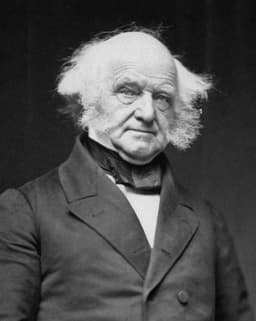
Martin Van Buren
Politician · Modern
62.6Total

Napoleon Bonaparte
General · Modern
82.4Total
Basic Information
Born
1782
1769
Died
1862
1821
Era
Modern
Modern
Nationality
United States
France
Occupation
Politician
General
Civilization
Western
Western
Score Comparison
Military (10%)
37.5
94.0
Political (20%)
65.9
75.0
Influence (20%)
72.3
82.0
Legacy (20%)
70.0
78.0
Leadership (15%)
79.2
80.0
Strategy (15%)
35.3
93.0
TOTAL
62.6
82.4
Rankings
🥇
Napoleon BonaparteLeader
Mil: 94.0Pol: 75.0Inf: 82.0
82.4
🥈
Martin Van Buren
Mil: 37.5Pol: 65.9Inf: 72.3
62.6
+19.8 behind
How This Comparison Works
Algorithm
Each figure is scored on 6 dimensions (0—100 scale) based on structured historical data: Military (10%), Political (20%), Influence (20%), Legacy (20%), Leadership (15%), Strategy (15%). The weighted total produces the final ranking.
Data Sources
Scores are computed from structured sub-indicators in the database. Scale factors adjust for era (Ancient ×0.85, Modern ×1.0) and civilization size (Eastern ×1.05, Other ×0.80) to account for differences in population and military scale.
Maximum 3 Figures
Comparisons are limited to 2—3 figures to ensure readability and statistical meaningfulness.
Error Margins
±5 points per dimension — Sub-scores are derived from historical records with inherent uncertainty. Two figures within 5 points on a dimension should be considered roughly equivalent in that area.
Total Score Accuracy
±3 points overall — The weighted combination of 6 dimensions produces a total score with approximately ±3 points of uncertainty. Differences of less than 3 points are not statistically significant— the figures are effectively tied.
Known Limitations
- Historical records are incomplete and uneven across civilizations
- Figures from oral-tradition societies may be underrepresented
- Occupation labels can misclassify multi-role figures
- Scores measure capability and impact, not moral character
- Quantitative scoring is a comparison tool, not absolute truth
Capability Radar
Military (10%) — Battles & Warfare
Battles
29
95
Win Rate
30
90
Expansion
36
95
Political (20%) — Governance & Reform
Reform
55
95
Diplomacy
50
80
Economy
45
85
Influence (20%) — Cultural & Global Reach
Cultural
40
85
Global
45
90
Legacy (20%) — Historical Impact
Historical
55
95
Longevity
50
90
Leadership (15%) — Power & Stability
Tenure
65
85
Stability
40
70
Strategy (15%) — Tactics & Innovation
Strategy
39
95
Tactics
40
98
Reform
45
92
Analysis will be generated on first visit.
Scores and timeline are available below. The page will refresh automatically when ready.
Martin Van Buren — Complete Timeline
1828 AD
Founded the Democratic PartyPolitical Action◆ Major
Van Buren organized the coalition of Jacksonian Democrats into the Democratic Party, creating a national political organization that supported Andrew Jackson's 1828 presidential campaign. This established the modern two-party system in the United States.
Political PartyJacksonian DemocracyParty System
Impact: nationalconstructive
1836 AD
Elected President of the United StatesPolitical Action◆ Major
Van Buren won the 1836 presidential election as the Democratic candidate, defeating Whig candidates William Henry Harrison and others. He succeeded Andrew Jackson and became the eighth president.
PresidencyElection
Impact: national
1837 AD
Panic of 1837Other◆ Major
A severe financial crisis began shortly after Van Buren took office, triggered by the collapse of speculative land bubbles and bank failures. The depression lasted until the mid-1840s, causing widespread unemployment and bank closures.
Economic CrisisDepressionBanking
Impact: nationaldestructive
1840 AD
Signed the Independent Treasury ActReform◆ Major
Van Buren signed legislation establishing an independent treasury system to manage federal funds without private banks. The system separated government deposits from state banks, aiming to prevent future panics.
Economic ReformTreasuryBanking
Impact: nationalconstructive
Lost 1840 Presidential ElectionPolitical Action◆ Major
Van Buren was defeated by Whig candidate William Henry Harrison in the 1840 election. The campaign focused on the economic depression and Van Buren's perceived elitism, leading to a landslide loss.
Election DefeatWhig Victory
Impact: nationaltragic
1848 AD
Free Soil Party CandidacyPolitical Action
Van Buren ran as the Free Soil Party candidate in the 1848 presidential election, opposing the expansion of slavery into territories. He split the Democratic vote, contributing to Whig Zachary Taylor's victory.
Third PartyAnti-SlaveryElection
Impact: national
Napoleon Bonaparte — Complete Timeline
1799 AD
Coup of 18 BrumaireOther◆ Major
Napoleon Bonaparte, with support from his brother Lucien and key political figures, overthrew the Directory in a bloodless coup. He established the Consulate with himself as First Consul, effectively becoming the ruler of France. This event ended the French Revolution's most unstable period.
French RevolutionCoupRise to Power
Impact: regional
1804 AD
Promulgation of the Napoleonic CodeOther◆ Major
Napoleon enacted the Civil Code of the French, known as the Napoleonic Code, a comprehensive set of laws that replaced the fragmented feudal legal systems. The code established legal equality, protected property rights, and secularized law. It became the basis for legal systems in many European and world countries.
Legal ReformNapoleonic CodeCivil Law
Impact: globalconstructive
1805 AD
Battle of AusterlitzWar◆ Major
Napoleon's Grande Arm
Napoleonic WarsBattleDecisive Victory
Impact: global
1812 AD
Invasion of RussiaWar◆ Major
Napoleon led the Grande Arm
Napoleonic WarsInvasionDisaster
Impact: globaldestructive
1815 AD
Battle of WaterlooWar◆ Major
Napoleon's French army was defeated by the combined forces of the Duke of Wellington's Anglo-Allied army and Gebhard Leberecht von Bl
Napoleonic WarsBattleFinal Defeat
Impact: globaldestructive
Similar Comparisons
Comments & Discussion
No comments yet. Be the first to share your thoughts!