Loading...
Abe Nobuyuki vs Napoleon Bonaparte
Napoleon Bonaparte leads by 27.7 pts · 2 figures compared
…
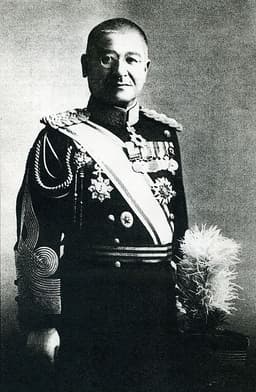
Abe Nobuyuki
General · Modern
43.2Total

Napoleon Bonaparte
General · Modern
70.9Total
Basic Information
Born
1875
1769
Died
1953
1821
Era
Modern
Modern
Nationality
Japan
France
Occupation
General
General
Civilization
Eastern
Western
Score Comparison
Military (10%)
50.0
94.0
Political (20%)
32.2
72.0
Influence (20%)
51.8
40.0
Legacy (20%)
39.2
80.0
Leadership (15%)
50.7
78.0
Strategy (15%)
30.3
90.0
TOTAL
43.2
70.9
Abe Nobuyuki — Complete Timeline
1939 AD
Service as Prime MinisterPolitical Action◆ Major
Abe Nobuyuki served as Prime Minister from August 1939 to January 1940. His cabinet was formed after the Nomonhan Incident and focused on resolving the conflict with the Soviet Union. He pursued a neutral foreign policy but was unable to control the military.
Prime MinisterNomonhan
Impact: national
1940 AD
Resignation Over Foreign PolicyPolitical Action
Abe resigned as Prime Minister in January 1940 after failing to resolve tensions with the United States over the abrogation of the U.S.-Japan Commercial Treaty. His resignation reflected the growing crisis in Japan's foreign relations.
ResignationU.S.-Japan Relations
Impact: nationaltragic
1944 AD
Governor-General of KoreaPolitical Action◆ Major
Abe served as Governor-General of Korea from 1944 to 1945, during the final years of World War II. He implemented harsh policies to mobilize Korean resources for the war effort, including forced labor and conscription.
Colonial RuleKoreaWar Mobilization
Impact: regionaldestructive
1946 AD
Post-War Purge and Political ComebackPolitical Action
After World War II, Abe was purged from public office by the Allied occupation authorities. However, he later returned to politics and was elected to the House of Representatives in 1952, serving until his death.
Post-WarPurgePolitical Comeback
Impact: national
Napoleon Bonaparte — Complete Timeline
1799 AD
Coup of 18 BrumaireOther◆ Major
Napoleon Bonaparte, with support from his brother Lucien and key political figures, overthrew the Directory in a bloodless coup. He established the Consulate with himself as First Consul, effectively becoming the ruler of France. This event ended the French Revolution's most unstable period.
French RevolutionCoupRise to Power
Impact: regional
1804 AD
Promulgation of the Napoleonic CodeOther◆ Major
Napoleon enacted the Civil Code of the French, known as the Napoleonic Code, a comprehensive set of laws that replaced the fragmented feudal legal systems. The code established legal equality, protected property rights, and secularized law. It became the basis for legal systems in many European and world countries.
Legal ReformNapoleonic CodeCivil Law
Impact: globalconstructive
1805 AD
Battle of AusterlitzWar◆ Major
Napoleon's Grande Arm
Napoleonic WarsBattleDecisive Victory
Impact: global
1812 AD
Invasion of RussiaWar◆ Major
Napoleon led the Grande Arm
Napoleonic WarsInvasionDisaster
Impact: globaldestructive
1815 AD
Battle of WaterlooWar◆ Major
Napoleon's French army was defeated by the combined forces of the Duke of Wellington's Anglo-Allied army and Gebhard Leberecht von Bl
Napoleonic WarsBattleFinal Defeat
Impact: globaldestructive
Expert Analysis
abe-nobuyuki-vs-napoleon-bonaparte
# The Emperor and the General: Two Paths Through the Modern Crucible
In the summer of 1815, a solitary figure stood on the deck of HMS *Bellerophon*, watching the coast of France disappear into the Atlantic mist. Napoleon Bonaparte, who had once commanded the largest army in European history, was sailing toward a final, lonely exile on Saint Helena. Just over a century later, in the autumn of 1939, another general—Abe Nobuyuki—ascended to the premiership of Japan, inheriting a nation already marching toward war. Both men were soldiers who became politicians. Both lived through eras of revolutionary upheaval. But while one remade the world in his image, the other was swept along by forces he could neither control nor fully comprehend. Why did their fates diverge so dramatically?
Origins
Napoleon was born in 1769 on Corsica, an island that had only recently become French. His family was minor nobility, but his education at French military academies exposed him to the Enlightenment ideals sweeping Europe. The French Revolution, which erupted when he was twenty, shattered the old order and created opportunities unknown under the monarchy. A brilliant artillery officer could rise not by birth but by talent—and Napoleon seized that chance with ferocious ambition.
Abe Nobuyuki, born in 1875 in Tokyo, came of age in a Japan undergoing its own transformation. The Meiji Restoration had ended the samurai era, and the nation was racing to modernize its military and industry. Abe attended the Imperial Japanese Army Academy, absorbing the ethos of absolute loyalty to the emperor and the belief that military expansion was Japan’s destiny. Where Napoleon’s world was one of revolutionary possibility, Abe’s was one of rigid hierarchy and nationalistic fervor. These differing soils produced very different fruits.
Rise to Power
Napoleon’s ascent was meteoric. At twenty-four, he was a general; at thirty, First Consul of France. His Italian campaign of 1796–1797 demonstrated his genius: rapid marches, decisive battles, and a talent for propaganda that made him a hero. The coup of 18 Brumaire in 1799 placed him at the helm of a nation exhausted by revolution and eager for order. His rise was a story of will and warfare, but also of political instinct—he understood that power in post-revolutionary France required both military laurels and civilian legitimacy.
Abe’s path was slower and more institutional. He rose through the army bureaucracy, serving in administrative roles rather than commanding great victories. His moment came in 1939, when Japan was mired in the undeclared war with China and reeling from the Nomonhan Incident, a humiliating defeat by Soviet forces. The civilian government collapsed, and the military elite turned to Abe as a safe pair of hands. He became Prime Minister in August 1939, not because he was a visionary, but because he was a compromise candidate—a general who could manage the army while keeping the bureaucracy intact.
Leadership & Governance
Napoleon governed with a fusion of military precision and political genius. His Napoleonic Code, enacted in 1804, standardized French law across conquered Europe, abolishing feudal privileges and establishing legal equality. He reformed education, created the Bank of France, and built roads and canals. Yet his governance was autocratic; he crowned himself emperor in 1804, silencing dissent and centralizing power. His military leadership was legendary—at Austerlitz in 1805, he crushed the Austrian and Russian armies with a masterpiece of deception and timing. But his political wisdom faltered when he overreached, invading Spain and Russia in campaigns that bled France dry.
Abe’s tenure as Prime Minister lasted only five months, from August 1939 to January 1940. He faced a crisis: the United States had abrogated the 1911 commercial treaty with Japan, threatening oil and steel supplies. Abe sought a diplomatic solution, but the army demanded a hard line. He was a general, yet he lacked the military prestige to command obedience from his own officers. His political score of 72.2 reflects a competent administrator, but his military score of 34.7 tells a deeper story—he was never a battlefield commander. Unlike Napoleon, who wielded war as an instrument of policy, Abe was a manager of war, not its master.
Triumph & Tragedy
Napoleon’s greatest moment was Austerlitz, where he defeated a larger coalition army in a single day, dissolving the Third Coalition and cementing his dominance. His tragedy was the invasion of Russia in 1812. With 600,000 men, he marched into a vast, empty country; the Russians refused battle, burned their own land, and let winter do the killing. Only 100,000 returned. Waterloo in 1815 was the final act—a battle he might have won had his subordinates acted faster, but defeat was already written in the overreach that preceded it.
Abe’s triumph is harder to locate. His brief premiership avoided immediate disaster, but he could not prevent the drift toward war. His tragedy was the post-war purge: in 1946, the Allied occupation authorities removed him from public office. He later returned to politics, but his legacy was tainted by association with Japanese militarism. He died in 1953, a footnote in a century of catastrophe.
Character & Destiny
Napoleon’s character was an engine of destiny: boundless energy, supreme confidence, and a mind that could grasp both the grand strategy and the smallest tactical detail. He once said, “I am not a man, I am a thing”—meaning he saw himself as an instrument of history. That self-belief drove him to conquer Europe, but it also blinded him to limits. He could not stop, and so he fell.
Abe’s character was suited to a different age. He was cautious, bureaucratic, and loyal to the system that had raised him. He lacked Napoleon’s charisma and strategic vision. His strategy score of 69.3 is respectable but not extraordinary. He was a product of his time, not its shaper. Where Napoleon bent history to his will, Abe was bent by it.
Legacy
Napoleon left behind a transformed Europe: the Napoleonic Code influenced legal systems from Brazil to Japan, his military innovations shaped modern warfare, and his legend inspired countless leaders. His legacy score of 78.0 reflects his enduring presence in Western culture—a figure of both admiration and caution.
Abe Nobuyuki is largely forgotten outside Japan. His legacy score of 54.8 is modest, a reflection of a career that served a doomed empire. He is remembered, if at all, as a symbol of the militarism that led Japan to ruin. No code bears his name; no battle is taught in military academies.
Conclusion
The contrast between Napoleon and Abe Nobuyuki is not merely a tale of success and failure. It is a story about the relationship between the individual and history. Napoleon emerged when the old world was collapsing, and he had the genius to build a new one. Abe emerged when the modern world was tearing itself apart, and he had only the competence to manage its machinery. One was a volcano, the other a tremor. One reshaped the map, the other was erased by it. Their lives remind us that history does not reward mere talent—it demands a moment, a vision, and a will that can seize both.
Rankings
🥇
Napoleon BonaparteLeader
Mil: 94.0Pol: 72.0Inf: 40.0
70.9
🥈
Abe Nobuyuki
Mil: 50.0Pol: 32.2Inf: 51.8
43.2
+27.7 behind
How This Comparison Works
Algorithm
Each figure is scored on 6 dimensions (0—100 scale) based on structured historical data: Military (10%), Political (20%), Influence (20%), Legacy (20%), Leadership (15%), Strategy (15%). The weighted total produces the final ranking.
Data Sources
Scores are computed from structured sub-indicators in the database. Scale factors adjust for era (Ancient ×0.85, Modern ×1.0) and civilization size (Eastern ×1.05, Other ×0.80) to account for differences in population and military scale.
Maximum 3 Figures
Comparisons are limited to 2—3 figures to ensure readability and statistical meaningfulness.
Error Margins
±5 points per dimension — Sub-scores are derived from historical records with inherent uncertainty. Two figures within 5 points on a dimension should be considered roughly equivalent in that area.
Total Score Accuracy
±3 points overall — The weighted combination of 6 dimensions produces a total score with approximately ±3 points of uncertainty. Differences of less than 3 points are not statistically significant— the figures are effectively tied.
Known Limitations
- Historical records are incomplete and uneven across civilizations
- Figures from oral-tradition societies may be underrepresented
- Occupation labels can misclassify multi-role figures
- Scores measure capability and impact, not moral character
- Quantitative scoring is a comparison tool, not absolute truth
Capability Radar
Military (10%) — Battles & Warfare
Battles
20
95
Win Rate
20
90
Expansion
10
95
Political (20%) — Governance & Reform
Reform
15
95
Diplomacy
20
80
Economy
15
85
Influence (20%) — Cultural & Global Reach
Cultural
10
85
Global
10
90
Legacy (20%) — Historical Impact
Historical
15
95
Longevity
10
90
Leadership (15%) — Power & Stability
Tenure
30
85
Stability
20
70
Strategy (15%) — Tactics & Innovation
Strategy
15
95
Tactics
15
98
Reform
10
92
Similar Comparisons
Comments & Discussion
GallicThunder6/17/2026
Calling this a comparison is like comparing a thunderbolt to a drizzle. Napoleon rewrote the military playbook with the Corps system and shattered coalitions across four campaigns. Abe was a competent logistics man who let the Imperial Army's insubordination run rampant—most famously ignoring his own China policy in 1937. One redrew borders; the other couldn't even control his own generals.
数据清算人6/17/2026
醒醒吧,这哪里是对决,这是拿加农炮打弹弓。拿破仑在奥斯特里茨用七万兵力干翻八万俄奥联军,战损比1:3;阿部信行任上日军在诺门罕被朱可夫打得满地找牙,死伤近两万。数据不会撒谎——一个是军事天才的巅峰,一个是组织溃败的标本。
GaulishStrategist6/17/2026
Napoleon didn't just win battles; he institutionalized victory with the *Grande Armée*'s decentralized command and merit-based officer corps. Abe, by contrast, presided over a military where promotion ran on clique loyalty and regional factionalism. When Napoleon lost at Waterloo, he still imposed his will on Europe for a decade. When Abe's China strategy failed, he just resigned and vanished.
平成武士6/17/2026
阿部信行的悲剧在于,他生在明治维新的尾声中,却死在军国主义的狂潮里。他试图用旧帝国的官僚手腕约束关东军,结果被参谋本部的少壮派活活架空。拿破仑至少能用《拿破仑法典》驯服法国;阿部连自己的陆军大臣都管不住。一个做时代的缔造者,一个不过是潮水的浮木。