Loading...
Albert Alcibiades vs Napoleon Bonaparte
Napoleon Bonaparte leads by 31.7 pts · 2 figures compared
…
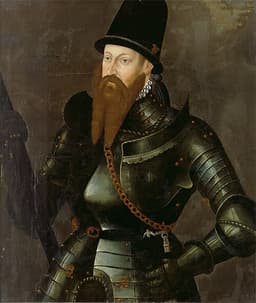
Albert Alcibiades
General · Modern
39.2Total

Napoleon Bonaparte
General · Modern
70.9Total
Basic Information
Born
1522
1769
Died
1557
1821
Era
Modern
Modern
Nationality
Brandenburg-Kulmbach
France
Occupation
General
General
Civilization
Western
Western
Score Comparison
Military (10%)
20.0
94.0
Political (20%)
27.9
72.0
Influence (20%)
50.2
40.0
Legacy (20%)
41.7
80.0
Leadership (15%)
38.1
78.0
Strategy (15%)
43.3
90.0
TOTAL
39.2
70.9
Albert Alcibiades — Complete Timeline
1527 AD
Became Margrave of Brandenburg-KulmbachPolitical Action◆ Major
Albert Alcibiades inherited the Margraviate of Brandenburg-Kulmbach, a small principality in Franconia. He became known for his aggressive military policies and expansionist ambitions, earning the nickname 'Alcibiades' for his warlike nature.
InheritanceMargrave
Impact: regional
1546 AD
Fought in the Schmalkaldic WarWar◆ Major
Albert Alcibiades fought on the side of Emperor Charles V in the Schmalkaldic War against the Protestant princes. He commanded troops in several battles, including the decisive Battle of M
Schmalkaldic WarImperial Service
Impact: regional
1552 AD
Raided and Plundered Franconian TerritoriesWar◆ Major
After the Treaty of Passau, Albert Alcibiades launched a series of raids and plundering campaigns across Franconia, attacking both Catholic and Protestant territories. His actions caused widespread destruction and destabilized the region, leading to his condemnation.
RaidingDestruction
Impact: regionaldestructive
1553 AD
Defeated at the Battle of SievershausenWar◆ Major
Albert Alcibiades was defeated by a coalition of princes led by Maurice of Saxony at the Battle of Sievershausen. Though he escaped, his forces were shattered, and he was forced to flee, ending his military ambitions.
BattleDefeat
Impact: regionaltragic
Placed under Imperial BanPolitical Action◆ Major
Albert Alcibiades was placed under the Imperial ban by Emperor Charles V for his violent raids and refusal to obey imperial authority. The ban declared him an outlaw, allowing any prince to attack him without legal consequences.
Imperial BanOutlaw
Impact: regionaldestructive
1557 AD
Died in ExileOther
Albert Alcibiades died in exile in France, having been driven from his lands after the Imperial ban. His death marked the end of the Brandenburg-Kulmbach line, and his territories were divided among neighboring princes.
ExileDeath
tragic
Napoleon Bonaparte — Complete Timeline
1799 AD
Coup of 18 BrumaireOther◆ Major
Napoleon Bonaparte, with support from his brother Lucien and key political figures, overthrew the Directory in a bloodless coup. He established the Consulate with himself as First Consul, effectively becoming the ruler of France. This event ended the French Revolution's most unstable period.
French RevolutionCoupRise to Power
Impact: regional
1804 AD
Promulgation of the Napoleonic CodeOther◆ Major
Napoleon enacted the Civil Code of the French, known as the Napoleonic Code, a comprehensive set of laws that replaced the fragmented feudal legal systems. The code established legal equality, protected property rights, and secularized law. It became the basis for legal systems in many European and world countries.
Legal ReformNapoleonic CodeCivil Law
Impact: globalconstructive
1805 AD
Battle of AusterlitzWar◆ Major
Napoleon's Grande Arm
Napoleonic WarsBattleDecisive Victory
Impact: global
1812 AD
Invasion of RussiaWar◆ Major
Napoleon led the Grande Arm
Napoleonic WarsInvasionDisaster
Impact: globaldestructive
1815 AD
Battle of WaterlooWar◆ Major
Napoleon's French army was defeated by the combined forces of the Duke of Wellington's Anglo-Allied army and Gebhard Leberecht von Bl
Napoleonic WarsBattleFinal Defeat
Impact: globaldestructive
Expert Analysis
albert-alcibiades-vs-napoleon-bonaparte
# The Conqueror and the Plunderer: Why Napoleon Built an Empire While Albert Alcibiades Burned One
In the spring of 1553, a German prince named Albert Alcibiades watched his cavalry thunder across the fields of Franconia, torching villages and monasteries with a fury that seemed to know no end. Two and a half centuries later, another man—a short, pale Corsican with eyes like winter ice—stood atop a hill in Egypt, pointing toward the pyramids and telling his 35,000 soldiers that forty centuries were looking down upon them. Both men wielded armies. Both men sought glory. One reshaped the legal and political landscape of Europe; the other left behind nothing but ash and a name that history would barely remember. Why did Napoleon Bonaparte become a titan of the modern world, while Albert Alcibiades remains a footnote—a cautionary tale of ambition without purpose?
The answer lies not in talent, but in the soil from which each man grew.
Origins
Napoleon was born in 1769 on the island of Corsica, a place that had only recently become French. His family was minor nobility, poor enough to feel the sting of hunger but proud enough to resent the mainland aristocracy that looked down on them. He spoke Italian before French, and his accent would mark him as an outsider for life. This marginality forged something essential in him: the hunger of the man who has nothing to lose and everything to prove.
Albert Alcibiades, born in 1522, inherited a different kind of marginality. He became Margrave of Brandenburg-Kulmbach in 1527 at the age of five—a tiny principality in Franconia, squeezed between the rising power of Saxony and the ambitions of the Habsburgs. His world was the Holy Roman Empire, a patchwork of hundreds of states where power was measured in titles, not territory. Where Napoleon grew up watching the old order crumble in the French Revolution, Albert grew up watching the Reformation tear Christendom apart. Both eras were violent, but the 1520s offered no new ideas—only old feuds dressed in religious robes.
Rise to Power
Napoleon’s rise was a revolution in miniature. He emerged from the chaos of the French Revolution not as a nobleman but as an artillery officer who knew how to place a cannon. At the Siege of Toulon in 1793, at just 24 years old, he devised the plan that drove the British from the harbor. By 1796, he was commanding the Army of Italy, and within a year he had forced Austria to the negotiating table. His path was meritocratic: talent, timing, and the collapse of the old regime allowed a Corsican outsider to become Emperor of the French by 1804.
Albert Alcibiades never had such a path. His rise was inheritance, not achievement. When he fought in the Schmalkaldic War of 1546, he chose the side of Emperor Charles V—a safe bet for a minor prince seeking favor. But Albert lacked Napoleon’s strategic patience. He fought well, but he fought for plunder, not for a vision. After the Treaty of Passau in 1552, when the Emperor’s attention turned elsewhere, Albert saw an opportunity. He launched a series of raids across Franconia, attacking bishoprics and free cities, taking what he could carry. It was the behavior of a warlord, not a statesman.
Leadership & Governance
Napoleon’s military genius—scored at 94—was matched by a political mind that understood the power of institutions. His Napoleonic Code reformed French law into a clear, rational system that abolished feudal privileges and enshrined equality before the law. He built schools, standardized weights and measures, and created a centralized bureaucracy that outlasted his empire. When he conquered, he didn’t just pillage; he reorganized. He gave his subjects something to admire even as he taxed them.
Albert Alcibiades, with a military score of 38 and a political score of 42, governed as he fought: by force. He had no code, no reforms, no vision beyond the next campaign. His raids in 1552–1553 were so brutal that the cities of Franconia appealed to the Emperor for protection. In 1553, Charles V placed Albert under the Imperial Ban—a sentence of outlawry that stripped him of all legal rights. His defeat at the Battle of Sievershausen later that year was not a strategic reversal but a moral collapse. Even his ally, Maurice of Saxony, died in that battle, but Albert was left isolated and despised.
Triumph & Tragedy
Napoleon’s greatest moment came not on a battlefield but in a cathedral. In December 1804, he crowned himself Emperor in Notre Dame, taking the crown from the Pope’s hands and placing it on his own head. It was an act of supreme arrogance—and supreme genius. He was saying that his authority came from his own will, not from God or tradition. His tragedy came later, in the snows of Russia in 1812. The Grande Armée of 600,000 men marched east and returned with fewer than 100,000. Napoleon’s hubris—his belief that he could conquer the infinite—broke him. He was exiled to Elba, returned for a hundred days, and finally defeated at Waterloo in 1815.
Albert Alcibiades had no such arc. His triumph was the sack of a few towns; his tragedy was that no one mourned him. After the Imperial Ban, he fled to France, where he died in 1557 at the age of 35—not in battle, but in obscurity. His lands were divided, his name forgotten except by specialists. He had spent his life fighting for nothing but his own survival, and even that he lost.
Character & Destiny
Napoleon was driven by what the French called *gloire*—a word that means both glory and fame, but also a kind of immortal reputation. He wrote to Josephine, “I live only for posterity.” Every battle, every law, every marriage alliance was a move in a game that would echo through centuries. His character was shaped by the Enlightenment: he believed in reason, order, and the power of the individual to shape history.
Albert Alcibiades was driven by something older and darker: the feudal instinct for revenge and plunder. His name itself—Alcibiades, borrowed from the treacherous Athenian general of antiquity—suggests a man who saw himself as a tragic hero. But he lacked the intelligence to match the ambition. He raided because he could not build. He fought because he could not negotiate. His character was a product of a dying age, the last gasp of knightly violence before the modern state made such chaos obsolete.
Legacy
Napoleon’s legacy is written into the DNA of modern Europe. The Napoleonic Code influenced legal systems from Belgium to Louisiana. His administrative reforms centralized state power in ways that still define France. He is remembered as both a liberator and a tyrant, but he is remembered. His scores—Military 94, Political 75, Influence 82, Legacy 78—reflect a man who changed the world, for better and worse.
Albert Alcibiades left nothing. His legacy score of 57 is generous. He is a curiosity, a name in a footnote, a cautionary tale about the limits of raw violence in a world that was learning to organize itself. He died in exile, and the only thing he bequeathed to history was a warning: that ambition without purpose is not ambition at all—it is mere destruction.
Conclusion
Both men were products of their times. Napoleon was born into an age of revolution, where old structures were collapsing and new ones could be built. Albert was born into an age of reformation, where old structures were merely fighting over which version of God was correct. Napoleon understood that power required institutions, laws, and a story that people could believe in. Albert understood only that power required swords. In the end, the swords broke, and the institutions endured. That is the difference between a conqueror and a plunderer—and why one still stands in our memory, while the other lies buried in the dust of a forgotten Franconian field.
Rankings
🥇
Napoleon BonaparteLeader
Mil: 94.0Pol: 72.0Inf: 40.0
70.9
🥈
Albert Alcibiades
Mil: 20.0Pol: 27.9Inf: 50.2
39.2
+31.7 behind
How This Comparison Works
Algorithm
Each figure is scored on 6 dimensions (0—100 scale) based on structured historical data: Military (10%), Political (20%), Influence (20%), Legacy (20%), Leadership (15%), Strategy (15%). The weighted total produces the final ranking.
Data Sources
Scores are computed from structured sub-indicators in the database. Scale factors adjust for era (Ancient ×0.85, Modern ×1.0) and civilization size (Eastern ×1.05, Other ×0.80) to account for differences in population and military scale.
Maximum 3 Figures
Comparisons are limited to 2—3 figures to ensure readability and statistical meaningfulness.
Error Margins
±5 points per dimension — Sub-scores are derived from historical records with inherent uncertainty. Two figures within 5 points on a dimension should be considered roughly equivalent in that area.
Total Score Accuracy
±3 points overall — The weighted combination of 6 dimensions produces a total score with approximately ±3 points of uncertainty. Differences of less than 3 points are not statistically significant— the figures are effectively tied.
Known Limitations
- Historical records are incomplete and uneven across civilizations
- Figures from oral-tradition societies may be underrepresented
- Occupation labels can misclassify multi-role figures
- Scores measure capability and impact, not moral character
- Quantitative scoring is a comparison tool, not absolute truth
Capability Radar
Military (10%) — Battles & Warfare
Battles
45
95
Win Rate
40
90
Expansion
30
95
Political (20%) — Governance & Reform
Reform
10
95
Diplomacy
15
80
Economy
10
85
Influence (20%) — Cultural & Global Reach
Cultural
20
85
Global
10
90
Legacy (20%) — Historical Impact
Historical
25
95
Longevity
15
90
Leadership (15%) — Power & Stability
Tenure
20
85
Stability
5
70
Strategy (15%) — Tactics & Innovation
Strategy
45
95
Tactics
50
98
Reform
10
92
Similar Comparisons
Comments & Discussion
灰烬守望者6/17/2026
拿哥知道怎么留东西在后头——民法、教育、法律改革。阿尔伯特·阿西比亚德烧教堂跟烧草纸似的,最后连自己名都烧没了。历史记住的不是毁灭,而是改变。人家留的是法典,他留的是灰。这俩放一块比,真的是侮辱拿破仑了。
Historian2906/17/2026
Napoleon's victories came from exploiting mass conscription—something unavailable to Albert Alcibiades. Without a nation-state's resources, a 16th-century prince can only raid, not conquer. Calling Napoleon's campaigns "genius" overlooks the revolutionary infrastructure behind him. Albert was a bandit; Napoleon was a bureaucrat with artillery. One spark versus a machine.