Loading...
Alexios I Komnenos vs Parakramabahu I
Alexios I Komnenos leads by 12.3 pts · 2 figures compared
…
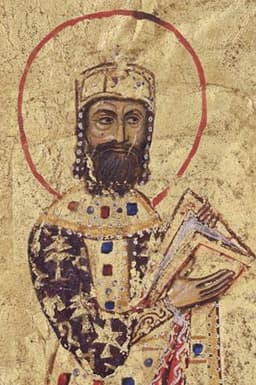
Alexios I Komnenos
Emperor · Medieval
78.4Total
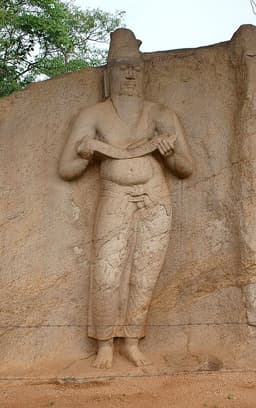
Parakramabahu I
Emperor · Medieval
66.1Total
Basic Information
Born
1048
1123
Died
1118
1186
Era
Medieval
Medieval
Nationality
Byzantine Empire
Sri Lanka
Occupation
Emperor
Emperor
Civilization
Western
Indian
Score Comparison
Military (10%)
61.7
82.0
Political (20%)
78.0
72.0
Influence (20%)
88.0
61.0
Legacy (20%)
80.0
52.0
Leadership (15%)
78.0
82.0
Strategy (15%)
68.0
65.4
TOTAL
78.4
66.1
Alexios I Komnenos — Complete Timeline
1081 AD
Battle of DyrrhachiumWar◆ Major
Alexios I Komnenos was defeated by the Norman army under Robert Guiscard at Dyrrhachium. The Byzantine forces were routed, and Alexios barely escaped. This loss allowed the Normans to occupy much of the western Balkans, though Alexios later recovered some territory.
Norman InvasionDefeatBalkans
Impact: regionaltragic
1090 AD
Reforms of the Byzantine Military and EconomyReform◆ Major
Alexios I implemented a series of reforms to restore Byzantine power. He reorganized the army by relying more on foreign mercenaries, reformed the currency (the hyperpyron), and granted tax exemptions to the Church. These measures stabilized the empire after decades of decline.
Military ReformEconomic ReformKomnenian Restoration
Impact: nationalconstructive
1095 AD
Appeal to the West: Council of PiacenzaPolitical Action
Alexios I sent envoys to Pope Urban II at the Council of Piacenza, requesting military aid against the Seljuk Turks. This appeal contributed to Urban's call for the First Crusade at the Council of Clermont later that year, initiating the Crusader movement.
First CrusadePope Urban IISeljuk Turks
Impact: global
1097 AD
First Crusade: Siege of NicaeaWar◆ Major
Alexios I cooperated with the Crusader army to besiege and capture Nicaea from the Seljuk Turks. The city was surrendered to Byzantine control, and Alexios used the Crusaders to recover key territories in Anatolia, though tensions later arose over land claims.
First CrusadeNicaeaByzantine-Crusader Relations
Impact: regionalconstructive
Parakramabahu I — Complete Timeline
1153 AD
Unification of Sri LankaWar
Parakramabahu I unified the entire island of Sri Lanka under his rule after a series of military campaigns. He defeated the rulers of Ruhuna and other regional kingdoms, ending a period of fragmentation.
Impact: national
1160 AD
Construction of Parakrama SamudraOther◆ Major
Parakramabahu I constructed the Parakrama Samudra, a massive man-made sea of interconnected tanks and canals near Polonnaruwa. This irrigation system, covering over 5,000 acres, was a major engineering achievement.
Impact: regionalconstructive
1165 AD
Invasion of BurmaWar◆ Major
Parakramabahu I launched a naval invasion of Burma (Pagan Kingdom) in retaliation for a trade dispute. The Sinhalese fleet captured the port of Kusumiya and sacked the city, demonstrating Sri Lanka's naval power.
Impact: regional
Reform of the Buddhist SanghaReform◆ Major
Parakramabahu I convened a council to purify the Buddhist Sangha. He expelled corrupt monks and re-established discipline, strengthening Theravada Buddhism in Sri Lanka.
Impact: nationalconstructive
1170 AD
Construction of Polonnaruwa VatadageCultural◆ Major
Parakramabahu I built the Polonnaruwa Vatadage, a circular relic house for the Tooth Relic of the Buddha. This structure is considered a masterpiece of Sinhalese architecture.
Impact: nationalconstructive
Expert Analysis
Alexios I Komnenos vs Parakramabahu I
# The Emperor and the King: Two Paths to Power in a Medieval World
On a dusty battlefield in modern-day Albania, in October 1081, a Byzantine emperor watched his elite Varangian Guard—Norse mercenaries wielding their legendary Danish axes—charge headlong into the Norman lines. Within hours, they would be annihilated, their severed heads adorning Norman pikes. Alexios I Komnenos, just months into his reign, had suffered a catastrophic defeat at Dyrrhachium. Half a world away and seventy years later, a Sinhalese prince named Parakramabahu was consolidating his power in the fertile plains of Sri Lanka, dreaming not of foreign mercenaries but of vast irrigation reservoirs and the purification of Buddhist monks. Two rulers, two civilizations, two utterly different definitions of what it meant to lead a medieval kingdom.
Origins
Alexios I Komnenos was born into the Byzantine military aristocracy in 1048, a world of court intrigue, crumbling frontiers, and the bitter memory of Manzikert. The empire he inherited was a wounded giant—Anatolia lost to the Seljuk Turks, the treasury empty, the army a shadow of its former self. His family had been exiled, recalled, and thrust into a desperate coup that placed him on the throne at age thirty-three. He was a product of crisis, shaped by the constant need to improvise, negotiate, and survive.
Parakramabahu I, born in 1123, came from a different world entirely. Sri Lanka was divided among warring Sinhalese principalities, but the island had not suffered the existential collapse that Byzantium had. His father, King Manabharana, ruled a small kingdom, and young Parakramabahu grew up watching the intricate politics of irrigation management—how water rights meant power, how canals were weapons, how a king’s legitimacy flowed from his ability to feed his people. He learned that conquest was not just about battles but about systems.
Rise to Power
Alexios seized the throne through a military coup against the incompetent Nikephoros III, but his path was never smooth. The Norman invasion under Robert Guiscard nearly destroyed him; the defeat at Dyrrhachium was so severe that contemporaries wrote his epitaph. Yet Alexios survived through sheer political cunning. He bribed the Holy Roman Emperor Henry IV to attack the Normans from behind. He married his daughter Anna to a rival claimant to neutralize him. He learned that in Byzantium, survival meant playing a long game of chess where every piece could betray you.
Parakramabahu’s rise was more methodical. He spent his youth in the court of his uncle, King Gajabahu II, feigning loyalty while secretly building alliances. When he finally rebelled in 1153, it was not a desperate coup but a calculated campaign to unify the island. He defeated his rivals one by one—first his uncle, then the rebellious southern chiefs—and by 1153, he was undisputed master of Sri Lanka. Where Alexios fought for survival, Parakramabahu fought for completion.
Leadership & Governance
Alexios I was a pragmatist who understood that the Byzantine Empire could no longer rely on its own strength. His military reforms—recorded in 1090—shifted the army toward foreign mercenaries, including the Varangians and the emerging Norman knights. He debased the currency to pay for them, angering the Orthodox Church and the peasantry. His greatest political masterstroke was the appeal to Pope Urban II at the Council of Piacenza in 1095, a desperate request for Western knights to fight the Turks. This single act unleashed the First Crusade, a force he could never fully control. At the Siege of Nicaea in 1097, he cooperated with the Crusaders to retake the city, but the relationship was fraught with mutual suspicion. Alexios wanted allies; the Crusaders wanted conquest.
Parakramabahu I governed very differently. His reforms focused inward: he purified the Buddhist Sangha in 1165, expelling corrupt monks and reestablishing discipline, because he believed spiritual corruption led to political decay. His greatest achievement was the Parakrama Samudra, a massive man-made sea completed around 1160—a network of reservoirs and canals that irrigated thousands of acres, turning the dry zone of Polonnaruwa into a breadbasket. This was state-building as hydraulic engineering. When he launched his naval invasion of Burma in 1165, it was not for survival but for revenge over a trade dispute—a projection of power, not a necessity.
Triumph & Tragedy
Alexios’s greatest triumph was surviving. He died in 1118, having restored the empire’s borders, founded the Komnenian dynasty, and set the stage for a century of recovery. But his tragedy was the Crusades themselves. The armies he summoned became a monster: they sacked Constantinople in 1204, a disaster he could not have foreseen but which his appeal had set in motion.
Parakramabahu’s triumph was the unification of Sri Lanka and the creation of a self-sustaining civilization. His tragedy was that it did not last. After his death in 1186, the kingdom fragmented, and the irrigation systems fell into disrepair. The Parakrama Samudra still stands, but the political unity he forged dissolved within a generation.
Character & Destiny
Alexios was a survivor, not a visionary. He lied to the Crusaders, broke promises, and manipulated everyone around him. But he kept his empire alive. His daughter Anna described him as a man who wept easily, who prayed constantly, who trusted no one. Parakramabahu was a builder, a man who believed that a king’s duty was to leave the land better than he found it. He was ruthless—he executed rivals without hesitation—but his cruelty served a vision of order, not mere survival.
Legacy
Alexios I is remembered as the founder of the Komnenian restoration, the man who opened the door to the Crusades. His legacy is ambiguous: he saved Byzantium, but the forces he unleashed eventually destroyed it. Parakramabahu I is remembered as a national hero in Sri Lanka, the king who built the sea of Parakrama, whose name is etched into the landscape itself. His legacy is concrete—you can still walk along his canals, still see the Vatadage he built for the Tooth Relic.
Conclusion
One emperor fought to hold a dying empire together; one king built a civilization from the ground up. Alexios lived by his wits, Parakramabahu by his works. Both succeeded in their own terms, and both saw their achievements crumble after their deaths. Perhaps the deepest difference is this: Alexios’s story is one of survival against impossible odds, while Parakramabahu’s is one of creation. But in the end, both remind us that medieval power was fragile—whether held by a Byzantine emperor or a Sinhalese king, it was always a matter of time.
Rankings
🥇
Alexios I KomnenosLeader
Mil: 61.7Pol: 78.0Inf: 88.0
78.4
🥈
Parakramabahu I
Mil: 82.0Pol: 72.0Inf: 61.0
66.1
+12.3 behind
How This Comparison Works
Algorithm
Each figure is scored on 6 dimensions (0—100 scale) based on structured historical data: Military (10%), Political (20%), Influence (20%), Legacy (20%), Leadership (15%), Strategy (15%). The weighted total produces the final ranking.
Data Sources
Scores are computed from structured sub-indicators in the database. Scale factors adjust for era (Ancient ×0.85, Modern ×1.0) and civilization size (Eastern ×1.05, Other ×0.80) to account for differences in population and military scale.
Maximum 3 Figures
Comparisons are limited to 2—3 figures to ensure readability and statistical meaningfulness.
Error Margins
±5 points per dimension — Sub-scores are derived from historical records with inherent uncertainty. Two figures within 5 points on a dimension should be considered roughly equivalent in that area.
Total Score Accuracy
±3 points overall — The weighted combination of 6 dimensions produces a total score with approximately ±3 points of uncertainty. Differences of less than 3 points are not statistically significant— the figures are effectively tied.
Known Limitations
- Historical records are incomplete and uneven across civilizations
- Figures from oral-tradition societies may be underrepresented
- Occupation labels can misclassify multi-role figures
- Scores measure capability and impact, not moral character
- Quantitative scoring is a comparison tool, not absolute truth
Capability Radar
Military (10%) — Battles & Warfare
Battles
75
75
Win Rate
70
80
Expansion
60
70
Political (20%) — Governance & Reform
Reform
85
80
Diplomacy
90
70
Economy
70
75
Influence (20%) — Cultural & Global Reach
Cultural
70
65
Global
75
40
Legacy (20%) — Historical Impact
Historical
85
70
Longevity
80
60
Leadership (15%) — Power & Stability
Tenure
80
85
Stability
75
80
Strategy (15%) — Tactics & Innovation
Strategy
85
75
Tactics
80
70
Reform
75
65
Similar Comparisons
Comments & Discussion
DyrrhachiumDreamer6/16/2026
Alexios bungled his opening act so badly that his own axe-wielding bodyguards got mulched. That’s not a leader; that’s a disaster tourist. Meanwhile Parakramabahu was busy engineering irrigation systems and monastic reforms—tangible, lasting civilization-building. Alexios spent decades scrambling to patch a collapsing empire with mercenaries and diplomatic flops. Parakramabahu unified a fractured island and left monuments of stone and water. Who actually ruled like a king, and who just survived
水渠之王6/16/2026
打仗靠北欧雇佣兵送人头,搞外交靠背叛十字军,这叫中兴?帕拉克拉马巴胡挖运河、修水库、统一僧团,每项工程都是百年根基。阿莱克修斯在迪拉基乌姆丢了脸,在安条克丢了信誉,最后把帝国缝补成个纸糊灯笼。而斯里兰卡的水利系统至今还在用。一个靠小手段苟延残喘,一个靠大格局再造山河,高下立判。
DemographicPragmatist6/16/2026
Numbers don’t lie: Alexios inherited maybe 100,000 square kilometers of bleeding frontier; Parakramabahu started with a fractured island half that size. Yet Alexios’s tax base hemorrhaged, his army shrank, and he bribed the First Crusade into being a problem. Parakramabahu tripled irrigated land, boosted population density, and left no succession crisis. Alexios traded short-term survival for long-term decay. Parakramabahu traded ambition for sustainability. If leadership is about resource manag
田野数据官6/16/2026
别吹什么“复兴罗马”,阿莱克修斯的金库靠贬值货币和卖官鬻爵撑了三十多年,最后连小亚细亚的内陆都没拿回来。帕拉克拉马巴胡呢?他把斯里兰卡的水稻产量翻了倍,修建了十几座大型水库,人口增长数据比同时期欧洲任何国家都好看。政策不是靠吹牛,是看结果。一个让国家流血,一个让土地生粮。数据摆在这,选谁还用说?