Loading...
Alexis I of Russia vs Napoleon Bonaparte
Napoleon Bonaparte leads by 11.4 pts · 2 figures compared
…
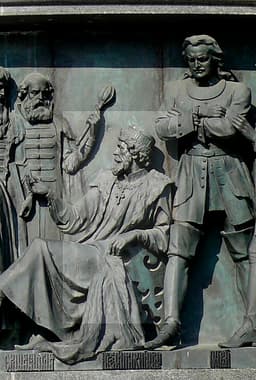
Alexis I of Russia
Emperor · Modern
59.5Total

Napoleon Bonaparte
General · Modern
70.9Total
Basic Information
Born
1629
1769
Died
1676
1821
Era
Modern
Modern
Nationality
Russia
France
Occupation
Emperor
General
Civilization
Western
Western
Score Comparison
Military (10%)
55.0
94.0
Political (20%)
60.0
72.0
Influence (20%)
55.0
40.0
Legacy (20%)
58.0
80.0
Leadership (15%)
72.0
78.0
Strategy (15%)
60.0
90.0
TOTAL
59.5
70.9
Alexis I of Russia — Complete Timeline
1649 AD
Enacted the 1649 Sobornoye Ulozheniye (Code of Laws)Reform◆ Major
Alexis I enacted the Sobornoye Ulozheniye, a comprehensive legal code that consolidated Russian law and strengthened serfdom by making peasants permanently bound to the land. The code also centralized state authority and defined the rights of nobles, clergy, and townspeople.
Legal CodeSerfdomCentralization
Impact: national
1654 AD
Led the 1654-1667 Russo-Polish WarWar◆ Major
Alexis I launched a war against the Polish-Lithuanian Commonwealth, initially capturing Smolensk and much of eastern Poland. The war, which included the Khmelnytsky Uprising and Swedish intervention, ended with the Truce of Andrusovo, gaining Russia left-bank Ukraine and Kiev.
WarPolandUkraine
Impact: regional
1662 AD
Suppressed the 1662 Copper RiotPolitical Action◆ Major
Alexis I's government brutally suppressed the Copper Riot in Moscow, a protest against the devaluation of copper coins and economic hardship. Thousands of rioters were killed or executed, and the rebellion led to the withdrawal of copper currency, restoring silver coinage.
RiotCopperEconomic
Impact: nationaldestructive
1666 AD
Supported the 1666-1667 Church Council that condemned the Old BelieversCultural◆ Major
Alexis I supported the Great Moscow Synod, which condemned the Old Believers and their leader Avvakum for opposing Patriarch Nikon's liturgical reforms. The council excommunicated the dissenters, leading to a schism (Raskol) in the Russian Orthodox Church that persisted for centuries.
ChurchSchismOld Believers
Impact: nationaldestructive
Napoleon Bonaparte — Complete Timeline
1799 AD
Coup of 18 BrumaireOther◆ Major
Napoleon Bonaparte, with support from his brother Lucien and key political figures, overthrew the Directory in a bloodless coup. He established the Consulate with himself as First Consul, effectively becoming the ruler of France. This event ended the French Revolution's most unstable period.
French RevolutionCoupRise to Power
Impact: regional
1804 AD
Promulgation of the Napoleonic CodeOther◆ Major
Napoleon enacted the Civil Code of the French, known as the Napoleonic Code, a comprehensive set of laws that replaced the fragmented feudal legal systems. The code established legal equality, protected property rights, and secularized law. It became the basis for legal systems in many European and world countries.
Legal ReformNapoleonic CodeCivil Law
Impact: globalconstructive
1805 AD
Battle of AusterlitzWar◆ Major
Napoleon's Grande Arm
Napoleonic WarsBattleDecisive Victory
Impact: global
1812 AD
Invasion of RussiaWar◆ Major
Napoleon led the Grande Arm
Napoleonic WarsInvasionDisaster
Impact: globaldestructive
1815 AD
Battle of WaterlooWar◆ Major
Napoleon's French army was defeated by the combined forces of the Duke of Wellington's Anglo-Allied army and Gebhard Leberecht von Bl
Napoleonic WarsBattleFinal Defeat
Impact: globaldestructive
Expert Analysis
alexis-i-of-russia-vs-napoleon-bonaparte
### The Conqueror and the Codifier
On a frozen December morning in 1676, Tsar Alexis I of Russia died in Moscow, his reign ending not with a bang but with the quiet rustle of parchment—the legal code he had enacted a quarter-century earlier. Across Europe, 145 years later, on a windswept island in the South Atlantic, Napoleon Bonaparte drew his last breath, his final years spent pacing a rocky shore, haunted by the ghost of an empire that had once stretched from Madrid to Warsaw. One man built a nation from within, the other remade a continent from without. Why did one die in bed, his dynasty secure, while the other perished in exile, his legacy written in cannon fire and code? The answer lies not merely in their deeds, but in the worlds that shaped them.
### Origins
Alexis I was born in 1629 into the fragile stability of early Romanov Russia. His father, Michael, had been elected tsar after the Time of Troubles, a period of anarchy and foreign invasion that had nearly erased Muscovy from the map. Young Alexis grew up in a world of wooden palaces, bearded boyars, and the solemn chants of Orthodox liturgy. He was taught that the tsar was God’s viceroy on earth, his authority absolute but his duty sacred. The Russia of his youth was a land turned inward, suspicious of the West, bound by tradition and faith.
Napoleon Bonaparte, born in 1769 on the island of Corsica, arrived in a world already in flux. His family were minor nobility, but his homeland had just been annexed by France. He spoke Italian before French, and his early letters seethe with resentment toward the French “occupiers.” Yet the French Revolution, which erupted when he was twenty, would become his ladder. It tore down the old order of kings and nobles, replacing it with a meritocracy where a gifted artillery officer could rise to command armies. Alexis inherited a throne; Napoleon seized one.
### Rise to Power
Alexis became tsar at sixteen, in 1645, after his father’s death. He did not conquer his throne; he simply sat upon it. His early reign was dominated by his tutor, the boyar Boris Morozov, who managed the state while the young tsar indulged in his passion for falconry. But Alexis was no puppet. In 1648, when a salt tax sparked riots in Moscow, he personally intervened, sacrificing Morozov to the mob’s fury while secretly spiriting him to safety. This was the first sign of a ruler who understood that power often requires a theatrical sacrifice.
Napoleon’s rise was a study in speed and audacity. In 1793, at age twenty-four, he commanded the artillery that drove the British from Toulon. By 1796, he was leading the Army of Italy, a ragtag force he transformed into a conquering machine. His victories in Italy—Lodi, Arcola, Rivoli—were not just military triumphs; they were political masterstrokes. He sent captured treasures back to Paris, wrote his own dispatches to shape public opinion, and negotiated treaties that made him a celebrity. When he returned to France in 1799, he overthrew the Directory in a coup and named himself First Consul. Alexis had inherited a crown; Napoleon forged one from the wreckage of a revolution.
### Leadership & Governance
The two rulers governed in radically different ways. Alexis’s greatest achievement was the Sobornoye Ulozheniye of 1649, a comprehensive legal code that consolidated centuries of scattered decrees. It defined crimes, established procedures, and—most fatefully—completed the legal enserfment of the Russian peasantry, binding them to the land and their lords. Alexis did not create serfdom, but he codified it, making it the iron backbone of Russian society for two centuries. He also waged the 1654–1667 Russo-Polish War, capturing Smolensk and much of eastern Poland. Yet his military strategy was cautious, his campaigns slow and methodical. He was a consolidator, not a conqueror.
Napoleon was a force of nature. His Napoleonic Code, enacted in 1804, was a legal revolution: it abolished feudal privileges, guaranteed religious freedom, and established merit-based advancement. It spread across Europe wherever his armies marched. His military genius—scored at 94 for strategy—was unmatched. He reorganized armies into corps, used speed to divide enemies, and won battles like Austerlitz in 1805, where he destroyed a Russo-Austrian army with breathtaking precision. But his governance was inseparable from his ambition. He crowned himself emperor in 1804, placed his brothers on thrones, and treated Europe as a chessboard. Alexis built a legal cage for Russia; Napoleon built an empire of smoke and steel.
### Triumph & Tragedy
Alexis’s greatest moment was perhaps the quietest: the enactment of the 1649 Code, which gave Russia a legal framework that endured until the 19th century. His tragedy was the Copper Riot of 1662, when his government’s clumsy devaluation of currency sparked a rebellion. He suppressed it brutally, but the fissures it revealed—between state and people, between reform and tradition—would haunt Russia for generations. He also supported the 1666–1667 Church Council that condemned the Old Believers, religious conservatives who rejected liturgical reforms. Thousands were burned at the stake or fled to Siberia. Alexis unified his realm through blood.
Napoleon’s triumph was Austerlitz, the “Battle of the Three Emperors,” where he crushed the combined might of Austria and Russia. His tragedy was the invasion of Russia in 1812. He marched with the largest army Europe had ever seen—over 600,000 men—into a vast, empty land. The Russians burned their own territory, refused battle, and let the winter do their work. Napoleon reached Moscow, but found it abandoned and aflame. His retreat was a nightmare of frost, starvation, and Cossack attacks. Only 30,000 soldiers limped back to France. It was not a single battle that broke him, but a continent’s geography and stubbornness.
### Character & Destiny
Alexis was a man of deep piety and cautious ambition. He was known as “the Quietest” for his gentle demeanor, but his letters reveal a sharp, sometimes cruel, intelligence. He could weep at a church service and order a rebel’s tongue cut out on the same day. His character reflected his Russia: Orthodox, autocratic, and suspicious of change. He did not seek to conquer the world; he sought to preserve what he had. Destiny, for him, was a slow river.
Napoleon was restless, brilliant, and insatiable. “I am not a man,” he once said, “I am a thing.” He saw the world as a problem to be solved by will and force. His character drove him to overreach: he could not stop. After defeating Prussia in 1806, he imposed a Continental System to blockade Britain, a fantasy that bled his empire dry. He divorced Josephine to marry an Austrian princess for an heir, a political move that alienated his old supporters. His destiny was a parabola: a steep rise, a blinding peak, a long fall.
### Legacy
Alexis’s legacy is quiet but profound. He fathered Peter the Great, who would drag Russia into the modern world, but Alexis laid the groundwork. His legal code defined Russian society until the emancipation of the serfs in 1861. He is remembered not as a conqueror, but as a builder—a tsar who gave his realm structure, however harsh.
Napoleon’s legacy is a thunderclap that still echoes. He reshaped Europe’s borders, spread nationalism, and inspired legal systems from Louisiana to Lebanon. His military campaigns are studied in every war college. But he also left a trail of ruin: millions dead, nations humiliated, and a legend of ambition that would tempt dictators for centuries.
### Conclusion
Standing at the edge of their eras, Alexis and Napoleon embody two faces of power. One built a fortress from within, using law and faith to bind a sprawling land; the other built a cathedral of conquest, using steel and glory to remake a continent. Alexis’s Russia survived him, growing slowly into an empire. Napoleon’s empire vanished with his exile, but his ideas remained, restless and uncontainable. Perhaps the deepest difference is this: Alexis governed a world he believed was eternal; Napoleon tried to create a world that was new. One preserved; the other transformed. And history, in its endless judgment, remembers the transformer with awe and the preserver with reverence—but it lives in the structures of both.
Rankings
🥇
Napoleon BonaparteLeader
Mil: 94.0Pol: 72.0Inf: 40.0
70.9
🥈
Alexis I of Russia
Mil: 55.0Pol: 60.0Inf: 55.0
59.5
+11.4 behind
How This Comparison Works
Algorithm
Each figure is scored on 6 dimensions (0—100 scale) based on structured historical data: Military (10%), Political (20%), Influence (20%), Legacy (20%), Leadership (15%), Strategy (15%). The weighted total produces the final ranking.
Data Sources
Scores are computed from structured sub-indicators in the database. Scale factors adjust for era (Ancient ×0.85, Modern ×1.0) and civilization size (Eastern ×1.05, Other ×0.80) to account for differences in population and military scale.
Maximum 3 Figures
Comparisons are limited to 2—3 figures to ensure readability and statistical meaningfulness.
Error Margins
±5 points per dimension — Sub-scores are derived from historical records with inherent uncertainty. Two figures within 5 points on a dimension should be considered roughly equivalent in that area.
Total Score Accuracy
±3 points overall — The weighted combination of 6 dimensions produces a total score with approximately ±3 points of uncertainty. Differences of less than 3 points are not statistically significant— the figures are effectively tied.
Known Limitations
- Historical records are incomplete and uneven across civilizations
- Figures from oral-tradition societies may be underrepresented
- Occupation labels can misclassify multi-role figures
- Scores measure capability and impact, not moral character
- Quantitative scoring is a comparison tool, not absolute truth
Capability Radar
Military (10%) — Battles & Warfare
Battles
45
95
Win Rate
50
90
Expansion
50
95
Political (20%) — Governance & Reform
Reform
65
95
Diplomacy
60
80
Economy
55
85
Influence (20%) — Cultural & Global Reach
Cultural
55
85
Global
50
90
Legacy (20%) — Historical Impact
Historical
65
95
Longevity
60
90
Leadership (15%) — Power & Stability
Tenure
70
85
Stability
50
70
Strategy (15%) — Tactics & Innovation
Strategy
55
95
Tactics
40
98
Reform
60
92
Similar Comparisons
Comments & Discussion
数据苦手6/17/2026
别吹拿破仑的“法典拯救欧洲”了。他推行法典的同时征收400%战争税,法国人口从2800万降到2600万。阿列克谢的《会议法典》稳定了动荡的俄罗斯,1649年后人口翻倍。数字会说话:拿破仑是死神的会计,阿列克谢是生者的书记官。
Glory's Fool6/17/2026
One died surrounded by icons and incense, his dynasty ruling another 200 years. The other died on a barren rock, his son an Austrian puppet. Alexis understood that power is the slow weaving of tradition; Napoleon thought it could be conquered in a single battle. History's verdict is brutal: stability beats spectacle every time.
经典学究6/17/2026
比较这两人就像比较锁与钥匙。阿列克谢是拜占庭式的“神圣沙皇”,用法典固化社会,像修理一艘老船。拿破仑是古罗马式的“执政官将军”,用剑与法重塑欧陆。阿列克谢的遗产是斯塔夫罗波尔大教堂,安静的赞美诗;拿破仑的是凯旋门,无声的战鼓。两种永恒,你选哪个?
Historian2016/17/2026
Alexis was the ultimate domestic consolidator—his 1649 *Ulozhenie* created a legal framework for serfdom that locked Russia into feudal stagnation for 200 years. Napoleon at least smashed the old order across Europe with the Civil Code, spreading meritocracy and property rights. Alexis built a prison; Napoleon built a school, even if he dressed it up in imperial robes.
Chronicler14656/17/2026
Don't forget the blowback. Alexis's crackdown on Old Believers splintered the Orthodox Church for centuries—that split fueled the riots that nearly toppled his son Peter. Napoleon's Continental System provoked Britain into blockading Europe and devastated the French economy. Both were hubristic fools who thought they could control history's chaos. The only difference: Alexis died of gout, Napoleon of cancer. Dictators always self-destruct.