Loading...
Alfonso VI of Leon vs Gangjong of Goryeo
Alfonso VI of Leon leads by 24.4 pts · 2 figures compared
…
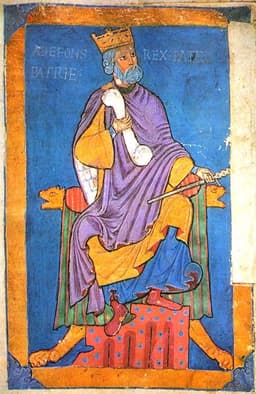
Alfonso VI of Leon
Emperor · Medieval
60.2Total

Gangjong of Goryeo
Emperor · Medieval
35.8Total
Basic Information
Born
1040
1152
Died
1109
1213
Era
Medieval
Medieval
Nationality
Leon
Korea
Occupation
Emperor
Emperor
Civilization
Western
Eastern
Score Comparison
Military (10%)
65.0
10.2
Political (20%)
45.0
29.3
Influence (20%)
62.0
47.9
Legacy (20%)
56.0
37.5
Leadership (15%)
72.0
33.6
Strategy (15%)
66.3
39.6
TOTAL
60.2
35.8
Alfonso VI of Leon — Complete Timeline
1077 AD
Title of 'Emperor of Spain'Political Action◆ Major
Alfonso VI claimed the title 'Imperator totius Hispaniae' (Emperor of all Spain) in 1077, asserting his supremacy over other Christian rulers. This title was used in diplomatic correspondence and reflected his ambition to unify Iberia.
Medieval IberiaImperial TitleHegemony
Impact: regional
1085 AD
Capture of ToledoWar◆ Major
Alfonso VI captured the city of Toledo from the Taifa of Toledo in May 1085. This was a major victory in the Reconquista, as Toledo was a historic capital of the Visigothic kingdom and a cultural center of Islamic Iberia.
ReconquistaToledoConquest
Impact: regionalconstructive
1086 AD
Battle of SagrajasWar◆ Major
Alfonso VI was defeated by the Almoravid army under Yusuf ibn Tashfin at the Battle of Sagrajas (Zallaqa). This defeat halted Christian expansion and forced Alfonso to seek help from other Christian kingdoms, marking a turning point in the Reconquista.
ReconquistaBattleAlmoravid
Impact: regionaltragic
1091 AD
Marriage to ZaidaPolitical Action
Alfonso VI married Zaida, a Muslim princess from Seville, who converted to Christianity and took the name Isabel. This marriage was a political alliance to secure peace with the Taifa of Seville and strengthen his position against the Almoravids.
Medieval IberiaMarriage AllianceDiplomacy
Impact: regional
Gangjong of Goryeo — Complete Timeline
1211 AD
Accession during Mongol threatPolitical Action◆ Major
Gangjong became king after his brother Huijong was deposed by Choe Chung-heon. His reign coincided with the first Mongol invasions of Goryeo, though he had no authority to direct military policy.
AccessionMongol ThreatGoryeo
Impact: national
Reign under Choe military rulePolitical Action
Like his predecessors, Gangjong was a puppet king under the Choe military dictatorship. All major decisions, including responses to the Mongol threat, were made by Choe Chung-heon and his private army.
Puppet KingMilitary RuleGoryeo
Impact: national
1213 AD
Death during Mongol invasionWar
Gangjong died in 1213, just as Mongol forces under Genghis Khan began their first major campaign against Goryeo. His brief reign of two years saw no significant policy changes, and the Choe regime continued to dominate.
DeathMongol InvasionGoryeo
Impact: nationaltragic
Expert Analysis
Origins
Alfonso VI of León was born in 1040, son of King Ferdinand I of León and Castile and Sancha of León. He inherited the throne of León in 1065 after his father divided the kingdom among his sons. His early life was marked by conflict with his brothers, Sancho II of Castile and García of Galicia, whom he eventually overcame. He was educated in the traditions of Christian Iberia and learned the art of warfare from a young age.
Gangjong of Goryeo was born in 1152, the son of King Myeongjong and Queen Uijeong. His early life was overshadowed by the dominance of the Choe military regime, which had seized power in 1170. He became king only after his brother Huijong was deposed by Choe Chung-heon in 1211. His education was limited to Confucian classics, but he had no real authority.
Rise to Power
Alfonso VI rose to power after defeating his brother Sancho II at the Battle of Golpejera in 1072, reuniting León and Castile. He then expanded his influence by demanding parias (tribute) from the Taifa kingdoms of al-Andalus. In 1077, he proclaimed himself 'Imperator totius Hispaniae' (Emperor of all Spain), asserting supremacy over other Christian rulers. His greatest triumph came in 1085 when he captured Toledo, a historic capital of the Visigoths, after a long siege.
Gangjong's rise was not of his own making. He was placed on the throne in 1211 by Choe Chung-heon, the military dictator, after his brother Huijong failed to obey the Choe family. He was a figurehead with no real power. His reign began just as the Mongol Empire under Genghis Khan was beginning its expansion into Northeast Asia. He scored 29.3 in political skill, reflecting his inability to influence events.
Leadership & Governance
Alfonso VI ruled with a combination of military force and diplomacy. He repopulated conquered territories with Christians from the north, granting fueros (charters) to towns like Toledo, which became a center of cultural exchange. He also married Zaida, a Muslim princess from Seville, to forge alliances. However, his governance was challenged by the Almoravid invasion after 1086. His leadership score of 72.0 reflects his ability to command loyalty, but his political score of 45.0 shows the limits of his statecraft.
Gangjong had no governance role. All decisions were made by Choe Chung-heon and his son Choe U. The military regime controlled the army, tax collection, and foreign policy. Gangjong's only recorded act was to send envoys to the Mongols, but he died in 1213 before any response. His leadership score of 33.6 indicates his powerlessness.
Triumph & Tragedy
Alfonso VI's greatest success was the capture of Toledo in 1085, which gave the Christians a strategic foothold in central Iberia and a symbol of reconquest. However, his defeat at the Battle of Sagrajas in 1086 by the Almoravids was a major setback. He lost many knights and saw the Taifa kingdoms replaced by a more formidable enemy. His claim to be 'Emperor of Spain' was never fully realized.
Gangjong's reign had no triumphs. His only notable event was his death in 1213, which occurred just as the Mongols attacked. His failure to resist the Choe regime or prepare for the Mongol threat led to decades of devastation for Goryeo. His military score of 10.2 reflects his complete lack of martial achievement.
Character & Destiny
Alfonso VI was ambitious and pragmatic, willing to use marriage and diplomacy to achieve his goals. He was also stubborn, refusing to compromise with the Almoravids, which led to his defeat. Historians note his role in the 'Reconquista' as a pivotal figure who shifted the balance of power. His character combined Christian zeal with political realism.
Gangjong was a passive ruler, unable to assert himself against the Choe dictatorship. He accepted his role as a puppet, which sealed his fate. His reign was too short to leave a personal mark. He is often forgotten in Korean history, overshadowed by the military rulers and later kings who fought the Mongols.
Legacy
Alfonso VI's legacy is immense. Toledo became a center of translation and cultural exchange, known as the 'School of Toledo,' where Christian, Muslim, and Jewish scholars worked together. His title of 'Emperor of Spain' influenced later Spanish monarchs. He scored 62.0 in influence and 56.0 in legacy, reflecting his lasting impact on Iberian history.
Gangjong's legacy is minimal. He is remembered only as a placeholder king during the Choe regime. The Mongol invasions that followed his death led to the destruction of Goryeo's capital and decades of subjugation. His influence score of 47.9 is generous, as his reign had no positive outcomes.
Conclusion
Alfonso VI of León had a far greater impact on history than Gangjong of Goryeo. His capture of Toledo and his claim to imperial authority shaped the Reconquista and the future of Spain. Gangjong, by contrast, was a powerless figurehead whose reign was a footnote in the Mongol invasions. The score gap of 24.4 points reflects this disparity. Alfonso VI's total score of 60.2 vs. Gangjong's 35.8 is a clear measure of their relative significance. While Alfonso VI had his failures, he actively shaped events; Gangjong was shaped by them. The evidence supports the conclusion that Alfonso VI was the more consequential ruler.
Rankings
🥇
Alfonso VI of LeonLeader
Mil: 65.0Pol: 45.0Inf: 62.0
60.2
🥈
Gangjong of Goryeo
Mil: 10.2Pol: 29.3Inf: 47.9
35.8
+24.4 behind
How This Comparison Works
Algorithm
Each figure is scored on 6 dimensions (0—100 scale) based on structured historical data: Military (10%), Political (20%), Influence (20%), Legacy (20%), Leadership (15%), Strategy (15%). The weighted total produces the final ranking.
Data Sources
Scores are computed from structured sub-indicators in the database. Scale factors adjust for era (Ancient ×0.85, Modern ×1.0) and civilization size (Eastern ×1.05, Other ×0.80) to account for differences in population and military scale.
Maximum 3 Figures
Comparisons are limited to 2—3 figures to ensure readability and statistical meaningfulness.
Error Margins
±5 points per dimension — Sub-scores are derived from historical records with inherent uncertainty. Two figures within 5 points on a dimension should be considered roughly equivalent in that area.
Total Score Accuracy
±3 points overall — The weighted combination of 6 dimensions produces a total score with approximately ±3 points of uncertainty. Differences of less than 3 points are not statistically significant— the figures are effectively tied.
Known Limitations
- Historical records are incomplete and uneven across civilizations
- Figures from oral-tradition societies may be underrepresented
- Occupation labels can misclassify multi-role figures
- Scores measure capability and impact, not moral character
- Quantitative scoring is a comparison tool, not absolute truth
Capability Radar
Military (10%) — Battles & Warfare
Battles
65
10
Win Rate
60
10
Expansion
70
5
Political (20%) — Governance & Reform
Reform
65
10
Diplomacy
70
20
Economy
60
10
Influence (20%) — Cultural & Global Reach
Cultural
60
10
Global
50
5
Legacy (20%) — Historical Impact
Historical
65
15
Longevity
55
10
Leadership (15%) — Power & Stability
Tenure
75
15
Stability
55
15
Strategy (15%) — Tactics & Innovation
Strategy
70
10
Tactics
55
10
Reform
50
5
Similar Comparisons
Comments & Discussion
No comments yet. Be the first to share your thoughts!