Loading...
Alfonso VI of Leon vs Emperor Gaozong of Tang
Emperor Gaozong of Tang leads by 0.2 pts · 2 figures compared
…
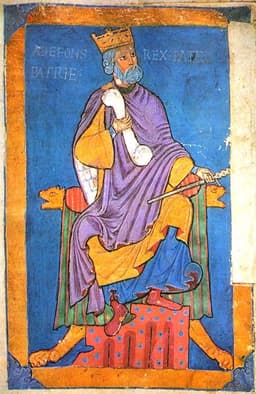
Alfonso VI of Leon
Emperor · Medieval
60.2Total
Emperor Gaozong of Tang
Emperor · Medieval
60.4Total
Basic Information
Born
1040
628
Died
1109
683
Era
Medieval
Medieval
Nationality
Leon
China
Occupation
Emperor
Emperor
Civilization
Western
Eastern
Score Comparison
Military (10%)
65.0
72.5
Political (20%)
45.0
62.7
Influence (20%)
62.0
61.0
Legacy (20%)
56.0
50.0
Leadership (15%)
72.0
68.0
Strategy (15%)
66.3
57.5
TOTAL
60.2
60.4
Alfonso VI of Leon — Complete Timeline
1077 AD
Title of 'Emperor of Spain'Political Action◆ Major
Alfonso VI claimed the title 'Imperator totius Hispaniae' (Emperor of all Spain) in 1077, asserting his supremacy over other Christian rulers. This title was used in diplomatic correspondence and reflected his ambition to unify Iberia.
Medieval IberiaImperial TitleHegemony
Impact: regional
1085 AD
Capture of ToledoWar◆ Major
Alfonso VI captured the city of Toledo from the Taifa of Toledo in May 1085. This was a major victory in the Reconquista, as Toledo was a historic capital of the Visigothic kingdom and a cultural center of Islamic Iberia.
ReconquistaToledoConquest
Impact: regionalconstructive
1086 AD
Battle of SagrajasWar◆ Major
Alfonso VI was defeated by the Almoravid army under Yusuf ibn Tashfin at the Battle of Sagrajas (Zallaqa). This defeat halted Christian expansion and forced Alfonso to seek help from other Christian kingdoms, marking a turning point in the Reconquista.
ReconquistaBattleAlmoravid
Impact: regionaltragic
1091 AD
Marriage to ZaidaPolitical Action
Alfonso VI married Zaida, a Muslim princess from Seville, who converted to Christianity and took the name Isabel. This marriage was a political alliance to secure peace with the Taifa of Seville and strengthen his position against the Almoravids.
Medieval IberiaMarriage AllianceDiplomacy
Impact: regional
Emperor Gaozong of Tang — Complete Timeline
657 AD
Conquest of the Western TurksWar◆ Major
Emperor Gaozong's general Su Dingfang defeated the Western Turkic Khaganate, bringing Central Asia under Tang control. This established Tang hegemony over the Silk Road and extended the empire's influence to the Caspian Sea.
ConquestExpansion
Impact: globalconstructive
660 AD
Illness and Regency of Wu ZetianPolitical Action
Emperor Gaozong suffered a stroke that left him partially incapacitated. His wife, Empress Wu Zetian, began to take an active role in governance, eventually becoming the de facto ruler. This marked the beginning of Wu Zetian's rise to power.
SuccessionRegency
Impact: regional
663 AD
Battle of BaekgangWar◆ Major
Tang and Silla forces defeated a combined Baekje-Yamato Japanese fleet at the Battle of Baekgang in Korea. This victory secured Tang control over the Korean peninsula and ended Japanese ambitions in Korea for centuries.
Naval BattleConquest
Impact: regionalconstructive
668 AD
Conquest of GoguryeoWar◆ Major
Emperor Gaozong, with the help of the Silla kingdom, conquered the Korean kingdom of Goguryeo. This victory expanded Tang territory into Manchuria and Korea, establishing a Tang protectorate over the region.
ConquestExpansion
Impact: regionalconstructive
Expert Analysis
Origins
Alfonso VI of León was born in 1047, the second son of King Ferdinand I of León and Sancha of León. He grew up in a Christian kingdom in northern Iberia, deeply involved in the Reconquista against Muslim taifas. His education focused on military training and political maneuvering among competing Christian states. After his father's death in 1065, Alfonso inherited León, while his brothers Sancho II and García received Castile and Galicia. A civil war ensued; Alfonso was defeated by Sancho at Llantada in 1068 and Golpejera in 1072, then captured and exiled to Toledo. There, he observed the Muslim court, gaining insights that would later aid his conquest. Sancho's assassination in 1072 allowed Alfonso to reclaim León and unite it with Castile.
Emperor Gaozong of Tang was born Li Zhi in 628, the ninth son of Emperor Taizong and Empress Zhangsun. As a prince, he received a Confucian education and was not initially expected to rule. His elder brothers competed for succession, but Taizong chose Li Zhi for his perceived filial piety and mild temperament. Gaozong became crown prince in 643 after the death of his brother Li Chengqian. He ascended the throne in 649 at age 21, inheriting a vast empire from his father, who had consolidated Tang power. Gaozong's early reign was guided by his father's advisors, but he soon asserted his own authority, aided by his wife Wu Zetian.
Rise to Power
Alfonso VI's rise was marked by fratricidal conflict. After Sancho II's murder in 1072, Alfonso returned from exile to claim Castile, forcing his brother García to flee and later imprisoning him for life. By 1073, Alfonso ruled León, Castile, and Galicia, making him the most powerful Christian king in Iberia. He then turned to the Muslim taifas, demanding tribute (parias) from Seville, Granada, and others. His strategic acumen culminated in the capture of Toledo on May 25, 1085, after a long siege. Toledo was a historic capital of the Visigothic kingdom, and its fall was a propaganda victory, allowing Alfonso to claim suzerainty over Muslim rulers. He took the title "Imperator totius Hispaniae" in 1077, asserting dominance over other Christian kings.
Gaozong's rise was smoother. As Taizong's chosen heir, he faced no immediate rivals. However, his reign was shaped by his relationship with Wu Zetian, a former concubine of Taizong. Gaozong fell in love with her and elevated her to consort, then empress in 655 after deposing his first wife. Wu Zetian became his trusted advisor and co-ruler, especially after Gaozong suffered a stroke in 660 that left him partially incapacitated. She effectively governed through him, consolidating power and purging opponents. Gaozong's reliance on Wu Zetian was both his rise and his limitation; he remained emperor but ceded increasing authority to her.
Leadership & Governance
Alfonso VI governed as a feudal warrior-king, personally leading campaigns and negotiating with Muslim rulers. He used a combination of military force and diplomacy, granting autonomy to conquered territories while imposing tribute. His capture of Toledo was a masterstroke: he allowed Muslims and Jews to remain, fostering a multicultural society. He repopulated the region with Christians from the north and granted fueros (charters) to cities. However, his reliance on parias made him vulnerable; when the Almoravids invaded from North Africa, his tributaries sought their protection. At the Battle of Sagrajas (Zallaqa) on October 23, 1086, Alfonso was routed by Yusuf ibn Tashfin, losing thousands of soldiers and his reputation. He later sought alliances with other Christian kings and even the French, but never regained the initiative.
Gaozong's leadership was more administrative, as he delegated much military command to generals like Su Dingfang and Li Shiji. He continued Taizong's expansionist policies, launching campaigns against the Western Turks and Goguryeo. His governance was marked by the rise of Wu Zetian, who implemented reforms and centralized power. Gaozong supported the civil service examination system, promoting meritocracy. However, his illness allowed Wu to dominate, leading to a dual rule where she made key decisions. Gaozong's reign saw the compilation of the Tang Code and the continuation of the equal-field system. His military successes were achieved through capable commanders, but his personal leadership was limited by his health.
Triumph & Tragedy
Alfonso VI's greatest triumph was the capture of Toledo in 1085, which secured a strategic stronghold and boosted Christian morale. He also successfully expanded his realm to the Tagus River. His diplomatic marriage to Zaida, a Muslim princess, exemplified his pragmatic approach. However, his greatest tragedy was the Battle of Sagrajas in 1086, where his army was devastated by the Almoravids. This defeat ended the era of Christian expansion for decades and forced him onto the defensive. He also failed to unite the Christian kingdoms permanently; his death in 1109 led to a succession crisis, as his only surviving child, Urraca, faced rebellion.
Gaozong's triumphs include the conquest of Goguryeo in 668, eliminating a longtime rival and extending Tang influence into Korea. His general Su Dingfang also crushed the Western Turks in 657, securing the Silk Road. The Battle of Baekgang in 663 destroyed Japanese ambitions in Korea. However, his tragedy was the loss of effective control to Wu Zetian. After his stroke, she sidelined his advisors and eventually purged his family. Gaozong died in 683, and Wu soon usurped the throne, establishing her own Zhou dynasty. His reign is often overshadowed by her rule, and his failure to manage succession led to instability.
Character & Destiny
Alfonso VI was a determined and ambitious ruler, but his temper and overconfidence contributed to his downfall. He was known for his piety and patronage of the Cluniac reform, but also for his ruthlessness towards his brothers. His decision to confront the Almoravids at Sagrajas rather than wait for reinforcements was a strategic error. He scored 72.0 in leadership, reflecting his ability to command loyalty, but his military score of 65.0 was hampered by poor tactical choices. His political score of 45.0 indicates his failure to secure a stable succession.
Gaozong was more passive and reliant on others, especially Wu Zetian. He was intelligent but indecisive, often deferring to his wife. His leadership score of 68.0 reflects his ability to delegate, but his political score of 62.7 was undermined by Wu's machinations. His military score of 72.5 was earned through his generals, not his own command. His character allowed Wu to dominate, and his destiny was to be a transitional figure between Taizong and Wu's Zhou dynasty.
Legacy
Alfonso VI's legacy is mixed. He is remembered as a key figure in the Reconquista, and his capture of Toledo was a landmark event. However, his defeat at Sagrajas set back Christian expansion. His claim to the title "Emperor of Spain" influenced later Spanish monarchy. He also fostered cultural exchange, as Toledo became a center for translation of Arabic works. His score in legacy is 56.0, reflecting his impact on Iberian history.
Gaozong's legacy is overshadowed by his wife, but his military conquests expanded Tang territory to its greatest extent. The conquest of Goguryeo and the Western Turks had lasting impact on East Asian geopolitics. His reign also saw the consolidation of Tang administration. However, his legacy score is 50.0, as his personal contributions are often minimized. His influence score is 61.0, due to Tang's cultural and political reach.
Conclusion
Comparing Alfonso VI and Gaozong reveals two different models of medieval kingship: one active and personal, the other delegative and reliant on a powerful consort. Alfonso's total score is 60.2, Gaozong's 60.4, a difference of only 0.2 points. However, impact must be measured by enduring change. Alfonso's capture of Toledo was a pivotal moment in the Reconquista, shifting the balance in Iberia. Gaozong's conquests were more extensive, but many were reversed within decades. The Tang empire declined after his death, while Alfonso's legacy directly influenced the rise of Castile. Therefore, Alfonso VI had a greater long-term impact on the history of his region. His actions set the stage for the eventual unification of Spain, while Gaozong's reign was a prelude to Wu Zetian's usurpation. Alfonso's personal leadership, despite his flaws, shaped the course of the Reconquista more decisively than Gaozong's delegated rule shaped East Asia.
Rankings
🥇
Emperor Gaozong of TangLeader
Mil: 72.5Pol: 62.7Inf: 61.0
60.4
🥈
Alfonso VI of Leon
Mil: 65.0Pol: 45.0Inf: 62.0
60.2
+0.2 behind
How This Comparison Works
Algorithm
Each figure is scored on 6 dimensions (0—100 scale) based on structured historical data: Military (10%), Political (20%), Influence (20%), Legacy (20%), Leadership (15%), Strategy (15%). The weighted total produces the final ranking.
Data Sources
Scores are computed from structured sub-indicators in the database. Scale factors adjust for era (Ancient ×0.85, Modern ×1.0) and civilization size (Eastern ×1.05, Other ×0.80) to account for differences in population and military scale.
Maximum 3 Figures
Comparisons are limited to 2—3 figures to ensure readability and statistical meaningfulness.
Error Margins
±5 points per dimension — Sub-scores are derived from historical records with inherent uncertainty. Two figures within 5 points on a dimension should be considered roughly equivalent in that area.
Total Score Accuracy
±3 points overall — The weighted combination of 6 dimensions produces a total score with approximately ±3 points of uncertainty. Differences of less than 3 points are not statistically significant— the figures are effectively tied.
Known Limitations
- Historical records are incomplete and uneven across civilizations
- Figures from oral-tradition societies may be underrepresented
- Occupation labels can misclassify multi-role figures
- Scores measure capability and impact, not moral character
- Quantitative scoring is a comparison tool, not absolute truth
Capability Radar
Military (10%) — Battles & Warfare
Battles
65
55
Win Rate
60
60
Expansion
70
65
Political (20%) — Governance & Reform
Reform
65
60
Diplomacy
70
65
Economy
60
60
Influence (20%) — Cultural & Global Reach
Cultural
60
50
Global
50
45
Legacy (20%) — Historical Impact
Historical
65
55
Longevity
55
50
Leadership (15%) — Power & Stability
Tenure
75
70
Stability
55
55
Strategy (15%) — Tactics & Innovation
Strategy
70
55
Tactics
55
50
Reform
50
40
Similar Comparisons
Comments & Discussion
No comments yet. Be the first to share your thoughts!