Loading...
Ali bin Said vs Napoleon Bonaparte
Napoleon Bonaparte leads by 31.3 pts · 2 figures compared
…
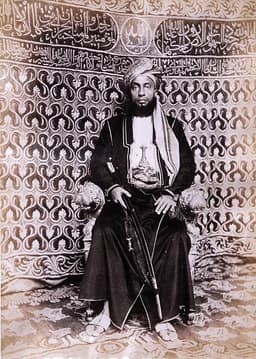
Ali bin Said
Emperor · Modern
39.6Total

Napoleon Bonaparte
General · Modern
70.9Total
Basic Information
Born
1854
1769
Died
1893
1821
Era
Modern
Modern
Nationality
Zanzibar
France
Occupation
Emperor
General
Civilization
Other
Western
Score Comparison
Military (10%)
43.3
94.0
Political (20%)
26.4
72.0
Influence (20%)
46.3
40.0
Legacy (20%)
34.2
80.0
Leadership (15%)
38.1
78.0
Strategy (15%)
54.3
90.0
TOTAL
39.6
70.9
Ali bin Said — Complete Timeline
1890 AD
Accession to the ThronePolitical Action◆ Major
Ali bin Said became the fourth sultan of Zanzibar following the death of his brother Khalifa bin Said. His reign began during the height of European colonial competition in East Africa, with Zanzibar already under British influence.
SuccessionSultanateColonial Era
Signing of the Heligoland-Zanzibar TreatyPolitical Action
Ali bin Said's government accepted the Heligoland-Zanzibar Treaty between Britain and Germany. This treaty defined colonial spheres of influence, with Zanzibar becoming a British protectorate while Germany gained control over mainland Tanganyika.
Colonial TreatyBritish ProtectorateScramble for Africa
Impact: regional
Establishment of British ProtectoratePolitical Action◆ Major
Ali bin Said formally accepted British protectorate status over Zanzibar. This gave Britain control over Zanzibar's foreign affairs and defense while the sultan retained internal authority, effectively ending Zanzibar's sovereignty.
British ProtectorateLoss of SovereigntyColonial Rule
Impact: regional
Napoleon Bonaparte — Complete Timeline
1799 AD
Coup of 18 BrumaireOther◆ Major
Napoleon Bonaparte, with support from his brother Lucien and key political figures, overthrew the Directory in a bloodless coup. He established the Consulate with himself as First Consul, effectively becoming the ruler of France. This event ended the French Revolution's most unstable period.
French RevolutionCoupRise to Power
Impact: regional
1804 AD
Promulgation of the Napoleonic CodeOther◆ Major
Napoleon enacted the Civil Code of the French, known as the Napoleonic Code, a comprehensive set of laws that replaced the fragmented feudal legal systems. The code established legal equality, protected property rights, and secularized law. It became the basis for legal systems in many European and world countries.
Legal ReformNapoleonic CodeCivil Law
Impact: globalconstructive
1805 AD
Battle of AusterlitzWar◆ Major
Napoleon's Grande Arm
Napoleonic WarsBattleDecisive Victory
Impact: global
1812 AD
Invasion of RussiaWar◆ Major
Napoleon led the Grande Arm
Napoleonic WarsInvasionDisaster
Impact: globaldestructive
1815 AD
Battle of WaterlooWar◆ Major
Napoleon's French army was defeated by the combined forces of the Duke of Wellington's Anglo-Allied army and Gebhard Leberecht von Bl
Napoleonic WarsBattleFinal Defeat
Impact: globaldestructive
Expert Analysis
ali-bin-said-vs-napoleon-bonaparte
# The Conqueror and the Sultan: Two Lives at the Crossroads of History
In the winter of 1815, Napoleon Bonaparte stood on the deck of the HMS *Bellerophon*, watching the coast of France recede into the Atlantic mist. He had once commanded armies that stretched from Madrid to Moscow; now he was a prisoner of the British, bound for a remote island in the South Atlantic. Half a world away and seventy-five years later, in 1890, Sultan Ali bin Said of Zanzibar signed a treaty that turned his island kingdom into a British protectorate. Where Napoleon had fought to the bitter end against the same empire, Ali bin Said accepted it as a matter of course. What divided these two rulers—one who shook the world and one who quietly acquiesced to its transformation—was not merely talent or ambition, but a fundamental difference in the worlds they inherited, the tools they possessed, and the choices they faced.
Origins
Napoleon Bonaparte was born in 1769 on Corsica, an island that had passed from Genoese to French control just a year before his birth. His family were minor nobles, but they were not wealthy, and they spoke Italian, not French. This marginality shaped him. He grew up with a chip on his shoulder—a sense that he had to prove himself against the established powers of France. The French Revolution, which erupted when he was twenty, shattered the old order and opened doors that had been closed to provincial outsiders. In the chaos of revolution, a young artillery officer could rise not by birth but by brilliance.
Ali bin Said was born in 1854, into a very different world: the ruling dynasty of Zanzibar, a sultanate built on the spice trade and the slave trade. His family were Omani Arabs who had ruled the Swahili coast for generations. He was raised in a palace, surrounded by courtiers and harem politics, in a society that prized continuity over ambition. Zanzibar was not a revolutionary state; it was a commercial one, dependent on monsoon winds and Indian merchants. The world outside was changing rapidly—steamships, machine guns, and European empires were closing in—but the sultan’s court did not produce men trained to think like conquerors.
Rise to Power
Napoleon’s rise was meteoric. In 1793, at the age of twenty-four, he drove the British out of the port of Toulon, earning promotion to brigadier general. In 1796, he took command of the French army in Italy and turned a starving, mutinous force into a victorious one, defeating the Austrians in a series of lightning campaigns. He was not just a general; he was a political phenomenon. By 1799, he had seized power in a coup, becoming First Consul of France. By 1804, he crowned himself Emperor. Every step was a gamble, and every gamble paid off—until they stopped paying off.
Ali bin Said came to power in 1890, not through conquest or revolution, but through inheritance. His brother Khalifa bin Said died, and Ali, as the next in line, ascended the throne. There was no drama, no struggle, no test of will. The sultanate was already a shadow of its former self. The British had been pressuring Zanzibar to end the slave trade for decades; the German Empire had seized territories on the mainland. Ali did not rise—he simply stepped into a role that was shrinking around him.
Leadership & Governance
Napoleon governed as he conquered: with energy, intelligence, and an unshakable belief in his own destiny. He reformed French law with the Napoleonic Code, which standardized legal systems across Europe and enshrined principles of meritocracy (though not equality for women). He centralized the state, created the Bank of France, and built roads and schools. His military genius was undeniable—scoring a 94 in military ability and a 93 in strategy—but his political wisdom was more fragile. He believed that victory could solve every problem, and he was wrong.
Ali bin Said’s governance was the opposite. He ruled for only three years, from 1890 to 1893, and his most significant act was signing the Heligoland-Zanzibar Treaty, which gave Germany control over the island of Heligoland in exchange for recognizing British dominance in Zanzibar. He accepted the establishment of a British protectorate, effectively ceding sovereignty over his kingdom’s foreign policy. His scores—military 35.6, political 40.5, leadership 35.8—reflect a ruler who did not lead so much as preside. He was not incompetent; he was powerless. The Scramble for Africa was not a war he could win; it was a tide he could not stop.
Triumph & Tragedy
Napoleon’s greatest triumph was the Battle of Austerlitz in 1805, where he crushed the combined armies of Russia and Austria. It was a masterpiece of strategy—feigning weakness, luring the enemy into a trap, then striking with devastating force. His greatest tragedy was the invasion of Russia in 1812. He marched 600,000 men into the Russian winter and returned with fewer than 100,000. The disaster broke his aura of invincibility. His final defeat at Waterloo in 1815 was less a military failure than a psychological one: he had thrown his last dice and lost.
Ali bin Said’s triumphs were modest. He maintained peace in Zanzibar during a period of transition, and he avoided the bloodshed that plagued other African rulers who resisted European colonization. His tragedy was that he had no real triumphs. He was a footnote in a story written by others. The Heligoland-Zanzibar Treaty, signed in 1890, defined his legacy: a sultan who gave away his kingdom with a signature.
Character & Destiny
Napoleon’s character was a furnace of ambition, energy, and arrogance. He once said, “I am not a man, but a thing—I have no heart.” He was driven by a need to impose his will on the world, and this drive made him both magnificent and doomed. He could not stop. Even in exile, he dictated memoirs and planned escapes. His destiny was to rise higher than any man of his time and fall harder.
Ali bin Said’s character is harder to discern from the historical record. He was likely a pragmatic man who saw the writing on the wall. Where Napoleon fought, Ali negotiated. Where Napoleon defied, Ali accommodated. He was not a coward; he was a realist. But realism in the face of overwhelming power is not the stuff of legend. His destiny was to be forgotten.
Legacy
Napoleon’s legacy is immense. The Napoleonic Code influenced legal systems across Europe and the Americas. His military tactics are still studied. His name is synonymous with ambition and genius. He scored 82 in influence and 78 in legacy—a testament to a man who, even in defeat, reshaped the world.
Ali bin Said’s legacy is slight. His score of 44.4 in legacy reflects a ruler who left little mark. Zanzibar remained a British protectorate until 1963, and the sultanate was overthrown in a revolution the following year. The spices still grow, the dhows still sail, but the sultan who signed away his throne is a name only specialists remember.
Conclusion
The difference between Napoleon and Ali bin Said is not a matter of intelligence or courage—it is a matter of context. Napoleon was born into a world of revolution, where a man with a sword and a vision could remake an empire. Ali bin Said was born into a world of empires, where the choices were submission or annihilation. One conquered Europe; the other surrendered an island. Both were products of their time, but one time was a storm and the other was a slow tide. History remembers the storm.
Rankings
🥇
Napoleon BonaparteLeader
Mil: 94.0Pol: 72.0Inf: 40.0
70.9
🥈
Ali bin Said
Mil: 43.3Pol: 26.4Inf: 46.3
39.6
+31.3 behind
How This Comparison Works
Algorithm
Each figure is scored on 6 dimensions (0—100 scale) based on structured historical data: Military (10%), Political (20%), Influence (20%), Legacy (20%), Leadership (15%), Strategy (15%). The weighted total produces the final ranking.
Data Sources
Scores are computed from structured sub-indicators in the database. Scale factors adjust for era (Ancient ×0.85, Modern ×1.0) and civilization size (Eastern ×1.05, Other ×0.80) to account for differences in population and military scale.
Maximum 3 Figures
Comparisons are limited to 2—3 figures to ensure readability and statistical meaningfulness.
Error Margins
±5 points per dimension — Sub-scores are derived from historical records with inherent uncertainty. Two figures within 5 points on a dimension should be considered roughly equivalent in that area.
Total Score Accuracy
±3 points overall — The weighted combination of 6 dimensions produces a total score with approximately ±3 points of uncertainty. Differences of less than 3 points are not statistically significant— the figures are effectively tied.
Known Limitations
- Historical records are incomplete and uneven across civilizations
- Figures from oral-tradition societies may be underrepresented
- Occupation labels can misclassify multi-role figures
- Scores measure capability and impact, not moral character
- Quantitative scoring is a comparison tool, not absolute truth
Capability Radar
Military (10%) — Battles & Warfare
Battles
5
95
Win Rate
5
90
Expansion
5
95
Political (20%) — Governance & Reform
Reform
10
95
Diplomacy
20
80
Economy
15
85
Influence (20%) — Cultural & Global Reach
Cultural
10
85
Global
5
90
Legacy (20%) — Historical Impact
Historical
10
95
Longevity
5
90
Leadership (15%) — Power & Stability
Tenure
15
85
Stability
10
70
Strategy (15%) — Tactics & Innovation
Strategy
5
95
Tactics
5
98
Reform
5
92
Similar Comparisons
Comments & Discussion
RustBeltStrategist6/17/2026
People romanticizing this as a "greater vs lesser" comparison are missing the point. Napoleon's rise was a product of revolutionary disruption that industrialized war—he inherited a mobilized nation-state and a million-man army. Ali bin Said inherited an oceanic trading empire where power came from Indian Ocean commerce and Omani naval tradition, not infantry columns. The real tragedy is how differently these systems responded to European pressure. Napoleon's France could resist because it had b
战史考据党6/17/2026
拿破仑粉最爱吹他"输给天气和英国人",但你们看看阿里·本·赛义德的条件?他1453年登基时奥斯曼刚拿下君士坦丁堡,地中海东岸全是穆斯林势力,马穆鲁克骑兵还能和威尼斯人打平手。拿破仑拿炮兵团打的是内部分裂的欧洲,阿里面对的是全盛期帖木儿帝国的残存势力——近东从来就是地狱模式。建议比较前先把"拿破仑靠革命上位"和"阿里靠血统治国"的视角去掉,看实际军力对比曲线。