Loading...
Amin al-Hafiz vs Napoleon Bonaparte
Napoleon Bonaparte leads by 31.6 pts · 2 figures compared
…
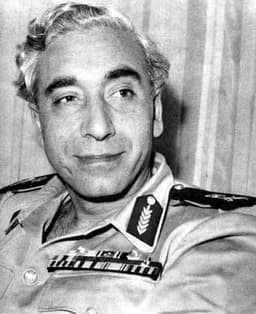
Amin al-Hafiz
General · Modern
39.3Total

Napoleon Bonaparte
General · Modern
70.9Total
Basic Information
Born
1921
1769
Died
—
1821
Era
Modern
Modern
Nationality
Syria
France
Occupation
General
General
Civilization
Middle Eastern
Western
Score Comparison
Military (10%)
10.2
94.0
Political (20%)
33.6
72.0
Influence (20%)
48.6
40.0
Legacy (20%)
37.5
80.0
Leadership (15%)
48.4
78.0
Strategy (15%)
45.0
90.0
TOTAL
39.3
70.9
Amin al-Hafiz — Complete Timeline
1963 AD
Became President of SyriaPolitical Action◆ Major
Amin al-Hafiz became President of Syria after the Baathist coup, serving as a leading figure in the party's early rule. His presidency was marked by internal Baathist factionalism and conflict with the Muslim Brotherhood.
PresidencyBaath Party
Impact: national
1966 AD
Overthrown by Salah JadidPolitical Action◆ Major
Amin al-Hafiz was overthrown in a coup led by Salah Jadid, a rival Baathist faction. He was imprisoned and later exiled, as the more radical neo-Baathists took control of Syria.
CoupBaath Factionalism
Impact: nationaldestructive
Napoleon Bonaparte — Complete Timeline
1799 AD
Coup of 18 BrumaireOther◆ Major
Napoleon Bonaparte, with support from his brother Lucien and key political figures, overthrew the Directory in a bloodless coup. He established the Consulate with himself as First Consul, effectively becoming the ruler of France. This event ended the French Revolution's most unstable period.
French RevolutionCoupRise to Power
Impact: regional
1804 AD
Promulgation of the Napoleonic CodeOther◆ Major
Napoleon enacted the Civil Code of the French, known as the Napoleonic Code, a comprehensive set of laws that replaced the fragmented feudal legal systems. The code established legal equality, protected property rights, and secularized law. It became the basis for legal systems in many European and world countries.
Legal ReformNapoleonic CodeCivil Law
Impact: globalconstructive
1805 AD
Battle of AusterlitzWar◆ Major
Napoleon's Grande Arm
Napoleonic WarsBattleDecisive Victory
Impact: global
1812 AD
Invasion of RussiaWar◆ Major
Napoleon led the Grande Arm
Napoleonic WarsInvasionDisaster
Impact: globaldestructive
1815 AD
Battle of WaterlooWar◆ Major
Napoleon's French army was defeated by the combined forces of the Duke of Wellington's Anglo-Allied army and Gebhard Leberecht von Bl
Napoleonic WarsBattleFinal Defeat
Impact: globaldestructive
Expert Analysis
amin-al-hafiz-vs-napoleon-bonaparte
# The Emperor and the General: Two Paths to Power, Two Destinies
On a June morning in 1815, Napoleon Bonaparte watched the sun rise over the muddy fields of Waterloo, his grand army arrayed for a battle that would decide the fate of Europe. A century and a half later, in a Damascus prison cell, Amin al-Hafiz stared at the same sun through barred windows, his presidency already a memory, his name already fading. Both were generals. Both seized power in turbulent times. Yet one conquered a continent and reshaped Western civilization, while the other ruled a fractured nation for barely three years before being erased by his own comrades. What separates a titan from a footnote? The answer lies not merely in talent, but in the raw material of history itself.
Origins
Napoleon Buonaparte was born in 1769 on Corsica, an island that had just passed from Italian to French control. His family was minor nobility, poor enough to hunger for advancement, proud enough to despise the French who now ruled them. Young Napoleon devoured military history and Enlightenment philosophy in equal measure. He was an outsider—Corsican in a French world—and that outsider’s hunger drove him. When revolution erupted in 1789, he was a twenty-year-old artillery lieutenant, watching the old order collapse with cold calculation.
Amin al-Hafiz was born in 1921 in Aleppo, Syria, then part of the French Mandate. His family was Sunni Arab, modest in means, rooted in a land that had been ruled by Ottomans, then French, and would soon be tossed into the chaos of Arab nationalism. He entered military academy, as ambitious young men did across the post-colonial world, and joined the Baath Party—a movement preaching Arab unity, socialism, and liberation from Western domination. In both men, we see the same pattern: a provincial upbringing, a military education, and a world turned upside down by revolution. But Napoleon’s revolution was a genuine earthquake that shattered an ancient monarchy; al-Hafiz’s revolution was a coup within a coup, a struggle for control of a party that itself had never truly controlled the nation.
Rise to Power
Napoleon’s ascent was a masterpiece of timing and audacity. In 1793, at age twenty-four, he drove the British fleet from Toulon and was promoted to brigadier general. In 1795, he saved the revolutionary government from a royalist mob with a “whiff of grapeshot”—cannon fire into the streets of Paris. By 1796, he commanded the Army of Italy, where he transformed a ragged force into a conquering machine, winning battle after battle against Austria. Each victory was a stepping stone. By 1799, with France exhausted and the Directory corrupt, he staged a coup and made himself First Consul. He was thirty years old.
Amin al-Hafiz took a different road. He rose through the Baath Party’s military wing, a shadowy world of secret cells and factional loyalties. In 1963, when the Baathists seized power in Syria, al-Hafiz emerged as a compromise candidate for president—acceptable to the various factions precisely because he was not too strong. He became president in March 1963, a figurehead for a party that was already tearing itself apart between civilian ideologues and military officers. His power was not won on battlefields but in back rooms, not through victories but through alliances.
Leadership & Governance
Napoleon ruled with a blend of iron discipline and visionary reform. He centralized the French state, created the Napoleonic Code—a legal system that enshrined equality before the law, property rights, and secular governance—and reorganized education, banking, and infrastructure. His military genius was staggering: at Austerlitz in 1805, he destroyed a combined Russian-Austrian army with a trap so elegant it is still studied in war colleges. He understood that war was politics by other means, and he waged both with relentless energy. Yet his political score of 75 reflects his fatal flaw: he could conquer but could not consolidate. He made enemies of Britain, Russia, Spain, and eventually all of Europe.
Amin al-Hafiz governed Syria during the Baath Party’s internal civil war. His regime was characterized not by reform but by survival. He nationalized industries, aligned with Egypt’s Gamal Abdel Nasser, and suppressed the Muslim Brotherhood—but these were moves dictated by party ideology, not personal vision. His military score of 19.9 is a stark contrast to Napoleon’s 94. He was not a battlefield commander; he was a political general whose authority rested on the shifting sands of factional loyalty. The Baath Party’s slogan—“Unity, Freedom, Socialism”—rang hollow as the party splintered into rival militias.
Triumph & Tragedy
Napoleon’s greatest moment was Austerlitz, where he crushed the Third Coalition and crowned himself master of Europe. His tragedy was the invasion of Russia in 1812. He marched 600,000 men into the vastness of winter and lost nearly all of them. Exiled to Elba, he escaped and returned for the Hundred Days, only to meet final defeat at Waterloo in 1815. He died in 1821 on Saint Helena, a prisoner of the British, still dictating his memoirs, still believing in his star.
Al-Hafiz’s triumph was simply becoming president—a fragile achievement in a nation where coups were the norm. His tragedy came in 1966, when his own deputy, Salah Jadid, led a coup that overthrew him. He was imprisoned, then exiled to Lebanon, Iraq, and finally France. He lived until 2009, an obscure figure in a Paris suburb, while the regime that replaced him—Hafez al-Assad’s—would rule Syria for decades with an iron fist. Al-Hafiz was not destroyed by foreign empires but by the mechanics of his own party.
Character & Destiny
Napoleon was a force of nature: arrogant, charismatic, brilliant, and insatiable. He once said, “Impossible is a word to be found only in the dictionary of fools.” His personality drove him to conquer, but also to overreach. He could not stop. His destiny was shaped by his own boundless ambition.
Amin al-Hafiz was a product of his system. He was cautious, factional, and ultimately replaceable. The Baath Party did not produce Napoleons; it produced apparatchiks. His destiny was to be a placeholder, a name in a footnote, while the real power—Assad, Jadid, the military committees—fought in the shadows. He lacked the vision, the ruthlessness, or the historical moment to transcend his circumstances.
Legacy
Napoleon’s legacy is immense. The Napoleonic Code influenced legal systems across Europe and the world. He reshaped national borders, inspired nationalism, and destroyed the old feudal order. His name is synonymous with military genius and imperial ambition. His legacy score of 78 reflects both his achievements and his ultimate failure.
Amin al-Hafiz’s legacy is nearly invisible. He is remembered, if at all, as a transitional figure in Syria’s slide into dictatorship. His legacy score of 48.9 is generous. He left no code, no lasting reform, no battle that historians study. He was a general who never fought a war, a president who never truly ruled.
Conclusion
Standing in the silent prison of Damascus, Amin al-Hafiz might have wondered at the strange hand of fate that made one general a legend and another a ghost. Napoleon Bonaparte commanded armies that shook the world; Amin al-Hafiz commanded a party that consumed itself. The difference was not merely talent—though Napoleon had genius in abundance—but circumstance. Napoleon rode the tiger of revolution at the moment when Europe was ripe for transformation. Al-Hafiz rode the same tiger in a region where revolution had become a revolving door. In the end, history does not remember those who merely hold power; it remembers those who reshape the world. And that requires not just a sword, but a vision strong enough to bend reality to its will.
Rankings
🥇
Napoleon BonaparteLeader
Mil: 94.0Pol: 72.0Inf: 40.0
70.9
🥈
Amin al-Hafiz
Mil: 10.2Pol: 33.6Inf: 48.6
39.3
+31.6 behind
How This Comparison Works
Algorithm
Each figure is scored on 6 dimensions (0—100 scale) based on structured historical data: Military (10%), Political (20%), Influence (20%), Legacy (20%), Leadership (15%), Strategy (15%). The weighted total produces the final ranking.
Data Sources
Scores are computed from structured sub-indicators in the database. Scale factors adjust for era (Ancient ×0.85, Modern ×1.0) and civilization size (Eastern ×1.05, Other ×0.80) to account for differences in population and military scale.
Maximum 3 Figures
Comparisons are limited to 2—3 figures to ensure readability and statistical meaningfulness.
Error Margins
±5 points per dimension — Sub-scores are derived from historical records with inherent uncertainty. Two figures within 5 points on a dimension should be considered roughly equivalent in that area.
Total Score Accuracy
±3 points overall — The weighted combination of 6 dimensions produces a total score with approximately ±3 points of uncertainty. Differences of less than 3 points are not statistically significant— the figures are effectively tied.
Known Limitations
- Historical records are incomplete and uneven across civilizations
- Figures from oral-tradition societies may be underrepresented
- Occupation labels can misclassify multi-role figures
- Scores measure capability and impact, not moral character
- Quantitative scoring is a comparison tool, not absolute truth
Capability Radar
Military (10%) — Battles & Warfare
Battles
5
95
Win Rate
5
90
Expansion
5
95
Political (20%) — Governance & Reform
Reform
20
95
Diplomacy
20
80
Economy
15
85
Influence (20%) — Cultural & Global Reach
Cultural
10
85
Global
10
90
Legacy (20%) — Historical Impact
Historical
15
95
Longevity
10
90
Leadership (15%) — Power & Stability
Tenure
30
85
Stability
10
70
Strategy (15%) — Tactics & Innovation
Strategy
5
95
Tactics
5
98
Reform
5
92
Similar Comparisons
Comments & Discussion
Emperor's Shadow6/17/2026
Napoleon and al-Hafiz aren't comparable. One reshaped Europe's legal codes and military doctrine; the other couldn't even hold Syria for three years. The Ba'athist general rode a wave of coups, not genius. Al-Hafiz was a placeholder—he lost power because his own faction preferred Hafez al-Assad's ruthlessness. Napoleon lost at Waterloo, but his legacy governs French law today. Al-Hafiz? He's a trivia question. That's the difference between empire and erasure.
尼罗河军刀6/17/2026
拿仑仑败于反法联盟,阿明·哈菲兹败于自己人。1963年他掌权,1966年就被党内政变赶走,连任都做不到三年。拿破仑流放厄尔巴岛还能回来百日王朝,哈菲兹关进监狱就再没翻身。不是能力问题——叙利亚复兴党内部比欧洲外交更残忍。他输在不懂清洗同事,拿破仑输在滑铁卢的泥巴里。一个悲剧,一个史诗。
Canon Blast6/17/2026
Both were artillery officers, but only one understood firepower as leverage. Napoleon's Italian campaign in 1796 proved he could turn cannon into political momentum—Lodi Bridge became a legend. Al-Hafiz? He commanded the Syrian army but never won a decisive battle. He crushed the 1964 Hama uprising, sure, but that's crowd control, not conquest. Napoleon made his victories into thrones. Al-Hafiz made his into a prison cell. Artillery doesn't create empires—ambition does.
沙漠测距6/17/2026
数据上讲,拿破仑指挥过60多场战役,阿明·哈菲兹可能连6场都没。他1963年上台时叙利亚GDP不到15亿美元,人均只有300多,全国六成文盲。拿破仑时代的法国是欧洲第一大国,人口2800万,工业领先。拿这两位比,就像拿骑兵刀跟原子弹比——不是一类量级。哈菲兹是个局部角色,拿破仑是系统改变者。数据不会骗人。
Double Eclipse6/17/2026
This comparison is off-center. Al-Hafiz wasn't a conqueror, he was a faction leader in a Syrian civil-military nightmare—three coups in his first year alone. Napoleon inherited revolutionary chaos and turned it into a centralized state. Al-Hafiz inherited Ba'athist chaos and turned it into more chaos. The real story is how different their institutions were: France had a nation ready for a strongman; Syria had a state barely ten years old, already fractured by sect and ambition. One built an empi