Loading...
Anami Korechika vs Napoleon Bonaparte
Napoleon Bonaparte leads by 28.4 pts · 2 figures compared
…
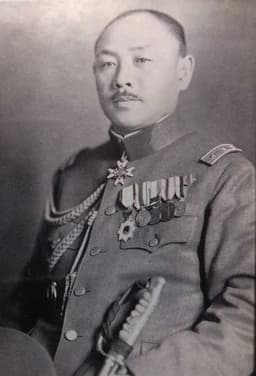
Anami Korechika
General · Modern
42.5Total

Napoleon Bonaparte
General · Modern
70.9Total
Basic Information
Born
1887
1769
Died
1945
1821
Era
Modern
Modern
Nationality
Japan
France
Occupation
General
General
Civilization
Eastern
Western
Score Comparison
Military (10%)
25.9
94.0
Political (20%)
30.8
72.0
Influence (20%)
49.4
40.0
Legacy (20%)
43.3
80.0
Leadership (15%)
51.9
78.0
Strategy (15%)
43.7
90.0
TOTAL
42.5
70.9
Anami Korechika — Complete Timeline
1945 AD
Appointed War MinisterPolitical Action◆ Major
Anami Korechika was appointed Minister of War in the cabinet of Prime Minister Kantaro Suzuki in April 1945. He was a key figure in the Japanese government during the final months of World War II, advocating for continued resistance against the Allies.
World War IIJapanese GovernmentMilitary Leadership
Impact: national
Opposed Surrender DecisionPolitical Action◆ Major
In August 1945, Anami opposed the Potsdam Declaration and advocated for a final decisive battle on the Japanese home islands. He argued against unconditional surrender, contributing to the deadlock in the Supreme War Council.
World War IISurrender DebateMilitary Faction
Impact: nationaldestructive
Committed SeppukuOther◆ Major
On August 15, 1945, after Emperor Hirohito announced Japan's surrender, Anami Korechika committed seppuku (ritual suicide) at his residence. He left a death poem and expressed regret for his role in the war, choosing death over surrender.
World War IIRitual SuicideEnd of War
Impact: nationaltragic
Napoleon Bonaparte — Complete Timeline
1799 AD
Coup of 18 BrumaireOther◆ Major
Napoleon Bonaparte, with support from his brother Lucien and key political figures, overthrew the Directory in a bloodless coup. He established the Consulate with himself as First Consul, effectively becoming the ruler of France. This event ended the French Revolution's most unstable period.
French RevolutionCoupRise to Power
Impact: regional
1804 AD
Promulgation of the Napoleonic CodeOther◆ Major
Napoleon enacted the Civil Code of the French, known as the Napoleonic Code, a comprehensive set of laws that replaced the fragmented feudal legal systems. The code established legal equality, protected property rights, and secularized law. It became the basis for legal systems in many European and world countries.
Legal ReformNapoleonic CodeCivil Law
Impact: globalconstructive
1805 AD
Battle of AusterlitzWar◆ Major
Napoleon's Grande Arm
Napoleonic WarsBattleDecisive Victory
Impact: global
1812 AD
Invasion of RussiaWar◆ Major
Napoleon led the Grande Arm
Napoleonic WarsInvasionDisaster
Impact: globaldestructive
1815 AD
Battle of WaterlooWar◆ Major
Napoleon's French army was defeated by the combined forces of the Duke of Wellington's Anglo-Allied army and Gebhard Leberecht von Bl
Napoleonic WarsBattleFinal Defeat
Impact: globaldestructive
Expert Analysis
anami-korechika-vs-napoleon-bonaparte
# The General and the Emperor: Two Paths from the Battlefield
On the morning of August 15, 1945, General Anami Korechika knelt in his Tokyo home, drew a ceremonial dagger, and disemboweled himself in the ancient samurai tradition of seppuku. Half a world away and 130 years earlier, Napoleon Bonaparte had abdicated his throne for the first time at Fontainebleau, weeping before his Old Guard. Both men were generals who had seen their nations humbled in catastrophic defeat. Yet one reshaped the legal and political foundations of Europe, while the other vanished into history as a footnote—a loyal soldier who chose death over dishonor. Why did their stories diverge so dramatically? The answer lies not merely in talent, but in the worlds they inhabited and the choices those worlds demanded.
Origins
Napoleon was born in 1769 on the island of Corsica, a year after France purchased the island from Genoa. He came from minor nobility, spoke French with an Italian accent, and grew up in a world where the old order was already cracking. The French Revolution erupted when he was twenty, opening a path for ambitious young men of modest birth. His education at military academies in Brienne and Paris gave him technical mastery, but the revolution gave him opportunity—a society where a captain could become a general at twenty-four.
Anami Korechika was born in 1887 in Oita Prefecture, Japan, into a samurai family that had served the feudal lords of the domain. He came of age during the Meiji Restoration, when Japan was rapidly modernizing its military while preserving its warrior ethos. His training at the Imperial Japanese Army Academy and the Army War College instilled not just tactics but a sacred duty: absolute loyalty to the emperor. Unlike Napoleon, whose world was being unmade, Anami’s world was being reforged in steel and tradition.
Rise to Power
Napoleon’s ascent was meteoric. In 1793, at the Siege of Toulon, he devised the plan that recaptured the port from British and royalist forces, earning promotion to brigadier general at twenty-four. In 1795, he saved the revolutionary government from a royalist uprising with a "whiff of grapeshot"—artillery fire into the Parisian streets. By 1796, he was commanding the Army of Italy, where he stunned Europe with a campaign that conquered northern Italy in a year. He was not merely a tactician; he was a political animal who understood that military glory translated into civilian power.
Anami’s rise was slower and more institutional. He served in the Siberian Intervention of 1918-1922, then as a military attaché in Europe, and later as commander of the 109th Division in China. His promotion to War Minister came only in April 1945, when Japan was already losing the war. He reached the pinnacle of power not through genius but through seniority, reputation, and ideological reliability—a man the military establishment trusted to uphold the samurai code.
Leadership & Governance
As First Consul and later Emperor, Napoleon governed with ruthless efficiency. He centralized the French state, created the Bank of France, and most enduringly, codified the Napoleonic Code—a legal framework that abolished feudalism, protected property rights, and established meritocracy in law. On the battlefield, he was a master of maneuver, speed, and decisive engagement. At Austerlitz in 1805, he crushed a combined Russian and Austrian army, a victory of strategic brilliance that destroyed the Third Coalition.
Anami’s leadership was defined by a single, agonizing choice. As War Minister from April to August 1945, he faced the collapse of Japan. American firebombing had incinerated Tokyo; the atomic bombs had devastated Hiroshima and Nagasaki; the Soviet Union had invaded Manchuria. Anami opposed surrender, urging a final "decisive battle" on the home islands that would have cost millions of lives. Yet when Emperor Hirohito decided to accept the Potsdam Declaration, Anami bowed to imperial will—then killed himself. He was a guardian of tradition, not a reformer.
Triumph & Tragedy
Napoleon’s greatest triumph was the Napoleonic Code, which spread across Europe and influenced legal systems from Latin America to Louisiana. His greatest tragedy was the invasion of Russia in 1812, where his Grand Army of over 600,000 men was destroyed by winter, disease, and scorched-earth tactics. He returned to Paris with fewer than 30,000 soldiers. Exiled to Elba, he escaped in 1815, raised another army, and met his final defeat at Waterloo—a battle he might have won had his subordinates arrived in time.
Anami’s triumph was almost invisible: his refusal to launch a coup d'état after the emperor’s surrender decision. Hardliners wanted to seize the imperial palace and continue the war. Anami, despite his own beliefs, prevented this, ensuring Japan’s peaceful transition to occupation and reconstruction. His tragedy was the seppuku itself—a death that symbolized Japan’s militarist past but did nothing to shape its future.
Character & Destiny
Napoleon was driven by an insatiable ambition and a conviction that he was destined to remake the world. "I am not a man," he once said, "but a thing." He saw himself as a force of history, and his personality—charismatic, calculating, visionary—allowed him to exploit the chaos of revolution. But his hubris also undid him. He could not stop conquering, and his enemies learned to unite against him.
Anami was driven by duty—to the emperor, to the samurai code, to the nation. He was not a visionary but a vessel. In his suicide note, he wrote: "I am committing seppuku as a samurai, and I pray that the emperor will be safe." His character was defined by obedience, not creation. He could not imagine a different Japan; he could only embody its old values in its final agony.
Legacy
Napoleon’s legacy is colossal. He reshaped the map of Europe, inspired nationalism, and his legal code remains foundational. He is remembered as both tyrant and genius, a man whose shadow falls across two centuries. Even his defeat at Waterloo became a byword for final reckoning.
Anami’s legacy is obscure outside Japan. He is a footnote in World War II history, remembered primarily for his ritual suicide. Yet his choice to obey the emperor rather than stage a coup arguably saved Japan from a bloody, pointless final battle. He represents the tragedy of a warrior culture that could not adapt—a man who was, in the end, more symbol than actor.
Conclusion
Standing at the abyss of defeat, both generals faced the same question: What do you do when your world ends? Napoleon chose exile, return, and final defiance. Anami chose ritual death. One sought to build a new world; the other sought to die honorably in the old one. Their differences were not just personal but civilizational. Napoleon belonged to a Europe that believed in progress, ambition, and the remaking of destiny. Anami belonged to a Japan that believed in hierarchy, duty, and the beauty of a perfect ending. Both were products of their time—but only one understood that history moves forward, not backward.
Rankings
🥇
Napoleon BonaparteLeader
Mil: 94.0Pol: 72.0Inf: 40.0
70.9
🥈
Anami Korechika
Mil: 25.9Pol: 30.8Inf: 49.4
42.5
+28.4 behind
How This Comparison Works
Algorithm
Each figure is scored on 6 dimensions (0—100 scale) based on structured historical data: Military (10%), Political (20%), Influence (20%), Legacy (20%), Leadership (15%), Strategy (15%). The weighted total produces the final ranking.
Data Sources
Scores are computed from structured sub-indicators in the database. Scale factors adjust for era (Ancient ×0.85, Modern ×1.0) and civilization size (Eastern ×1.05, Other ×0.80) to account for differences in population and military scale.
Maximum 3 Figures
Comparisons are limited to 2—3 figures to ensure readability and statistical meaningfulness.
Error Margins
±5 points per dimension — Sub-scores are derived from historical records with inherent uncertainty. Two figures within 5 points on a dimension should be considered roughly equivalent in that area.
Total Score Accuracy
±3 points overall — The weighted combination of 6 dimensions produces a total score with approximately ±3 points of uncertainty. Differences of less than 3 points are not statistically significant— the figures are effectively tied.
Known Limitations
- Historical records are incomplete and uneven across civilizations
- Figures from oral-tradition societies may be underrepresented
- Occupation labels can misclassify multi-role figures
- Scores measure capability and impact, not moral character
- Quantitative scoring is a comparison tool, not absolute truth
Capability Radar
Military (10%) — Battles & Warfare
Battles
15
95
Win Rate
10
90
Expansion
5
95
Political (20%) — Governance & Reform
Reform
15
95
Diplomacy
20
80
Economy
10
85
Influence (20%) — Cultural & Global Reach
Cultural
15
85
Global
10
90
Legacy (20%) — Historical Impact
Historical
30
95
Longevity
20
90
Leadership (15%) — Power & Stability
Tenure
40
85
Stability
5
70
Strategy (15%) — Tactics & Innovation
Strategy
25
95
Tactics
20
98
Reform
10
92
Similar Comparisons
Comments & Discussion
战锤拿破仑6/17/2026
拿战迷的自我修养:把科西嘉矮子和昭和武夫放一起,说明你根本没搞懂“战争”和“政治”的根本区别。拿破仑用战争重塑了《法国民法典》和欧洲地图,而阿南惟几只是个忠诚执行“神风特攻”自杀命令的棋子。一个开创了现代陆军参谋体系,另一个连瓜达尔卡纳尔岛的后勤都管不好。结论? 拿破仑是改写历史的建筑师,阿南只是个殉葬品。
Napoleonic Overlord6/17/2026
Let’s stop pretending these two belong in the same sentence. Napoleon fundamentally rewrote European law and military organization; Anami was a conservative samurai who couldn't adapt to industrial warfare. Napoleon lost at Waterloo because he gambled on a single battle. Anami lost an entire empire because he gambled on kamikaze desperation. Comparing their seppuku to Napoleon’s weeping farewell is like comparing a chess grandmaster to a shogi piece that can only move forward.
数据祛魅师6/17/2026
什么“忠臣”与“霸主”之争,全是叙事毒药。看数字: 拿破仑指挥过超过60场战役,横跨20年,影响国家数十个。阿南惟几? 作为陆军大臣,他连日本本土决战“一亿玉碎”的死亡预估数都拒绝核实。一个是战略家,一个是数字聋哑人。别用“武士道”洗白他——真正的忠诚是计算伤亡数字,而不是用切腹逃避战败清算。
Bismarck's Statistician6/17/2026
Stop romanticizing suicide as honor. Anami's seppuku wasn't a noble act; it was a refusal to face consequences. Napoleon's first abdication at Fontainebleau was a calculated political move to preserve his dynasty, even if it failed. Anami's final gesture? Empty theater that prevented no further suffering. Napoleon slept in palaces, wrote memoirs, and shaped civil codes. Anami wrote a death poem and disappeared. One had a future; the other had only an exit.
东洋炼钢师6/17/2026
拿阿南惟几跟拿破仑比,等于拿单刃刀比军刀。拿破仑是欧洲政治机器的设计师,阿南惟几是昭和军部这台失控机车的螺丝钉。拿破仑有《拿破仑法典》传世,阿南惟几只留下了“一亿总忏悔”的遗言。但必须承认:阿南拒绝在投降文件上签字、至死反对占领,这份固执本质上是旧日本陆军系统性愚蠢的缩影,而不是什么个人悲剧。
The Last Daimyo6/17/2026
Calling Anami a "tragic figure" misses the point. Napoleon was an empire builder who understood geopolitical chess. Anami was a