Loading...
This comparison has not been analyzed yet.
One-time AI generation (~1 minute). Scores and timeline are already available below.
Andrei Yeremenko vs Douglas MacArthur
Douglas MacArthur leads by 19.8 pts · 2 figures compared
…
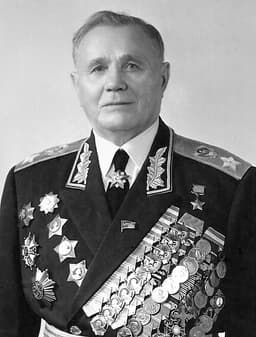
Andrei Yeremenko
General · Modern
45.9Total
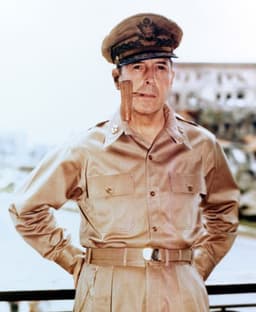
Douglas MacArthur
General · Modern
65.7Total
Basic Information
Born
1892
1880
Died
1970
1964
Era
Modern
Modern
Nationality
USSR
United States
Occupation
General
General
Civilization
Western
Western
Score Comparison
Military (10%)
47.5
85.0
Political (20%)
29.3
78.0
Influence (20%)
51.8
68.0
Legacy (20%)
45.8
40.0
Leadership (15%)
47.3
78.0
Strategy (15%)
52.5
68.0
TOTAL
45.9
65.7
Andrei Yeremenko — Complete Timeline
1941 AD
Battle of MoscowWar
Yeremenko commanded the Bryansk Front during the Battle of Moscow. His forces were encircled and defeated at the Battle of Bryansk, but he escaped and later participated in the counteroffensive.
World War IIMoscowEncirclement
Impact: regionaltragic
1942 AD
Battle of StalingradWar◆ Major
Yeremenko commanded the Stalingrad Front during the Battle of Stalingrad. He coordinated the defense of the city and later the encirclement of the German 6th Army in Operation Uranus.
World War IIStalingradOperation Uranus
Impact: global
1944 AD
Crimean OffensiveWar
Yeremenko commanded the Separate Coastal Army during the Crimean Offensive. His forces liberated Sevastopol and cleared German and Romanian troops from the Crimea.
World War IICrimeaSevastopol
Impact: regional
1965 AD
Publication of memoirsCultural
Yeremenko published his memoirs, 'Stalingrad: Notes of a Front Commander'. The book provided a detailed account of the battle from the Soviet perspective, though it was criticized for exaggerating his own role.
MemoirStalingradHistoriography
Impact: national
Douglas MacArthur — Complete Timeline
1942 AD
Battle of Bataan and CorregidorWar◆ Major
MacArthur commanded US and Filipino forces defending the Bataan Peninsula and Corregidor Island against Japanese invasion. After months of resistance, he was ordered to evacuate to Australia, leaving his troops who later surrendered and endured the Bataan Death March.
World War IIPacific TheaterDefeat
Impact: regionaltragic
1944 AD
Return to the PhilippinesWar◆ Major
MacArthur led the Allied invasion of Leyte Gulf, fulfilling his promise 'I shall return.' The campaign liberated the Philippines from Japanese occupation, a major strategic victory in the Pacific War.
World War IIPacific TheaterVictory
Impact: regionalconstructive
1945 AD
Surrender of JapanWar
MacArthur, as Supreme Commander for the Allied Powers, accepted Japan's formal surrender aboard USS Missouri in Tokyo Bay. This ended World War II and began the Allied occupation of Japan under his leadership.
World War IIJapanOccupation
Impact: globalconstructive
Occupation of Japan ReformsReform◆ Major
MacArthur oversaw the Allied occupation of Japan, implementing sweeping reforms including a new constitution, land redistribution, women's suffrage, and demilitarization. These changes transformed Japan into a democratic and pacifist state.
JapanPost-WarDemocratization
Impact: globalprogressive
1950 AD
Inchon LandingWar◆ Major
MacArthur planned and executed a bold amphibious assault at Inchon, South Korea, behind North Korean lines. The operation cut North Korean supply lines and recaptured Seoul, turning the tide of the Korean War.
Korean WarAmphibious AssaultVictory
Impact: regionalconstructive
1951 AD
Dismissal by President TrumanPolitical Action◆ Major
President Harry S. Truman relieved MacArthur of command for insubordination after MacArthur publicly advocated for expanding the Korean War into China. The dismissal sparked a political controversy in the US and ended MacArthur's military career.
Korean WarCivil-Military RelationsDismissal
Impact: nationaldestructive
This comparison has not been analyzed yet.
One-time AI generation (~1 minute). Scores and timeline are already available below.
Rankings
🥇
Douglas MacArthurLeader
Mil: 85.0Pol: 78.0Inf: 68.0
65.7
🥈
Andrei Yeremenko
Mil: 47.5Pol: 29.3Inf: 51.8
45.9
+19.8 behind
How This Comparison Works
Algorithm
Each figure is scored on 6 dimensions (0—100 scale) based on structured historical data: Military (10%), Political (20%), Influence (20%), Legacy (20%), Leadership (15%), Strategy (15%). The weighted total produces the final ranking.
Data Sources
Scores are computed from structured sub-indicators in the database. Scale factors adjust for era (Ancient ×0.85, Modern ×1.0) and civilization size (Eastern ×1.05, Other ×0.80) to account for differences in population and military scale.
Maximum 3 Figures
Comparisons are limited to 2—3 figures to ensure readability and statistical meaningfulness.
Error Margins
±5 points per dimension — Sub-scores are derived from historical records with inherent uncertainty. Two figures within 5 points on a dimension should be considered roughly equivalent in that area.
Total Score Accuracy
±3 points overall — The weighted combination of 6 dimensions produces a total score with approximately ±3 points of uncertainty. Differences of less than 3 points are not statistically significant— the figures are effectively tied.
Known Limitations
- Historical records are incomplete and uneven across civilizations
- Figures from oral-tradition societies may be underrepresented
- Occupation labels can misclassify multi-role figures
- Scores measure capability and impact, not moral character
- Quantitative scoring is a comparison tool, not absolute truth
Capability Radar
Military (10%) — Battles & Warfare
Battles
70
85
Win Rate
55
75
Expansion
20
85
Political (20%) — Governance & Reform
Reform
10
85
Diplomacy
20
75
Economy
10
70
Influence (20%) — Cultural & Global Reach
Cultural
20
70
Global
20
80
Legacy (20%) — Historical Impact
Historical
40
85
Longevity
25
70
Leadership (15%) — Power & Stability
Tenure
30
80
Stability
15
65
Strategy (15%) — Tactics & Innovation
Strategy
60
90
Tactics
65
80
Reform
30
70
Similar Comparisons
Comments & Discussion
No comments yet. Be the first to share your thoughts!