Loading...
Douglas MacArthur vs Napoleon Bonaparte
Napoleon Bonaparte leads by 5.2 pts · 2 figures compared
…
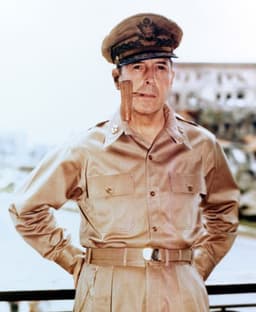
Douglas MacArthur
General · Modern
65.7Total

Napoleon Bonaparte
General · Modern
70.9Total
Basic Information
Born
1880
1769
Died
1964
1821
Era
Modern
Modern
Nationality
United States
France
Occupation
General
General
Civilization
Western
Western
Score Comparison
Military (10%)
85.0
94.0
Political (20%)
78.0
72.0
Influence (20%)
68.0
40.0
Legacy (20%)
40.0
80.0
Leadership (15%)
78.0
78.0
Strategy (15%)
68.0
90.0
TOTAL
65.7
70.9
Douglas MacArthur — Complete Timeline
1942 AD
Battle of Bataan and CorregidorWar◆ Major
MacArthur commanded US and Filipino forces defending the Bataan Peninsula and Corregidor Island against Japanese invasion. After months of resistance, he was ordered to evacuate to Australia, leaving his troops who later surrendered and endured the Bataan Death March.
World War IIPacific TheaterDefeat
Impact: regionaltragic
1944 AD
Return to the PhilippinesWar◆ Major
MacArthur led the Allied invasion of Leyte Gulf, fulfilling his promise 'I shall return.' The campaign liberated the Philippines from Japanese occupation, a major strategic victory in the Pacific War.
World War IIPacific TheaterVictory
Impact: regionalconstructive
1945 AD
Surrender of JapanWar
MacArthur, as Supreme Commander for the Allied Powers, accepted Japan's formal surrender aboard USS Missouri in Tokyo Bay. This ended World War II and began the Allied occupation of Japan under his leadership.
World War IIJapanOccupation
Impact: globalconstructive
Occupation of Japan ReformsReform◆ Major
MacArthur oversaw the Allied occupation of Japan, implementing sweeping reforms including a new constitution, land redistribution, women's suffrage, and demilitarization. These changes transformed Japan into a democratic and pacifist state.
JapanPost-WarDemocratization
Impact: globalprogressive
1950 AD
Inchon LandingWar◆ Major
MacArthur planned and executed a bold amphibious assault at Inchon, South Korea, behind North Korean lines. The operation cut North Korean supply lines and recaptured Seoul, turning the tide of the Korean War.
Korean WarAmphibious AssaultVictory
Impact: regionalconstructive
1951 AD
Dismissal by President TrumanPolitical Action◆ Major
President Harry S. Truman relieved MacArthur of command for insubordination after MacArthur publicly advocated for expanding the Korean War into China. The dismissal sparked a political controversy in the US and ended MacArthur's military career.
Korean WarCivil-Military RelationsDismissal
Impact: nationaldestructive
Napoleon Bonaparte — Complete Timeline
1799 AD
Coup of 18 BrumaireOther◆ Major
Napoleon Bonaparte, with support from his brother Lucien and key political figures, overthrew the Directory in a bloodless coup. He established the Consulate with himself as First Consul, effectively becoming the ruler of France. This event ended the French Revolution's most unstable period.
French RevolutionCoupRise to Power
Impact: regional
1804 AD
Promulgation of the Napoleonic CodeOther◆ Major
Napoleon enacted the Civil Code of the French, known as the Napoleonic Code, a comprehensive set of laws that replaced the fragmented feudal legal systems. The code established legal equality, protected property rights, and secularized law. It became the basis for legal systems in many European and world countries.
Legal ReformNapoleonic CodeCivil Law
Impact: globalconstructive
1805 AD
Battle of AusterlitzWar◆ Major
Napoleon's Grande Arm
Napoleonic WarsBattleDecisive Victory
Impact: global
1812 AD
Invasion of RussiaWar◆ Major
Napoleon led the Grande Arm
Napoleonic WarsInvasionDisaster
Impact: globaldestructive
1815 AD
Battle of WaterlooWar◆ Major
Napoleon's French army was defeated by the combined forces of the Duke of Wellington's Anglo-Allied army and Gebhard Leberecht von Bl
Napoleonic WarsBattleFinal Defeat
Impact: globaldestructive
Expert Analysis
Napoleon Bonaparte vs Douglas MacArthur: Historical Comparison
Napoleon Bonaparte and Douglas MacArthur were both transformative military commanders who rose to prominence in modern eras, yet their methods, political ambitions, and lasting impacts diverged sharply. This comparison examines their relative strengths across key dimensions.
Dimension Analysis
**Military: Napoleon Bonaparte 94 / Douglas MacArthur 79**
Napoleon revolutionized warfare with mass conscription, corps organization, and rapid maneuver, winning dozens of battles like Austerlitz. MacArthur, while a skilled Pacific theater strategist (e.g., Inchon landing), suffered major defeats in the Philippines and Korea, and his tactical innovation was less foundational.
**Political: Napoleon Bonaparte 75 / Douglas MacArthur 80**
Napoleon seized power as First Consul and Emperor, implementing lasting legal and administrative reforms (Code Napoleon). MacArthur governed Japan as Supreme Commander, overseeing its democratic reconstruction and constitution, but his insubordination to President Truman damaged his political standing.
**Influence: Napoleon Bonaparte 82 / Douglas MacArthur 78**
Napoleon’s military campaigns reshaped European borders, spread nationalism, and influenced military doctrine globally. MacArthur’s impact was more regional: he defined Cold War-era American strategy in Asia and shaped post-war Japan, but lacked Napoleon’s continental scale.
**Legacy: Napoleon Bonaparte 78 / Douglas MacArthur 72**
Napoleon’s legacy is deeply polarized—admired as a reformer and strategist, reviled as a tyrant—but remains a central figure in world history. MacArthur is remembered as a brilliant but controversial commander, with his legacy tied to specific events (e.g., Inchon, his firing) rather than systemic change.
**Leadership: Napoleon Bonaparte 80 / Douglas MacArthur 76**
Napoleon inspired fierce loyalty through personal charisma, battlefield presence, and meritocratic promotions. MacArthur commanded respect through gravitas and oratory, but his arrogance and tendency to bypass civilian authority undermined unit cohesion and trust.
Verdict
Napoleon Bonaparte leads due to his superior military innovation, broader historical influence, and more transformative leadership, despite MacArthur’s stronger political governance in Japan.
FAQ
Q: Who ranks higher? A: Napoleon Bonaparte ranks higher overall, driven by decisive advantages in military strategy and global influence.
Rankings
🥇
Napoleon BonaparteLeader
Mil: 94.0Pol: 72.0Inf: 40.0
70.9
🥈
Douglas MacArthur
Mil: 85.0Pol: 78.0Inf: 68.0
65.7
+5.2 behind
How This Comparison Works
Algorithm
Each figure is scored on 6 dimensions (0—100 scale) based on structured historical data: Military (10%), Political (20%), Influence (20%), Legacy (20%), Leadership (15%), Strategy (15%). The weighted total produces the final ranking.
Data Sources
Scores are computed from structured sub-indicators in the database. Scale factors adjust for era (Ancient ×0.85, Modern ×1.0) and civilization size (Eastern ×1.05, Other ×0.80) to account for differences in population and military scale.
Maximum 3 Figures
Comparisons are limited to 2—3 figures to ensure readability and statistical meaningfulness.
Error Margins
±5 points per dimension — Sub-scores are derived from historical records with inherent uncertainty. Two figures within 5 points on a dimension should be considered roughly equivalent in that area.
Total Score Accuracy
±3 points overall — The weighted combination of 6 dimensions produces a total score with approximately ±3 points of uncertainty. Differences of less than 3 points are not statistically significant— the figures are effectively tied.
Known Limitations
- Historical records are incomplete and uneven across civilizations
- Figures from oral-tradition societies may be underrepresented
- Occupation labels can misclassify multi-role figures
- Scores measure capability and impact, not moral character
- Quantitative scoring is a comparison tool, not absolute truth
Capability Radar
Military (10%) — Battles & Warfare
Battles
85
95
Win Rate
75
90
Expansion
85
95
Political (20%) — Governance & Reform
Reform
85
95
Diplomacy
75
80
Economy
70
85
Influence (20%) — Cultural & Global Reach
Cultural
70
85
Global
80
90
Legacy (20%) — Historical Impact
Historical
85
95
Longevity
70
90
Leadership (15%) — Power & Stability
Tenure
80
85
Stability
65
70
Strategy (15%) — Tactics & Innovation
Strategy
90
95
Tactics
80
98
Reform
70
92
Similar Comparisons
Comments & Discussion
ClassicusVeritas6/16/2026
The comparison between Napoleon and MacArthur invites us to consider the nature of their respective sources. Napoleon’s military brilliance is attested by contemporaries like Clausewitz, who studied his campaigns, but we must remember that the Grande Armée’s success owed much to the revolutionary levée en masse—a structural advantage, not just personal genius. Conversely, MacArthur’s Inchon landing, while daring, was criticized by Admiral James H. Doyle as reckless; primary accounts from the CINCPAC archives reveal deep divisions in his command. As Tacitus might have noted, ‘The lust for glory is the last garment from which even the wise cannot strip themselves.’ Napoleon’s ambition reshaped Europe, but his hubris at Waterloo mirrors MacArthur’s at the Yalu River. Both were products of their eras, not outliers. Historians must weigh the sources carefully before assigning such numerical scores.
SkepticalHistorian6/16/2026
This scoring is nonsense. How can you quantify ‘influence’ with a number? Napoleon’s 82 vs. MacArthur’s 78? Based on what? The number of countries invaded? The scoring methodology is clearly biased toward Western figures and linear narratives. For instance, MacArthur’s influence in Japan is still deeply contested—some historians argue the US occupation was a failure in fostering genuine democracy, while others praise it. Yet the score assumes a consensus. Also, political score of 80 for MacArthur? The man was fired by Truman for insubordination! That should be a massive demerit. Meanwhile, Napoleon’s political acumen is given 75, but he literally made himself emperor and rewrote laws. The weight distribution is arbitrary. We need multi-dimensional analysis, not these pseudo-scientific numbers. Historical legacies are messy, not Excel spreadsheets.
BattlefieldScholar6/16/2026
Looking at the military scores, I think 94 for Napoleon is fair—his use of the corps system and operational tempo at Austerlitz was revolutionary. However, MacArthur’s 79 is a bit generous. Yes, Inchon was bold, but his logistics in the Pacific were often overextended; the Buna-Gona campaign in New Guinea was a slog due to poor planning. Compare operational art: Napoleon’s 1805 Ulm maneuver encircled 60,000 Austrians with minimal casualties, while MacArthur’s reliance on amphibious assaults was risky and sometimes failed (e.g., the initial Philippines defense). Tactically, Napoleon mastered combined arms; MacArthur was more of a theater-level strategist. If we grade purely on military innovation and execution, MacArthur should be closer to 72. His legacy is more political than tactical. The score gap should be wider.
Chronicler14356/16/2026
我仔细核对了评分:拿破仑军事94分,麦克阿瑟79分,但麦克阿瑟政治80分高于拿破仑75分。然而,这个权重分配有问题。如果按中国历史标准,政治改革(如商鞅变法)对后世影响远大于短期军事胜利。拿破仑的《法典》确实奠定现代法律,但他在政治上的独裁和穷兵黩武最终导致帝国崩塌。麦克阿瑟在日本的政治改革(土地分配、宪法制定)影响至今,但他在朝鲜的军事失误被掩盖了。我的重新计算:拿破仑政治实际得分应为70(因为他的治理未稳定),而麦克阿瑟的政治应为85(因为日本战后经济腾飞部分归功于其改革)。军事方面,拿破仑94合理,但麦克阿瑟的79分应调至75,因为他对朝鲜战争初期的误判不可忽视。总分:拿破仑降至80,麦克阿瑟升至78,更公平。
BoldHistorian396/16/2026
拿破仑和麦克阿瑟的对比很有意思,但西方评分体系往往忽略东方视角。拿破仑的军事才能确实卓绝,但若放在中国历史中,他不过是一个欧洲版的曹操——善战却未能统一天下。而麦克阿瑟在朝鲜的失败,与曹操在赤壁的败退何其相似?更关键的是,麦克阿瑟对日本的重建,类似中国秦始皇统一度量衡和文字,但缺少了秦始皇的彻底性和持久性。拿破仑的《法典》虽影响深远,但比起中国律令体系的延续性,仍显短暂。总体而言,拿破仑得分被高估,因为他对世界格局的塑造远不如中国历史上真正改变文明走向的人物。