Loading...
Ariel Sharon vs Napoleon Bonaparte
Napoleon Bonaparte leads by 12.6 pts · 2 figures compared
…
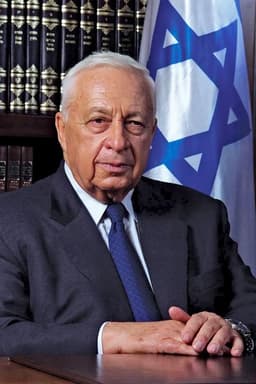
Ariel Sharon
General · Modern
58.3Total

Napoleon Bonaparte
General · Modern
70.9Total
Basic Information
Born
1928
1769
Died
—
1821
Era
Modern
Modern
Nationality
Israel
France
Occupation
General
General
Civilization
Middle Eastern
Western
Score Comparison
Military (10%)
67.3
94.0
Political (20%)
45.0
72.0
Influence (20%)
56.7
40.0
Legacy (20%)
54.0
80.0
Leadership (15%)
68.0
78.0
Strategy (15%)
69.1
90.0
TOTAL
58.3
70.9
Ariel Sharon — Complete Timeline
1982 AD
Command of the 1982 Lebanon WarWar◆ Major
As Minister of Defense, Sharon directed the Israeli invasion of Lebanon to expel the PLO. The war led to the Sabra and Shatila massacre, for which an Israeli commission found Sharon indirectly responsible, forcing his resignation as defense minister.
Lebanon WarSabra and ShatilaMilitary Campaign
Impact: regionaldestructive
2001 AD
Election as Prime MinisterPolitical Action◆ Major
Sharon was elected prime minister of Israel in a special election, defeating Ehud Barak. His victory came during the Second Intifada, and he adopted a hardline security policy, including military operations in Palestinian areas.
ElectionSecond IntifadaSecurity Policy
Impact: national
2005 AD
Disengagement from GazaPolitical Action◆ Major
Sharon implemented the unilateral disengagement plan, withdrawing all Israeli settlers and military forces from the Gaza Strip and dismantling four settlements in the West Bank. The move was controversial within Israel but internationally supported.
Gaza WithdrawalSettlementsUnilateral Action
Impact: regionalconstructive
Napoleon Bonaparte — Complete Timeline
1799 AD
Coup of 18 BrumaireOther◆ Major
Napoleon Bonaparte, with support from his brother Lucien and key political figures, overthrew the Directory in a bloodless coup. He established the Consulate with himself as First Consul, effectively becoming the ruler of France. This event ended the French Revolution's most unstable period.
French RevolutionCoupRise to Power
Impact: regional
1804 AD
Promulgation of the Napoleonic CodeOther◆ Major
Napoleon enacted the Civil Code of the French, known as the Napoleonic Code, a comprehensive set of laws that replaced the fragmented feudal legal systems. The code established legal equality, protected property rights, and secularized law. It became the basis for legal systems in many European and world countries.
Legal ReformNapoleonic CodeCivil Law
Impact: globalconstructive
1805 AD
Battle of AusterlitzWar◆ Major
Napoleon's Grande Arm
Napoleonic WarsBattleDecisive Victory
Impact: global
1812 AD
Invasion of RussiaWar◆ Major
Napoleon led the Grande Arm
Napoleonic WarsInvasionDisaster
Impact: globaldestructive
1815 AD
Battle of WaterlooWar◆ Major
Napoleon's French army was defeated by the combined forces of the Duke of Wellington's Anglo-Allied army and Gebhard Leberecht von Bl
Napoleonic WarsBattleFinal Defeat
Impact: globaldestructive
Expert Analysis
ariel-sharon-vs-napoleon-bonaparte
# The Conqueror and the Bulldozer
On a June evening in 1815, Napoleon Bonaparte stood on the muddy fields of Waterloo, watching his Imperial Guard crumble before the British squares. Nearly two centuries later, in August 2005, Ariel Sharon watched Israeli soldiers carry weeping settlers from their homes in Gaza. Both men were generals who became national leaders. Both reshaped their nations through war and will. But one built an empire that collapsed in a single day, while the other dismantled his own conquests by choice. Why did their paths diverge so sharply?
Origins
Napoleon was born in 1769 on Corsica, an island that had just become French. His family was minor nobility, poor and resentful of French rule. He spoke Italian before French, and his childhood was shaped by the humiliation of conquest. The French Revolution, erupting when he was twenty, offered him what birth could not: a ladder. In the chaos of revolutionary wars, talent mattered more than blood. He seized that opening with ferocious ambition.
Ariel Sharon was born in 1928 in British Mandate Palestine, on a cooperative farm called Kfar Malal. His parents were Russian Jewish immigrants, tough and ideological. They had fled pogroms and built their lives with their own hands. Sharon grew up defending the farm from Arab attacks, learning early that survival depended on force. The Holocaust, which consumed European Jewry during his teenage years, taught him a darker lesson: Jews could not rely on anyone but themselves.
Both men emerged from edges—Napoleon from the fringe of a continent, Sharon from the fringe of a nation. But Napoleon’s world was opening, full of revolutionary possibility. Sharon’s world was closing, a small country fighting for its existence.
Rise to Power
Napoleon’s ascent was meteoric. At twenty-four, he drove the British from Toulon. At twenty-six, he crushed a royalist uprising in Paris with a “whiff of grapeshot.” At twenty-seven, he led a ragged army across the Alps into Italy and won six battles in a month. His secret was speed and audacity—he moved faster than his enemies could think. By 1799, he was First Consul of France. By 1804, Emperor.
Sharon’s rise was slower and bloodier. In the 1948 War of Independence, he commanded a platoon. In 1953, he formed Unit 101, a commando squad that launched retaliatory raids across Arab borders. These raids were brutal—the 1953 attack on Qibya killed sixty-nine Palestinians, including many women and children. Sharon was criticized but not stopped. He became known as “the bulldozer,” a man who pushed through obstacles, including his own superiors. In 1967, his division led the capture of the Sinai. In 1973, he crossed the Suez Canal, turning the Yom Kippur War around. But political power came only in his seventies, after decades of controversy.
Napoleon rose through brilliance; Sharon rose through endurance.
Leadership & Governance
As ruler, Napoleon was a whirlwind. He reformed French law with the Napoleonic Code, which abolished feudalism and enshrined equality before the law. He centralized education, created the Bank of France, and rebuilt Paris with grand boulevards. His military genius—scored at 93 for strategy—was matched by political vision. But he could not stop. Victory demanded more victory. By 1812, he controlled most of Europe, but his empire was a house of cards, held together by his personal presence.
Sharon as prime minister was different. His military score of 67.6 reflects a general who was effective but controversial. As a politician, he was ruthless—he expanded settlements in the West Bank, defying international opinion. But in 2005, he did something unexpected. He ordered the withdrawal of all Israeli settlers and soldiers from Gaza. Eight thousand settlers were evacuated. Homes were demolished. Sharon, the man who had spent decades building Jewish settlements, became the man who tore them down.
Napoleon governed to expand. Sharon governed to consolidate.
Triumph & Tragedy
Napoleon’s greatest triumph was Austerlitz in 1805, where he destroyed a larger Russian and Austrian army with perfect timing. His greatest tragedy was the invasion of Russia in 1812. He marched 600,000 men into the snow; fewer than 100,000 came back. He never recovered.
Sharon’s greatest triumph was crossing the Suez Canal in 1973, a daring maneuver that saved Israel from strategic defeat. His greatest tragedy was the 1982 Lebanon War, which he directed as Defense Minister. The war drove the PLO from Beirut, but it also led to the Sabra and Shatila massacre, where Christian militiamen killed hundreds of Palestinian refugees while Israeli forces controlled the area. An Israeli commission found Sharon indirectly responsible. He was forced to resign.
Both men were haunted by civilian deaths. Napoleon’s wars killed millions across Europe. Sharon’s wars killed thousands in Lebanon and Palestine. But Sharon lived to see his own withdrawal from Gaza condemned by his former allies as a betrayal. Napoleon died on Saint Helena, isolated and defeated.
Character & Destiny
Napoleon was driven by an insatiable hunger for glory. “I live only for posterity,” he said. He could not stop because he believed his destiny was infinite. Every victory demanded another. Every defeat demanded revenge. His personality—brilliant, restless, narcissistic—made his rise possible and his fall inevitable.
Sharon was driven by survival. He did not seek glory; he sought security. He built settlements because he believed they protected Israel. He withdrew from Gaza because he believed staying would destroy Israel. His bulldozer personality—stubborn, pragmatic, indifferent to criticism—allowed him to change course when facts changed. He was not a visionary; he was a fixer.
Napoleon’s destiny was tragedy. Sharon’s was ambiguity.
Legacy
Napoleon left the Napoleonic Code, which shapes European law today. He left the myth of the self-made man, the soldier-emperor who rose from nothing. His military campaigns are still studied. His influence score of 82 reflects a man who changed how Europe thinks about power, law, and nationhood.
Sharon left a divided legacy. To Israelis, he is the bulldozer who saved the country in 1973 and the leader who broke the taboo of withdrawing from biblical land. To Palestinians, he is the architect of occupation, the man who built settlements and invaded Lebanon. His legacy score of 69 reflects this fracture.
Napoleon built an empire that crumbled. Sharon dismantled his own conquests before they could crumble.
Conclusion
Both men were generals who became statesmen. Both used force to reshape their world. But Napoleon, the conqueror, could not stop conquering. Sharon, the bulldozer, knew when to stop building. The difference lies not in their ambition but in their understanding of limits. Napoleon believed he had none. Sharon learned that even bulldozers hit walls. In the end, the general who tore down his own walls may have been wiser than the one who tried to conquer the world.
Rankings
🥇
Napoleon BonaparteLeader
Mil: 94.0Pol: 72.0Inf: 40.0
70.9
🥈
Ariel Sharon
Mil: 67.3Pol: 45.0Inf: 56.7
58.3
+12.6 behind
How This Comparison Works
Algorithm
Each figure is scored on 6 dimensions (0—100 scale) based on structured historical data: Military (10%), Political (20%), Influence (20%), Legacy (20%), Leadership (15%), Strategy (15%). The weighted total produces the final ranking.
Data Sources
Scores are computed from structured sub-indicators in the database. Scale factors adjust for era (Ancient ×0.85, Modern ×1.0) and civilization size (Eastern ×1.05, Other ×0.80) to account for differences in population and military scale.
Maximum 3 Figures
Comparisons are limited to 2—3 figures to ensure readability and statistical meaningfulness.
Error Margins
±5 points per dimension — Sub-scores are derived from historical records with inherent uncertainty. Two figures within 5 points on a dimension should be considered roughly equivalent in that area.
Total Score Accuracy
±3 points overall — The weighted combination of 6 dimensions produces a total score with approximately ±3 points of uncertainty. Differences of less than 3 points are not statistically significant— the figures are effectively tied.
Known Limitations
- Historical records are incomplete and uneven across civilizations
- Figures from oral-tradition societies may be underrepresented
- Occupation labels can misclassify multi-role figures
- Scores measure capability and impact, not moral character
- Quantitative scoring is a comparison tool, not absolute truth
Capability Radar
Military (10%) — Battles & Warfare
Battles
75
95
Win Rate
70
90
Expansion
60
95
Political (20%) — Governance & Reform
Reform
55
95
Diplomacy
50
80
Economy
45
85
Influence (20%) — Cultural & Global Reach
Cultural
55
85
Global
60
90
Legacy (20%) — Historical Impact
Historical
65
95
Longevity
50
90
Leadership (15%) — Power & Stability
Tenure
60
85
Stability
40
70
Strategy (15%) — Tactics & Innovation
Strategy
80
95
Tactics
85
98
Reform
65
92
Similar Comparisons
Comments & Discussion
BATTLEFIELD_GURU6/17/2026
Napoleon lost everything at Waterloo because he forgot logistics, winning battles means nothing if you can't supply the retreat. Sharon understood that—he bulldozed settlements to create defensive depth, not to grab symbolic ground. One was a gambler, the other was a farmer. Napoleon would've traded all his eagles for one good supply line.
田野考古学家6/17/2026
拿皇的帝国建立在意大利战役的速胜上,但沙龙的定居点战略从1948年开始就在地图上画线了。拿破仑在金字塔战役前说“士兵们,四十个世纪在看着你们”,而沙龙在加沙撤离时默默数着四十个家庭被强制搬离。一个是创造神话,一个是拆除神话。
DATA_SCEPTIC6/17/2026
The comparison glosses over scale—Napoleon commanded armies of 500,000 men across a continent, Sharon fought in wars with total mobilized forces of maybe 300,000 max. Napoleon's campaigns killed millions, Sharon's policies displaced maybe 10,000 settlers. It's like comparing a wildfire to a barbecue. Context matters more than narrative.
古典学叛徒6/17/2026
你们把科西嘉暴发户和基布兹农民放一起对比,本质上是在对比两种不同的“失败”。拿破仑的失败是史诗式的,他的法典至今影响着欧洲;沙龙的失败是悲剧式的,他的分离墙把以色列钉在了道德靶子上。没有奥斯特里茨式的光辉,就没有圣赫勒拿式的沉默。
REVISIONIST_RAT6/17/2026
Calling Sharon a "dismantler" is historical whitewashing. He didn't choose to leave Gaza—he withdrew because the occupation was bleeding Israel dry, and he knew it was unsustainable. Napoleon would've built a wall and shot the protesters. Sharon just did the math faster. Both were pragmatists in an age of myths, but one got a legend, the other got a coma.