Loading...
Arthur Harris vs Napoleon Bonaparte
Napoleon Bonaparte leads by 11.4 pts · 2 figures compared
…
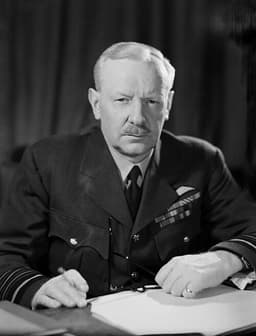
Arthur Harris
General · Modern
59.5Total

Napoleon Bonaparte
General · Modern
70.9Total
Basic Information
Born
1892
1769
Died
1984
1821
Era
Modern
Modern
Nationality
United Kingdom
France
Occupation
General
General
Civilization
Western
Western
Score Comparison
Military (10%)
67.3
94.0
Political (20%)
43.7
72.0
Influence (20%)
65.0
40.0
Legacy (20%)
52.0
80.0
Leadership (15%)
65.0
78.0
Strategy (15%)
72.0
90.0
TOTAL
59.5
70.9
Arthur Harris — Complete Timeline
1942 AD
Appointed Commander-in-Chief of Bomber CommandPolitical Action◆ Major
Harris was appointed Commander-in-Chief of RAF Bomber Command. He implemented the area bombing directive, targeting German cities to destroy civilian morale and industrial capacity, a strategy that remained controversial.
World War IIBombingRoyal Air Force
Impact: global
1943 AD
Battle of the RuhrWar◆ Major
Harris directed a sustained bombing campaign against the Ruhr industrial region, using new tactics like the 'Oboe' navigation system. The campaign damaged German war production but also caused heavy bomber losses.
World War IIStrategic BombingGermany
Impact: regionaldestructive
Bombing of Hamburg (Operation Gomorrah)War◆ Major
Harris ordered a series of raids on Hamburg that created a firestorm, killing an estimated 37,000 civilians and destroying much of the city. The operation used 'Window' (chaff) to confuse German radar, reducing bomber losses.
World War IIStrategic BombingCivilian Casualties
Impact: regionaldestructive
1945 AD
Bombing of DresdenWar◆ Major
Harris ordered the bombing of Dresden, resulting in a firestorm that killed an estimated 25,000 civilians. The raid became a symbol of the moral controversy surrounding area bombing, though its military necessity was debated.
World War IIStrategic BombingCivilian Casualties
Impact: regionaldestructive
Napoleon Bonaparte — Complete Timeline
1799 AD
Coup of 18 BrumaireOther◆ Major
Napoleon Bonaparte, with support from his brother Lucien and key political figures, overthrew the Directory in a bloodless coup. He established the Consulate with himself as First Consul, effectively becoming the ruler of France. This event ended the French Revolution's most unstable period.
French RevolutionCoupRise to Power
Impact: regional
1804 AD
Promulgation of the Napoleonic CodeOther◆ Major
Napoleon enacted the Civil Code of the French, known as the Napoleonic Code, a comprehensive set of laws that replaced the fragmented feudal legal systems. The code established legal equality, protected property rights, and secularized law. It became the basis for legal systems in many European and world countries.
Legal ReformNapoleonic CodeCivil Law
Impact: globalconstructive
1805 AD
Battle of AusterlitzWar◆ Major
Napoleon's Grande Arm
Napoleonic WarsBattleDecisive Victory
Impact: global
1812 AD
Invasion of RussiaWar◆ Major
Napoleon led the Grande Arm
Napoleonic WarsInvasionDisaster
Impact: globaldestructive
1815 AD
Battle of WaterlooWar◆ Major
Napoleon's French army was defeated by the combined forces of the Duke of Wellington's Anglo-Allied army and Gebhard Leberecht von Bl
Napoleonic WarsBattleFinal Defeat
Impact: globaldestructive
Expert Analysis
arthur-harris-vs-napoleon-bonaparte
# The Emperor and the Airman: Two Visions of War
In the summer of 1943, as firestorms consumed Hamburg and turned 37,000 civilians to ash, a British commander sat in his bunker miles from the flames. Arthur Harris had never led men into battle, never felt the weight of a sword in his hand. A century earlier, another commander had felt that weight intimately—Napoleon Bonaparte, who had personally led his armies across Europe, who had wept over fallen soldiers at Austerlitz, and who had once said, “In war, the moral is to the physical as three to one.” Two generals, two centuries, two ways of waging war. One conquered an empire with cavalry charges and cannon fire; the other conquered a nation’s conscience with bombers and firestorms. What drove such different paths, and what do they tell us about the nature of command itself?
Origins
Napoleon Bonaparte was born in 1769 on the island of Corsica, a year after it became French territory. His family was minor nobility, but poor. He spoke French with an Italian accent, and his classmates mocked him. That humiliation forged something—a hunger for recognition, a belief that he could reshape the world that had rejected him. He devoured military history, studied artillery, and emerged from the chaos of the French Revolution as a young officer of genius.
Arthur Harris was born in 1892 in Cheltenham, England, to a colonial civil servant. He grew up in Rhodesia, learning to ride horses and shoot rifles on the African veld. He was restless, rebellious, and left school at seventeen to farm tobacco. When the First World War broke out, he joined the Rhodesian Regiment, then transferred to the Royal Flying Corps. He survived the trenches by taking to the skies. For Harris, war was not about personal valor or close combat—it was about machines, distance, and destruction delivered from above.
Rise to Power
Napoleon’s ascent was meteoric. In 1793, at age twenty-four, he drove the British out of Toulon with a brilliant artillery plan. By 1796, he commanded the Army of Italy, where he defeated larger Austrian forces through speed and audacity. His Italian campaign made him a national hero. In 1799, he seized power in a coup, becoming First Consul. By 1804, he crowned himself Emperor. He had risen not through birth but through sheer force of will and talent.
Harris’s rise was slower, more bureaucratic. He was a competent officer in the Royal Flying Corps, then the Royal Air Force. He advocated for strategic bombing in the 1920s and 1930s, arguing that air power could win wars by breaking civilian morale. In 1942, with Britain desperate for a way to strike back at Germany, he was appointed Commander-in-Chief of Bomber Command. He was fifty years old, and he finally had the tools to prove his theories.
Leadership & Governance
Napoleon ruled as an emperor and a reformer. He centralized the French state, established the Napoleonic Code—a legal framework that influenced much of Europe—and reorganized education and finance. On the battlefield, he was a master of maneuver, of the decisive blow, of exploiting enemy mistakes. He led from the front, sharing the dangers of his men. At Austerlitz in 1805, he crushed the Russian and Austrian armies with a feigned retreat and a devastating flank attack. He was a military genius who also understood politics: he made peace with the Church, stabilized the currency, and created a meritocratic elite.
Harris governed through technology and organization. He oversaw the massive expansion of Bomber Command, introducing new aircraft like the Lancaster and new tactics like the “bomber stream” to overwhelm German defenses. His campaigns—the Battle of the Ruhr in 1943, the bombing of Hamburg, the controversial raid on Dresden in 1945—were industrial operations. He did not lead men into battle; he directed fleets of machines from a desk. His political wisdom was limited: he refused to adapt when the war shifted, insisting on area bombing even when precision targeting became possible. He was a tactician, not a statesman.
Triumph & Tragedy
Napoleon’s greatest moment was Austerlitz, where he achieved the perfect victory. His greatest tragedy was the invasion of Russia in 1812. He marched 600,000 men into the vastness, expecting a decisive battle. Instead, the Russians retreated, burned their own land, and let winter do the killing. Napoleon returned with fewer than 100,000. He was exiled to Elba, returned for the Hundred Days, and was finally defeated at Waterloo in 1815. His ambition destroyed him.
Harris’s triumph was Hamburg—a firestorm that destroyed half the city and proved that bombing could devastate an industrial center. His tragedy was Dresden, in February 1945. The war was nearly won; the city was full of refugees and had little military value. The firestorm killed an estimated 25,000 civilians, and the raid became a symbol of unnecessary destruction. After the war, Harris was criticized, even shunned. He was never given a peerage, and his name became synonymous with moral ambiguity.
Character & Destiny
Napoleon was driven by ambition, ego, and a sense of destiny. He believed he could shape history, and for a time, he did. But his character also contained fatal flaws: arrogance, impatience, an inability to stop. He said, “Power is my mistress,” and he pursued her to the end. His personality created both his triumphs and his ruin.
Harris was stubborn, single-minded, and unapologetic. He believed that bombing would shorten the war and save lives—British lives. He once said, “The Nazis entered this war under the rather childish delusion that they were going to bomb everyone else, and nobody was going to bomb them.” He was not cruel, but he was cold. He accepted civilian casualties as a necessary cost. His character made him effective in a total war, but it also made him a target of moral judgment.
Legacy
Napoleon left a mixed legacy. He is remembered as a military genius and a reformer, but also as a tyrant who caused millions of deaths. The Napoleonic Code remains a foundation of civil law in many countries. His name is etched into the Arc de Triomphe, and his body lies in the Invalides. He is a symbol of ambition and greatness, but also of hubris.
Harris’s legacy is more contested. Bomber Command was crucial to the Allied war effort, but the ethics of area bombing remain debated. In Germany, he is remembered as a war criminal. In Britain, he is a figure of controversy. A statue of him in London was unveiled in 1992, but it has been repeatedly vandalized. He represents the cold logic of industrial war, where killing from the sky became routine.
Conclusion
Napoleon and Harris both waged war on a massive scale, but they inhabited different moral universes. Napoleon fought with armies against armies; Harris fought with bombers against cities. One was a romantic figure of the old world, the other a grim bureaucrat of the new. Their differences are not just personal—they are historical. Napoleon belonged to an era when war was still a contest of wills, where generals could see their enemies and feel their losses. Harris belonged to an age of industrialized destruction, where commanders pressed buttons and watched cities burn from miles away.
Yet both were shaped by their times, and both believed they were doing what was necessary. Napoleon conquered Europe to spread revolutionary ideals—or to satisfy his own ego. Harris bombed Germany to win a war against fascism—or to prove his theories right. History judges them harshly, but it also remembers them. In the end, they remind us that war is never clean, never simple, and that the men who wage it are as flawed as the conflicts they create.
Rankings
🥇
Napoleon BonaparteLeader
Mil: 94.0Pol: 72.0Inf: 40.0
70.9
🥈
Arthur Harris
Mil: 67.3Pol: 43.7Inf: 65.0
59.5
+11.4 behind
How This Comparison Works
Algorithm
Each figure is scored on 6 dimensions (0—100 scale) based on structured historical data: Military (10%), Political (20%), Influence (20%), Legacy (20%), Leadership (15%), Strategy (15%). The weighted total produces the final ranking.
Data Sources
Scores are computed from structured sub-indicators in the database. Scale factors adjust for era (Ancient ×0.85, Modern ×1.0) and civilization size (Eastern ×1.05, Other ×0.80) to account for differences in population and military scale.
Maximum 3 Figures
Comparisons are limited to 2—3 figures to ensure readability and statistical meaningfulness.
Error Margins
±5 points per dimension — Sub-scores are derived from historical records with inherent uncertainty. Two figures within 5 points on a dimension should be considered roughly equivalent in that area.
Total Score Accuracy
±3 points overall — The weighted combination of 6 dimensions produces a total score with approximately ±3 points of uncertainty. Differences of less than 3 points are not statistically significant— the figures are effectively tied.
Known Limitations
- Historical records are incomplete and uneven across civilizations
- Figures from oral-tradition societies may be underrepresented
- Occupation labels can misclassify multi-role figures
- Scores measure capability and impact, not moral character
- Quantitative scoring is a comparison tool, not absolute truth
Capability Radar
Military (10%) — Battles & Warfare
Battles
75
95
Win Rate
70
90
Expansion
60
95
Political (20%) — Governance & Reform
Reform
40
95
Diplomacy
30
80
Economy
20
85
Influence (20%) — Cultural & Global Reach
Cultural
55
85
Global
65
90
Legacy (20%) — Historical Impact
Historical
70
95
Longevity
50
90
Leadership (15%) — Power & Stability
Tenure
60
85
Stability
20
70
Strategy (15%) — Tactics & Innovation
Strategy
80
95
Tactics
85
98
Reform
90
92
Similar Comparisons
Comments & Discussion
BombardierBonaparte6/17/2026
"Comparing Harris to Napoleon is like comparing a slaughterhouse butcher to a master chef. Napoleon won decisive battles with operational brilliance and personal leadership at Austerlitz. Harris just burned cities from a desk in High Wycombe. His Hamburg firestorm killed 37,000 civilians in 1943 without breaking German morale—a strategic failure. Give me the Little Corporal who conquered Europe with 20 battalions, not the Air Marshal who needed 1,000 bombers to torch a cathedral city."
历史算术家6/17/2026
"这个比较完全是假数字!拿破仑打了60多场战役,平均每场指挥6万人,面对面赢下了大部分。哈里斯呢?他指挥的是轰炸机司令部74万人,却从未见过一个敌人。数据不会说谎——拿破仑的伤亡比是1:3,占领了整个欧洲;哈里斯炸死35万德国平民,战争却多拖了一年。这叫将军?这叫坐办公室的屠杀会计。"
RawlsianWarrior6/17/2026
"Harris's campaign violated the just war principle of discrimination far worse than anything Napoleon did. The Emperor at least aimed at enemy armies—his artillery at Austerlitz targeted Russian battalions, not Dresden housewives. Harris deliberately bombed civilian areas to break morale, knowing it was illegal under Hague Conventions. Napoleon's 'whiff of grapeshot' killed 200 rebels; Harris's Operation Gomorrah killed 37,000 in one week. One is a tactical excess, the other is industrial scale
战场诗人6/17/2026
"拿破仑在博罗季诺战役中,面对尸山血海,亲自骑马穿越炮火,命令军官‘不要吝惜自己’。哈里斯呢?他坐在办公桌后,看着轰炸机投下的燃烧弹点燃了整个德累斯顿——那里根本没有军事目标,只有难民和艺术杰作。一个将军用剑写下史诗,另一个用火机烧毁图书馆。拿破仑至少见过血,哈里斯只见过地图上的色块。"
CorsicanComplex6/17/2026
"You're comparing the architect of the Continental System to the creator of the bomber stream? Fine. Harris won his war—Nazi Germany fell in 1945. Napoleon lost everything by 1815. But here's the catch: Napoleon fought with his men, wept over their bodies, and wrote poetry about war. Harris never commanded a combat mission, never saw a plane shot down. The Emperor's leadership was personal and magnetic; Harris's was statistical and cold. Give me the man who could inspire 20,000 to die for him ov