Loading...
This comparison has not been analyzed yet.
One-time AI generation (~1 minute). Scores and timeline are already available below.
Askia Daoud vs Isabella II of Spain
Askia Daoud leads by 11.2 pts · 2 figures compared
…

Askia Daoud
Emperor · Modern
57.7Total
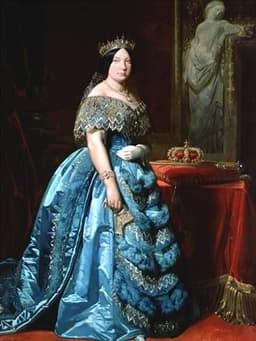
Isabella II of Spain
Emperor · Modern
46.5Total
Basic Information
Born
1520
1830
Died
1582
1904
Era
Modern
Modern
Nationality
Songhai Empire
Spain
Occupation
Emperor
Emperor
Civilization
Other
Western
Score Comparison
Military (10%)
30.0
24.4
Political (20%)
72.0
35.1
Influence (20%)
59.0
51.0
Legacy (20%)
47.5
41.7
Leadership (15%)
75.0
65.7
Strategy (15%)
60.0
57.8
TOTAL
57.7
46.5
Askia Daoud — Complete Timeline
1549 AD
Accession as Askia of SonghaiPolitical Action◆ Major
Askia Daoud became ruler of the Songhai Empire after the death of his brother, Askia Ishaq I. His reign, lasting over 30 years, is considered the longest in Songhai history and was marked by internal peace and administrative consolidation.
SuccessionLong Reign
Impact: nationalconstructive
1550 AD
Patronage of Islamic ScholarshipCultural◆ Major
Askia Daoud continued the Songhai tradition of patronizing Islamic scholars and the University of Sankore in Timbuktu. This period saw a flourishing of learning and intellectual activity, reinforcing Timbuktu's status as a center of Islamic culture.
PatronageIslamic ScholarshipTimbuktu
Impact: regionalprogressive
1582 AD
Death of Askia DaoudOther◆ Major
Askia Daoud died after a reign of approximately 33 years. His death triggered a succession crisis among his many sons, weakening the Songhai Empire and setting the stage for the Moroccan invasion a decade later.
DeathSuccession Crisis
Impact: nationaltragic
Isabella II of Spain — Complete Timeline
1833 AD
First Carlist WarWar◆ Major
The First Carlist War broke out between the Isabelline forces (liberals) and the Carlists (absolutists). The war lasted until 1840 and ended with the defeat of the Carlists, but left Spain politically divided.
Civil WarCarlist WarsLiberal vs Absolutist
Impact: nationaldestructive
Accession to the thronePolitical Action◆ Major
Isabella II became Queen of Spain at age three after the death of her father Ferdinand VII. Her minority sparked the First Carlist War between supporters of Isabella and those of her uncle Carlos.
SuccessionCarlist WarsRegency
Impact: national
1843 AD
Declaration of majorityPolitical Action◆ Major
Isabella II was declared of age at 13, ending the regency of General Espartero. Her personal rule was marked by instability, with frequent changes of government and military interventions.
RegencyMonarchyPolitical Instability
Impact: national
1868 AD
Revolution of 1868 and exilePolitical Action
The Glorious Revolution (La Gloriosa) overthrew Isabella II, who fled to France. The revolution ended the Bourbon monarchy and led to the Sexenio Democr
RevolutionExileBourbon Restoration
Impact: nationaltragic
This comparison has not been analyzed yet.
One-time AI generation (~1 minute). Scores and timeline are already available below.
Rankings
🥇
Askia DaoudLeader
Mil: 30.0Pol: 72.0Inf: 59.0
57.7
🥈
Isabella II of Spain
Mil: 24.4Pol: 35.1Inf: 51.0
46.5
+11.2 behind
How This Comparison Works
Algorithm
Each figure is scored on 6 dimensions (0—100 scale) based on structured historical data: Military (10%), Political (20%), Influence (20%), Legacy (20%), Leadership (15%), Strategy (15%). The weighted total produces the final ranking.
Data Sources
Scores are computed from structured sub-indicators in the database. Scale factors adjust for era (Ancient ×0.85, Modern ×1.0) and civilization size (Eastern ×1.05, Other ×0.80) to account for differences in population and military scale.
Maximum 3 Figures
Comparisons are limited to 2—3 figures to ensure readability and statistical meaningfulness.
Error Margins
±5 points per dimension — Sub-scores are derived from historical records with inherent uncertainty. Two figures within 5 points on a dimension should be considered roughly equivalent in that area.
Total Score Accuracy
±3 points overall — The weighted combination of 6 dimensions produces a total score with approximately ±3 points of uncertainty. Differences of less than 3 points are not statistically significant— the figures are effectively tied.
Known Limitations
- Historical records are incomplete and uneven across civilizations
- Figures from oral-tradition societies may be underrepresented
- Occupation labels can misclassify multi-role figures
- Scores measure capability and impact, not moral character
- Quantitative scoring is a comparison tool, not absolute truth
Capability Radar
Military (10%) — Battles & Warfare
Battles
40
36
Win Rate
60
37
Expansion
30
42
Political (20%) — Governance & Reform
Reform
70
20
Diplomacy
65
25
Economy
75
15
Influence (20%) — Cultural & Global Reach
Cultural
55
20
Global
40
15
Legacy (20%) — Historical Impact
Historical
50
30
Longevity
45
20
Leadership (15%) — Power & Stability
Tenure
85
60
Stability
80
5
Strategy (15%) — Tactics & Innovation
Strategy
50
45
Tactics
45
51
Reform
55
49
Similar Comparisons
Comments & Discussion
No comments yet. Be the first to share your thoughts!