Loading...
Isabella II of Spain vs Wolfgang William of Neuburg
Isabella II of Spain leads by 2.6 pts · 2 figures compared
…
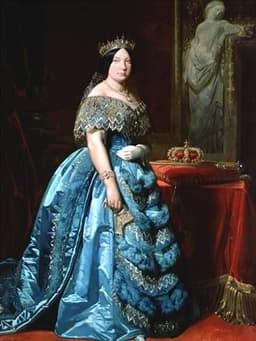
Isabella II of Spain
Emperor · Modern
46.5Total

Wolfgang William of Neuburg
Emperor · Modern
43.9Total
Basic Information
Born
1830
1578
Died
1904
1653
Era
Modern
Modern
Nationality
Spain
Neuburg
Occupation
Emperor
Emperor
Civilization
Western
Western
Score Comparison
Military (10%)
24.4
21.2
Political (20%)
35.1
40.8
Influence (20%)
51.0
47.9
Legacy (20%)
41.7
37.5
Leadership (15%)
65.7
58.8
Strategy (15%)
57.8
54.8
TOTAL
46.5
43.9
Isabella II of Spain — Complete Timeline
1833 AD
First Carlist WarWar◆ Major
The First Carlist War broke out between the Isabelline forces (liberals) and the Carlists (absolutists). The war lasted until 1840 and ended with the defeat of the Carlists, but left Spain politically divided.
Civil WarCarlist WarsLiberal vs Absolutist
Impact: nationaldestructive
Accession to the thronePolitical Action◆ Major
Isabella II became Queen of Spain at age three after the death of her father Ferdinand VII. Her minority sparked the First Carlist War between supporters of Isabella and those of her uncle Carlos.
SuccessionCarlist WarsRegency
Impact: national
1843 AD
Declaration of majorityPolitical Action◆ Major
Isabella II was declared of age at 13, ending the regency of General Espartero. Her personal rule was marked by instability, with frequent changes of government and military interventions.
RegencyMonarchyPolitical Instability
Impact: national
1868 AD
Revolution of 1868 and exilePolitical Action
The Glorious Revolution (La Gloriosa) overthrew Isabella II, who fled to France. The revolution ended the Bourbon monarchy and led to the Sexenio Democr
RevolutionExileBourbon Restoration
Impact: nationaltragic
Wolfgang William of Neuburg — Complete Timeline
1609 AD
Claimed the Jülich-Cleves-Berg InheritancePolitical Action◆ Major
Following the death of John William of Cleves, Wolfgang William, as the son of the Count Palatine of Neuburg, put forward his claim to the J
Succession ClaimJülich Succession
Impact: regional
1613 AD
Converted to CatholicismPolitical Action
Wolfgang William converted from Lutheranism to Catholicism to secure the support of the Catholic League and the Spanish Habsburgs in the J
Religious ConversionPolitical StrategyCatholicism
Impact: regional
1614 AD
Treaty of XantenPolitical Action◆ Major
Wolfgang William and the Elector of Brandenburg signed the Treaty of Xanten, which partitioned the J
TreatyPartitionJülich Succession
Impact: regionalconstructive
Expert Analysis
Origins
Isabella II of Spain was born on 10 October 1830 in Madrid, the eldest daughter of King Ferdinand VII and his fourth wife, Maria Christina of Bourbon-Two Sicilies. Her birth was politically charged because Ferdinand had abolished the Salic Law to allow female succession, leading to conflict with his brother Carlos. Isabella's early years were shaped by a court factionalism that would define her reign. She received a limited education, focusing on religious instruction and courtly manners, with little preparation for governance.
Wolfgang William of Neuburg was born on 4 November 1578 in Neuburg an der Donau, the eldest son of Count Palatine Philip Louis of Neuburg and Anna of Cleves. He was raised in the Lutheran faith and educated in law and governance. His family had long-standing claims to the Jülich-Cleves-Berg inheritance, which would become the central ambition of his life. Wolfgang William's upbringing was typical for a German prince, with emphasis on statecraft and military training, though his political acumen would later prove more significant than his martial skills.
Rise to Power
Isabella II became queen at age three upon Ferdinand's death in 1833. Her mother, Maria Christina, served as regent, but the succession was immediately contested by Carlos, sparking the First Carlist War (1833-1840). The Isabelline faction, composed of liberals and moderates, ultimately prevailed, but the war weakened the monarchy. In 1843, at age 13, Isabella was declared of age, ending the regency of General Baldomero Espartero. Her personal rule began amid political instability, with frequent changes of government and military interventions.
Wolfgang William's rise centered on the Jülich-Cleves-Berg succession crisis. When Duke John William of Cleves died in 1609 without issue, Wolfgang William, as a descendant of the duchy's last ruling family, claimed the inheritance. However, other claimants included John Sigismund of Brandenburg. To gain support from the Catholic League and the Spanish Habsburgs, Wolfgang William converted from Lutheranism to Catholicism in 1613, a turning point that secured his position. The conflict was temporarily resolved by the Treaty of Xanten (1614), which partitioned the territories: Wolfgang William received the duchies of Jülich and Berg, while Brandenburg got Cleves, Mark, and Ravensberg.
Leadership & Governance
Isabella II's leadership was marked by weak governance and reliance on military strongmen. She frequently changed prime ministers—over 30 during her reign—and was influenced by court camarillas. Her reign saw the rise of the Moderate Party under Ramón María Narváez, who imposed a conservative constitution in 1845. Isabella's personal involvement in politics was often indecisive, and she failed to stabilize the country. Her military score of 24.4 reflects her lack of martial command, while her political score of 35.1 indicates her inability to maintain effective governance.
Wolfgang William, as Count Palatine of Neuburg and later Duke of Jülich and Berg, ruled with a focus on consolidation and religious unity. After converting, he promoted the Counter-Reformation in his territories, suppressing Protestantism and inviting Jesuit and Capuchin orders. He centralized administration and sought to strengthen his small state through marriage alliances—marrying first Magdalene of Bavaria and later Catherine Charlotte of Palatinate-Zweibrücken. His political score of 40.8 and leadership score of 58.8 show a more effective, albeit narrower, governance than Isabella's.
Triumph & Tragedy
Isabella II's greatest triumph was surviving the Carlist wars and maintaining the Bourbon dynasty on the throne, despite her personal shortcomings. However, her reign was plagued by corruption, military coups, and the loss of most American colonies. The Glorious Revolution of 1868 forced her into exile in France, ending her rule. Her legacy score of 41.7 reflects the mixed assessment of her reign.
Wolfgang William's triumph was securing the Jülich-Cleves-Berg inheritance through the Treaty of Xanten, a significant territorial gain for the House of Neuburg. However, his conversion alienated many Protestant subjects and led to ongoing tensions. His military score of 21.2 indicates limited martial success, and his legacy is overshadowed by the broader Thirty Years' War that followed. He died in 1653, leaving his territories to his son Philip William.
Character & Destiny
Isabella II was described as strong-willed but politically naive, often swayed by favorites like General Ramón María Narváez and Father Antonio María Claret. Her inability to assert authority or form stable governments led to her downfall. Historians note that she lacked the political acumen needed to navigate Spain's turbulent 19th century.
Wolfgang William was pragmatic and determined, willing to change his religion for political gain. His conversion shows a calculating nature, prioritizing territorial ambition over personal faith. He was a capable administrator but not a great military leader, and his decisions contributed to the religious polarization of the region.
Legacy
Isabella II's legacy is that of a monarch who presided over Spain's decline as a great power. Her reign saw the definitive loss of the American colonies and the rise of military intervention in politics. The Bourbon dynasty was restored in 1874 under her son Alfonso XII, but the monarchy's prestige was permanently damaged. Her total score of 46.5 reflects a below-average impact compared to other rulers.
Wolfgang William's legacy is more localized. He established the Neuburg line of the House of Wittelsbach and secured the Palatinate's hold on Jülich and Berg. However, his conversion intensified religious conflicts in the Holy Roman Empire, contributing to the Thirty Years' War. His total score of 43.9 suggests a modest but significant regional impact.
Conclusion
Isabella II and Wolfgang William were both rulers of moderate impact, but Isabella's influence on Spanish history through the Carlist Wars and the collapse of the Spanish Empire gives her a slight edge. With a total score of 46.5 to Wolfgang William's 43.9, Isabella's reign had broader consequences, despite her political failures. Wolfgang William's achievements were more circumscribed to German territorial politics. Therefore, Isabella II of Spain had greater historical impact.
Rankings
🥇
Isabella II of SpainLeader
Mil: 24.4Pol: 35.1Inf: 51.0
46.5
🥈
Wolfgang William of Neuburg
Mil: 21.2Pol: 40.8Inf: 47.9
43.9
+2.6 behind
How This Comparison Works
Algorithm
Each figure is scored on 6 dimensions (0—100 scale) based on structured historical data: Military (10%), Political (20%), Influence (20%), Legacy (20%), Leadership (15%), Strategy (15%). The weighted total produces the final ranking.
Data Sources
Scores are computed from structured sub-indicators in the database. Scale factors adjust for era (Ancient ×0.85, Modern ×1.0) and civilization size (Eastern ×1.05, Other ×0.80) to account for differences in population and military scale.
Maximum 3 Figures
Comparisons are limited to 2—3 figures to ensure readability and statistical meaningfulness.
Error Margins
±5 points per dimension — Sub-scores are derived from historical records with inherent uncertainty. Two figures within 5 points on a dimension should be considered roughly equivalent in that area.
Total Score Accuracy
±3 points overall — The weighted combination of 6 dimensions produces a total score with approximately ±3 points of uncertainty. Differences of less than 3 points are not statistically significant— the figures are effectively tied.
Known Limitations
- Historical records are incomplete and uneven across civilizations
- Figures from oral-tradition societies may be underrepresented
- Occupation labels can misclassify multi-role figures
- Scores measure capability and impact, not moral character
- Quantitative scoring is a comparison tool, not absolute truth
Capability Radar
Military (10%) — Battles & Warfare
Battles
36
10
Win Rate
37
10
Expansion
42
10
Political (20%) — Governance & Reform
Reform
20
20
Diplomacy
25
40
Economy
15
20
Influence (20%) — Cultural & Global Reach
Cultural
20
15
Global
15
10
Legacy (20%) — Historical Impact
Historical
30
20
Longevity
20
15
Leadership (15%) — Power & Stability
Tenure
60
30
Stability
5
25
Strategy (15%) — Tactics & Innovation
Strategy
45
10
Tactics
51
10
Reform
49
5
Similar Comparisons
Comments & Discussion
No comments yet. Be the first to share your thoughts!