Loading...
Isabella II of Spain vs Saud of Saudi Arabia
Isabella II of Spain leads by 5.4 pts · 2 figures compared
…
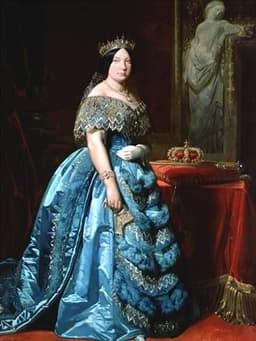
Isabella II of Spain
Emperor · Modern
46.5Total

Saud of Saudi Arabia
Emperor · Modern
41.1Total
Basic Information
Born
1830
1902
Died
1904
1969
Era
Modern
Modern
Nationality
Spain
Saudi Arabia
Occupation
Emperor
Emperor
Civilization
Western
Middle Eastern
Score Comparison
Military (10%)
24.4
14.9
Political (20%)
35.1
33.6
Influence (20%)
51.0
50.2
Legacy (20%)
41.7
36.7
Leadership (15%)
65.7
55.3
Strategy (15%)
57.8
45.0
TOTAL
46.5
41.1
Isabella II of Spain — Complete Timeline
1833 AD
First Carlist WarWar◆ Major
The First Carlist War broke out between the Isabelline forces (liberals) and the Carlists (absolutists). The war lasted until 1840 and ended with the defeat of the Carlists, but left Spain politically divided.
Civil WarCarlist WarsLiberal vs Absolutist
Impact: nationaldestructive
Accession to the thronePolitical Action◆ Major
Isabella II became Queen of Spain at age three after the death of her father Ferdinand VII. Her minority sparked the First Carlist War between supporters of Isabella and those of her uncle Carlos.
SuccessionCarlist WarsRegency
Impact: national
1843 AD
Declaration of majorityPolitical Action◆ Major
Isabella II was declared of age at 13, ending the regency of General Espartero. Her personal rule was marked by instability, with frequent changes of government and military interventions.
RegencyMonarchyPolitical Instability
Impact: national
1868 AD
Revolution of 1868 and exilePolitical Action
The Glorious Revolution (La Gloriosa) overthrew Isabella II, who fled to France. The revolution ended the Bourbon monarchy and led to the Sexenio Democr
RevolutionExileBourbon Restoration
Impact: nationaltragic
Saud of Saudi Arabia — Complete Timeline
1953 AD
Became King of Saudi ArabiaPolitical Action◆ Major
Saud of Saudi Arabia became the second king of Saudi Arabia after the death of his father, Abdulaziz Al Saud. His reign was marked by lavish spending and internal family conflicts.
Saudi ArabiaSuccessionKing
Impact: national
1964 AD
Deposed by the Royal FamilyPolitical Action◆ Major
King Saud was deposed by a family council led by his half-brother Faisal, due to mismanagement and financial crises. He was forced into exile, ending his ineffective rule.
Saudi ArabiaDepositionExile
Impact: nationaltragic
1969 AD
Died in ExileOther
Saud of Saudi Arabia died in exile in Athens, Greece. His death marked the end of his life after being removed from power, with his brother Faisal continuing as king.
Saudi ArabiaExileDeath
Impact: national
Expert Analysis
Origins
Isabella II of Spain (1830-1904) was born into the Bourbon dynasty, the eldest daughter of King Ferdinand VII and his fourth wife, Maria Christina. Her birth triggered a succession crisis because Ferdinand had abolished the Salic Law to allow female inheritance, leading to the Carlist Wars. Isabella received a limited education, focused on religious instruction and court etiquette, as her status as a child queen meant her upbringing was controlled by regents and political factions.
Saud of Saudi Arabia (1902-1969) was the second son of King Abdulaziz Al Saud (Ibn Saud), the founder of modern Saudi Arabia. Born in Kuwait during his father's exile, Saud grew up in the harsh desert environment, learning tribal politics and warfare. He was trained in traditional leadership skills, including diplomacy and military command, as his father prepared him for succession. Unlike Isabella, Saud had direct experience in consolidating his father's conquests, leading campaigns against rebellious tribes.
Rise to Power
Isabella II became queen at age three upon her father's death in 1833, with her mother Maria Christina serving as regent. This triggered the First Carlist War (1833-1840) between supporters of Isabella (liberals) and those of her uncle Carlos (absolutists). The war ended with the Convention of Vergara in 1839, securing Isabella's throne. She was declared of age at 13 in 1843, ending the regency of General Espartero. Her personal rule began amidst political instability, with factions like the Moderates and Progressives vying for control.
Saud was named crown prince in 1933 and became king on November 9, 1953, after his father's death. His rise was uneventful; he was the designated heir, and the transition was smooth due to the Al Saud family's unity. However, Saud lacked his father's authority and faced challenges from his half-brother Faisal, who had served as foreign minister and prime minister. Saud's early reign focused on continuing his father's policies, including oil development and infrastructure projects.
Leadership & Governance
Isabella II's leadership was characterized by indecisiveness and reliance on a series of military strongmen (espadones). She intervened in politics by appointing and dismissing governments, often based on personal favoritism rather than merit. Her reign saw 33 governments and numerous constitutions (1837, 1845, 1856, 1869). She supported the Moderate Party, leading to the Progressive Biennium (1854-1856) when she was forced to accept a liberal constitution. Her governance score of 65.7 reflects some influence but poor stability.
Saud ruled as an absolute monarch but with limited personal involvement in day-to-day governance, delegating to his cabinet. He pursued generous welfare programs and infrastructure spending, but his lavish lifestyle and financial mismanagement led to a budget deficit by 1958. The Saudi riyal was devalued, and the country faced a fiscal crisis. His leadership score of 55.3 indicates weak administrative control. In contrast, his half-brother Faisal implemented austerity measures and modernized the bureaucracy, undermining Saud's authority.
Triumph & Tragedy
Isabella II's greatest success was surviving the Carlist Wars and maintaining the Bourbon dynasty, albeit with liberal support. She also oversaw a period of cultural and economic growth, including the beginnings of railway construction and the expansion of the telegraph network. However, her reign was marred by the corruption of her court, the 'Spanish Inquisition' analogies, and the failure to address social problems. Her greatest tragedy was the Revolution of 1868 (La Gloriosa), which forced her into exile in France, where she abdicated in 1870. She never returned to Spain.
Saud's triumph was overseeing the early years of Saudi Arabia's oil boom, which transformed the kingdom's economy and international standing. He established the Ministry of Petroleum and Mineral Resources and signed agreements with foreign companies. His tragedy was his deposition by the royal family in 1964 due to financial mismanagement and political incompetence. He lived in exile in Egypt and later Greece, dying in 1969. His legacy was overshadowed by Faisal's modernization.
Character & Destiny
Isabella II was described as willful but poorly educated, often manipulated by her confessors and favorites. Her personal life was scandalous, with rumors of numerous lovers and illegitimate children, which eroded public respect. Her character led to a loss of legitimacy, making her vulnerable to revolution. Historical assessments note her lack of political acumen and inability to adapt to the changing liberal currents.
Saud was known for his generosity and piety but also for extravagance and poor judgment. He was not as politically astute as Faisal, and his spending alienated the religious establishment and the royal family. His character led to a coup within the family, as his brothers deemed him unfit. Historians view him as a transitional figure who failed to manage the new oil wealth responsibly.
Legacy
Isabella II's legacy is mixed: she is remembered as a symbol of the unstable 19th-century Spanish monarchy. The Sexenio Democratico (1868-1874) followed her exile, leading to the First Spanish Republic and eventually the Bourbon Restoration under her son Alfonso XII. Her reign accelerated the decline of absolute monarchy in Spain. In historical scores, she scores 41.7 in legacy.
Saud's legacy is largely negative in Saudi historiography, often portrayed as a failure compared to Faisal. However, his reign saw the foundation of modern state institutions, including the cabinet system and the Council of Ministers. The financial crisis he caused led to fiscal reforms. His legacy score is 36.7. In broader terms, his deposition established the principle that the king must rule competently or be replaced by the family.
Conclusion
Isabella II of Spain, with a total score of 46.5, edges out Saud of Saudi Arabia (41.1) by 5.4 points. Isabella's higher scores in leadership (65.7 vs 55.3) and strategy (57.8 vs 45.0) reflect her longer reign and greater political maneuvering, despite her ultimate failure. Both figures were deposed due to incompetence, but Isabella's impact on Spanish history is more significant: her reign triggered a series of political experiments that shaped modern Spain. Saud's reign was a cautionary tale within the Al Saud family, but his policies were quickly reversed. Therefore, Isabella II had greater historical impact, though neither left a positive legacy.
Rankings
🥇
Isabella II of SpainLeader
Mil: 24.4Pol: 35.1Inf: 51.0
46.5
🥈
Saud of Saudi Arabia
Mil: 14.9Pol: 33.6Inf: 50.2
41.1
+5.4 behind
How This Comparison Works
Algorithm
Each figure is scored on 6 dimensions (0—100 scale) based on structured historical data: Military (10%), Political (20%), Influence (20%), Legacy (20%), Leadership (15%), Strategy (15%). The weighted total produces the final ranking.
Data Sources
Scores are computed from structured sub-indicators in the database. Scale factors adjust for era (Ancient ×0.85, Modern ×1.0) and civilization size (Eastern ×1.05, Other ×0.80) to account for differences in population and military scale.
Maximum 3 Figures
Comparisons are limited to 2—3 figures to ensure readability and statistical meaningfulness.
Error Margins
±5 points per dimension — Sub-scores are derived from historical records with inherent uncertainty. Two figures within 5 points on a dimension should be considered roughly equivalent in that area.
Total Score Accuracy
±3 points overall — The weighted combination of 6 dimensions produces a total score with approximately ±3 points of uncertainty. Differences of less than 3 points are not statistically significant— the figures are effectively tied.
Known Limitations
- Historical records are incomplete and uneven across civilizations
- Figures from oral-tradition societies may be underrepresented
- Occupation labels can misclassify multi-role figures
- Scores measure capability and impact, not moral character
- Quantitative scoring is a comparison tool, not absolute truth
Capability Radar
Military (10%) — Battles & Warfare
Battles
36
10
Win Rate
37
10
Expansion
42
10
Political (20%) — Governance & Reform
Reform
20
20
Diplomacy
25
30
Economy
15
20
Influence (20%) — Cultural & Global Reach
Cultural
20
20
Global
15
20
Legacy (20%) — Historical Impact
Historical
30
20
Longevity
20
10
Leadership (15%) — Power & Stability
Tenure
60
40
Stability
5
10
Strategy (15%) — Tactics & Innovation
Strategy
45
10
Tactics
51
10
Reform
49
10
Similar Comparisons
Comments & Discussion
No comments yet. Be the first to share your thoughts!