Loading...
Bhim Singh II of Kota vs Napoleon Bonaparte
Napoleon Bonaparte leads by 26.4 pts · 2 figures compared
…
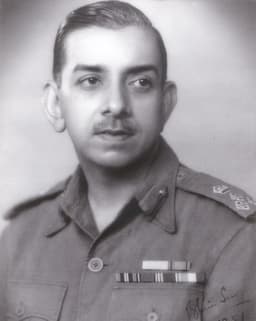
Bhim Singh II of Kota
Emperor · Modern
44.5Total

Napoleon Bonaparte
General · Modern
70.9Total
Basic Information
Born
1909
1769
Died
1991
1821
Era
Modern
Modern
Nationality
India
France
Occupation
Emperor
General
Civilization
Indian
Western
Score Comparison
Military (10%)
45.3
94.0
Political (20%)
36.5
72.0
Influence (20%)
47.1
40.0
Legacy (20%)
35.0
80.0
Leadership (15%)
58.8
78.0
Strategy (15%)
51.3
90.0
TOTAL
44.5
70.9
Bhim Singh II of Kota — Complete Timeline
1940 AD
Accession as Maharao of KotaPolitical Action◆ Major
Bhim Singh II became the Maharao of Kota at age 31, succeeding his father. His reign spanned the end of British colonial rule and the integration of princely states into independent India, requiring him to navigate political transitions.
SuccessionPrincely StateTransition
Impact: regional
1949 AD
Integration of Kota into the Indian UnionPolitical Action
Bhim Singh II signed the Instrument of Accession, merging Kota into the Dominion of India. He later served as a member of the Rajasthan Legislative Assembly and as a Rajya Sabha member, participating in democratic governance after the end of princely rule.
Indian IndependenceIntegrationDemocracy
Impact: national
1960 AD
Establishment of the Kota Barrage and irrigation projectsReform◆ Major
Bhim Singh II championed the construction of the Kota Barrage on the Chambal River, a major irrigation project that transformed agriculture in the region. The project provided water for farming and helped mitigate droughts, benefiting thousands of farmers.
IrrigationAgricultureDevelopment
Impact: regionalconstructive
1970 AD
Environmental conservation efforts in KotaReform
Bhim Singh II initiated environmental conservation programs, including the protection of the Chambal River ecosystem and the establishment of wildlife sanctuaries. His efforts contributed to the preservation of the region's biodiversity, including the gharial crocodile.
EnvironmentConservationWildlife
Impact: regionalconstructive
Napoleon Bonaparte — Complete Timeline
1799 AD
Coup of 18 BrumaireOther◆ Major
Napoleon Bonaparte, with support from his brother Lucien and key political figures, overthrew the Directory in a bloodless coup. He established the Consulate with himself as First Consul, effectively becoming the ruler of France. This event ended the French Revolution's most unstable period.
French RevolutionCoupRise to Power
Impact: regional
1804 AD
Promulgation of the Napoleonic CodeOther◆ Major
Napoleon enacted the Civil Code of the French, known as the Napoleonic Code, a comprehensive set of laws that replaced the fragmented feudal legal systems. The code established legal equality, protected property rights, and secularized law. It became the basis for legal systems in many European and world countries.
Legal ReformNapoleonic CodeCivil Law
Impact: globalconstructive
1805 AD
Battle of AusterlitzWar◆ Major
Napoleon's Grande Arm
Napoleonic WarsBattleDecisive Victory
Impact: global
1812 AD
Invasion of RussiaWar◆ Major
Napoleon led the Grande Arm
Napoleonic WarsInvasionDisaster
Impact: globaldestructive
1815 AD
Battle of WaterlooWar◆ Major
Napoleon's French army was defeated by the combined forces of the Duke of Wellington's Anglo-Allied army and Gebhard Leberecht von Bl
Napoleonic WarsBattleFinal Defeat
Impact: globaldestructive
Expert Analysis
bhim-singh-ii-of-kota-vs-napoleon-bonaparte
# The Emperor and the Prince: Two Paths from Power to Purpose
In the spring of 1815, Napoleon Bonaparte stood on the fields of Waterloo, his Grande Armée shattered, his empire crumbling around him. A century and a quarter later, in the winter of 1940, Bhim Singh II ascended the throne of Kota, a princely state in British India, inheriting not a continent but a small kingdom already bowing to the winds of change. One man had conquered Europe; the other would surrender his crown voluntarily. What separates a titan of history from a prince of quiet duty? The answer lies not in the scale of their domains, but in the depth of their understanding of power itself.
Origins
Napoleon was born in 1769 on the island of Corsica, a year after its annexation by France. His family was minor nobility, poor and ambitious. The French Revolution, erupting when he was twenty, shattered the old order and opened paths unimaginable under the Bourbon monarchy. A young artillery officer of modest birth could now rise to command armies—and perhaps a nation. Corsica’s rugged independence shaped his character: fierce, calculating, and deeply suspicious of established hierarchies.
Bhim Singh II, born in 1909, entered a world already mapped and governed. His father, Maharao Umed Singh II, ruled Kota under British suzerainty, a prince whose authority was real but circumscribed. The young prince was educated at Mayo College, an elite school for Indian royalty, where he learned English, law, and the arts of diplomacy. Where Napoleon’s world was one of violent upheaval, Bhim Singh’s was one of managed transition. The difference in their eras—revolution versus decolonization—would define their destinies.
Rise to Power
Napoleon’s ascent was meteoric. At twenty-four, he drove the British out of Toulon. At twenty-six, he suppressed a royalist uprising in Paris with a “whiff of grapeshot.” By thirty, he had conquered Italy and Egypt, and by thirty-five, he crowned himself Emperor of the French. Each victory fed the next: military success translated into political capital, which funded further conquest. His rise was a product of both genius and opportunity—the Revolution had destroyed the old aristocracy, and Napoleon filled the vacuum with his own ambition.
Bhim Singh II’s path was quieter but no less significant. He became Maharao of Kota in 1940 at age thirty-one, inheriting a state that had existed for centuries but whose future was uncertain. World War II raged, and Indian independence was a decade away. Unlike Napoleon, who seized power, Bhim Singh received it as a trust. His challenge was not to conquer but to navigate. The turning point came in 1949, when he signed the Instrument of Accession, merging Kota into the Dominion of India. It was an act of political realism, not surrender—a recognition that the age of princely states was ending.
Leadership & Governance
Napoleon’s governance was a paradox: a dictator who codified liberty. The Napoleonic Code, established in 1804, abolished feudal privileges, guaranteed religious freedom, and standardized law across his empire. It was a revolutionary document wrapped in imperial authority. Yet his rule was also militaristic: he appointed family members to thrones, suppressed dissent, and drained France’s youth into endless wars. His genius lay in organization—he could mobilize armies, administer conquered territories, and inspire loyalty through merit. But his political wisdom was brittle: he trusted no one, centralized everything, and could not stop fighting.
Bhim Singh II governed differently. His reforms were not carved into stone but into the land itself. In 1960, he championed the Kota Barrage on the Chambal River, a massive irrigation project that transformed Rajasthan’s arid fields into farmland. It was not a conquest but a construction—a quiet revolution of water and wheat. His environmental conservation efforts in the 1970s, protecting the Chambal River ecosystem, reflected a leadership that thought in decades, not battles. His military score of 38.1 versus Napoleon’s 94.0 tells the story: one man waged war, the other waged peace.
Triumph & Tragedy
Napoleon’s greatest moment was Austerlitz in 1805, where he crushed the combined armies of Austria and Russia, cementing his reputation as history’s finest strategist. His greatest tragedy was the invasion of Russia in 1812—a catastrophic miscalculation that cost half a million lives and destroyed his Grand Armée. The pattern was consistent: ambition overreach, triumph followed by hubris. Waterloo in 1815 was the final act, a battle he should have won but lost to timing, weather, and the Prussian arrival.
Bhim Singh II’s triumph was subtler: the peaceful integration of Kota into India, preserving its identity while surrendering its sovereignty. His tragedy was the loss of his kingdom itself. By signing the Instrument of Accession, he became a constitutional figurehead, his ancestral authority dissolved into a democratic republic. Where Napoleon died in exile on St. Helena, Bhim Singh died in 1991 in his own palace, but both men outlived their thrones. The difference was that Bhim Singh chose to let go.
Character & Destiny
Napoleon’s character was forged in fire. He was brilliant, restless, and consumed by an insatiable need for control. “I am not a man,” he once said, “but a thing.” He saw himself as an instrument of destiny, and destiny demanded conquest. His decisions—from the sale of Louisiana to the invasion of Russia—were driven by a strategic mind that could calculate odds but could not calculate limits. His personality shaped history because he refused to accept any boundary.
Bhim Singh II’s character was shaped by acceptance. He understood that power in the modern world was not about armies but about adaptation. His political score of 72.0, higher than his military 38.1, reflects a man who knew when to fight and when to fold. Where Napoleon expanded, Bhim Singh consolidated. Where Napoleon defied history, Bhim Singh flowed with it. Their different outcomes were not matters of talent but of temperament—one sought to bend the world, the other to serve it.
Legacy
Napoleon’s legacy is monumental and contested. He is remembered as a military genius, a reformer, and a tyrant. The Napoleonic Code influences legal systems across Europe and the Americas. His name adorns streets, battles, and books. Yet his legacy is also one of destruction—millions dead, Europe scarred, nationalism unleashed. His total score of 82.4 reflects a figure of immense impact but mixed judgment.
Bhim Singh II’s legacy is quieter but enduring. The Kota Barrage still irrigates fields; the Chambal River still flows through protected gorges. He is remembered not as a conqueror but as a caretaker—a prince who used his final authority to build, not to fight. His legacy score of 46.6 is modest by Napoleon’s standards, but it measures different things: not conquest, but conservation; not empire, but environment.
Conclusion
Standing at opposite ends of the modern age, Napoleon and Bhim Singh II represent two faces of leadership. One believed that power was something to be seized, the other that it was something to be stewarded. Napoleon’s story is a tragedy of ambition; Bhim Singh’s is a drama of adaptation. Both men faced the same fundamental question—what does it mean to rule?—but answered it in opposite ways. The emperor conquered a continent and lost everything; the prince surrendered a kingdom and gained a legacy of peace. In the end, perhaps the greater ruler is not the one who commands the most armies, but the one who understands when to lay down his sword.
Rankings
🥇
Napoleon BonaparteLeader
Mil: 94.0Pol: 72.0Inf: 40.0
70.9
🥈
Bhim Singh II of Kota
Mil: 45.3Pol: 36.5Inf: 47.1
44.5
+26.4 behind
How This Comparison Works
Algorithm
Each figure is scored on 6 dimensions (0—100 scale) based on structured historical data: Military (10%), Political (20%), Influence (20%), Legacy (20%), Leadership (15%), Strategy (15%). The weighted total produces the final ranking.
Data Sources
Scores are computed from structured sub-indicators in the database. Scale factors adjust for era (Ancient ×0.85, Modern ×1.0) and civilization size (Eastern ×1.05, Other ×0.80) to account for differences in population and military scale.
Maximum 3 Figures
Comparisons are limited to 2—3 figures to ensure readability and statistical meaningfulness.
Error Margins
±5 points per dimension — Sub-scores are derived from historical records with inherent uncertainty. Two figures within 5 points on a dimension should be considered roughly equivalent in that area.
Total Score Accuracy
±3 points overall — The weighted combination of 6 dimensions produces a total score with approximately ±3 points of uncertainty. Differences of less than 3 points are not statistically significant— the figures are effectively tied.
Known Limitations
- Historical records are incomplete and uneven across civilizations
- Figures from oral-tradition societies may be underrepresented
- Occupation labels can misclassify multi-role figures
- Scores measure capability and impact, not moral character
- Quantitative scoring is a comparison tool, not absolute truth
Capability Radar
Military (10%) — Battles & Warfare
Battles
30
95
Win Rate
32
90
Expansion
33
95
Political (20%) — Governance & Reform
Reform
20
95
Diplomacy
25
80
Economy
20
85
Influence (20%) — Cultural & Global Reach
Cultural
15
85
Global
5
90
Legacy (20%) — Historical Impact
Historical
10
95
Longevity
10
90
Leadership (15%) — Power & Stability
Tenure
30
85
Stability
25
70
Strategy (15%) — Tactics & Innovation
Strategy
36
95
Tactics
44
98
Reform
45
92
Similar Comparisons
Comments & Discussion
KotaConqueror6/17/2026
You can't seriously compare a Napoleon to a minor princeling. Bhim Singh II never commanded armies, never rewrote legal codes, never reshaped a continent. His "achievement" was voluntarily giving up a throne he inherited by accident of birth. Napoleon earned his crown through genius and blood—thirty years of European history bent to his will. Comparing them insults everything Napoleon represents: ambition, strategy, world-historical transformation. Bhim Singh's surrender shows grace, sure, but g
数据拆解侠6/17/2026
这个对比完全无视了量化维度。拿破仑在1805年奥斯特里茨战役就干掉了反法同盟三万人,控制法国人口超2800万;而Bhim Singh II统治的科塔土邦面积不到1.5万平方公里,人口约60万,在二战期间对英军的“贡献”不过是一支象征性骑兵队加几万卢比捐款。军事力量差三四个数量级,治下人口差五十倍,这叫“平等比较”?没数据支撑的跨时空对比都是修辞包装,不是历史分析。
Franco-Gallic Scholar6/17/2026
Both comparisons miss the crucial institutional context. Napoleon inherited the revolutionary apparatus of meritocratic promotion, central bureaucracy, and the levée en masse—he didn't create them alone. Bhim Singh II inherited nothing but a medieval tributary system maintained by British bayonets. The real comparison is between two political orders, not two men. One was a product of a nation-state in fire, the other a relic of an empire in decay. Personal characteristics are irrelevant without
复古爱好者6/17/2026
拿破仑的科西嘉口音到死都没改掉,他手写的情书里拼写错误一堆;Bhim Singh II能流利引用莎士比亚和普鲁塔克,还自己翻译过印度史诗。谁更有“文明”?拿破仑用炮火把欧洲秩序炸成碎片,Bhim Singh II靠一篇退位演讲就完成了权力交接。从优雅和智慧看,印度王子完胜。别拿军团数量来比,战争是野蛮人的游戏,和平转型才考验真正的领袖头脑。
Chronicler47656/17/2026
Napoleon fell three times—Elba, Waterloo, death—and still needed a British prison island. Bhim Singh II stepped down once, gracefully, and lived to serve as a constitutional figurehead. One man's ego required the world's destruction to satisfy; the other's dignity accepted his era's end. That's not lesser or greater—that's two completely different definitions of what leadership means. Napoleon mistook personal glory for historical duty. Bhim Singh II understood that duty sometimes means letting