Loading...
Bhim Singh of Mewar vs Napoleon Bonaparte
Napoleon Bonaparte leads by 28.5 pts · 2 figures compared
…
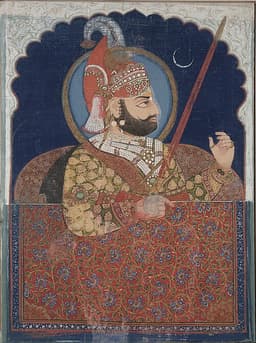
Bhim Singh of Mewar
Emperor · Modern
42.4Total

Napoleon Bonaparte
General · Modern
70.9Total
Basic Information
Born
1761
1769
Died
1828
1821
Era
Modern
Modern
Nationality
India
France
Occupation
Emperor
General
Civilization
Indian
Western
Score Comparison
Military (10%)
14.9
94.0
Political (20%)
32.2
72.0
Influence (20%)
51.0
40.0
Legacy (20%)
40.0
80.0
Leadership (15%)
62.2
78.0
Strategy (15%)
39.6
90.0
TOTAL
42.4
70.9
Bhim Singh of Mewar — Complete Timeline
1778 AD
Last Coronation at ChittorCultural
Bhim Singh was crowned Maharana at Chittor, the traditional capital of Mewar. This was the last coronation held at Chittor before the fort was abandoned due to Maratha threats.
CoronationChittorMewar
Impact: regional
1800 AD
Resisted Maratha InvasionsWar◆ Major
Bhim Singh led Mewar's resistance against Maratha raids under Holkar and Scindia. Despite limited resources, he defended Chittor and Udaipur, but the kingdom was weakened by constant warfare.
Maratha WarsDefenseMewar
Impact: regional
1818 AD
Treaty of 1818 with the BritishPolitical Action◆ Major
Bhim Singh signed a subsidiary alliance with the British East India Company, making Mewar a princely state under British suzerainty. This ended Mewar's independence and brought it under colonial control.
TreatyBritish RajPrincely State
Impact: regional
Napoleon Bonaparte — Complete Timeline
1799 AD
Coup of 18 BrumaireOther◆ Major
Napoleon Bonaparte, with support from his brother Lucien and key political figures, overthrew the Directory in a bloodless coup. He established the Consulate with himself as First Consul, effectively becoming the ruler of France. This event ended the French Revolution's most unstable period.
French RevolutionCoupRise to Power
Impact: regional
1804 AD
Promulgation of the Napoleonic CodeOther◆ Major
Napoleon enacted the Civil Code of the French, known as the Napoleonic Code, a comprehensive set of laws that replaced the fragmented feudal legal systems. The code established legal equality, protected property rights, and secularized law. It became the basis for legal systems in many European and world countries.
Legal ReformNapoleonic CodeCivil Law
Impact: globalconstructive
1805 AD
Battle of AusterlitzWar◆ Major
Napoleon's Grande Arm
Napoleonic WarsBattleDecisive Victory
Impact: global
1812 AD
Invasion of RussiaWar◆ Major
Napoleon led the Grande Arm
Napoleonic WarsInvasionDisaster
Impact: globaldestructive
1815 AD
Battle of WaterlooWar◆ Major
Napoleon's French army was defeated by the combined forces of the Duke of Wellington's Anglo-Allied army and Gebhard Leberecht von Bl
Napoleonic WarsBattleFinal Defeat
Impact: globaldestructive
Expert Analysis
bhim-singh-of-mewar-vs-napoleon-bonaparte
# The Emperor and the Maharana: Two Monarchs in an Age of Empires
On a June morning in 1815, Napoleon Bonaparte stood on a muddy field near Waterloo, watching his Imperial Guard march into cannon fire for the last time. Three years later and five thousand miles away, Bhim Singh of Mewar sat in his palace at Udaipur, dipping a quill into ink to sign away the sovereignty his ancestors had defended for eight centuries. These two men, born only eight years apart, faced the same historical force—the rise of European imperialism—yet their paths could not have diverged more dramatically. One remade Europe and fell like a thunderbolt; the other held his ground and faded like twilight. What explains the difference?
Origins
Napoleon Bonaparte was born in 1769 on the Mediterranean island of Corsica, a territory only recently annexed by France. His family belonged to the minor nobility—impoverished, ambitious, and resentful of French rule. Young Napoleon spoke Italian before French, carried the chip of a provincial outsider, and attended military school on scholarship, where classmates mocked his accent and his poverty. The French Revolution, erupting when he was twenty, would become his ladder. It demolished the old aristocracy and opened command to talent alone.
Bhim Singh was born in 1761 into a very different world. The House of Mewar claimed descent from the Sun, and its rulers had held Chittor for centuries. His ancestors included Maharana Pratap, the legendary warrior who fought Akbar's Mughal Empire to a standstill. Bhim Singh inherited not just a throne but a sacred duty: to protect the land of the Sisodiyas. By his birth, however, Mewar was already squeezed between the expanding Maratha Confederacy and the creeping British East India Company. His inheritance was a diminished kingdom, not a rising empire.
The core difference was timing and opportunity. Napoleon was born into revolution, which shattered the old order and rewarded audacity. Bhim Singh was born into a slow entropy, where every path led to submission.
Rise to Power
Napoleon’s ascent was meteoric. At twenty-four, he drove the British out of Toulon and became a brigadier general. At twenty-six, he crushed a royalist uprising in Paris with a "whiff of grapeshot." At twenty-seven, he took command of the Army of Italy and within a year had humiliated Austria, carved up Italian states, and sent wagonloads of treasure back to Paris. His Italian campaign of 1796–1797 was a masterpiece of speed, deception, and psychological warfare. He did not just win battles; he rewrote the map.
Bhim Singh’s rise was quieter. He was crowned Maharana at Chittor in 1778, the last coronation ever held in that ancient fortress. The ceremony was deliberately traditional, a ritual assertion of continuity in a world of change. He did not seize power through genius; he inherited it through blood. His early years were spent managing a shrinking treasury, negotiating with Maratha chieftains who treated him as a vassal, and watching his dynasty’s prestige erode.
The contrast is not one of ability but of context. Napoleon could climb because the ladder was there. Bhim Singh could only hold his ground because the ground itself was sinking.
Leadership & Governance
As emperor, Napoleon was a whirlwind of reform. The Napoleonic Code of 1804 standardized French law, abolished feudal privileges, and established meritocracy in theory if not always in practice. He centralized education, built roads, reformed banking, and negotiated the Concordat with the Pope to stabilize religion. His military system was revolutionary: corps that could march separately and strike together, aggressive pursuit, and the use of artillery as a decisive arm. At Austerlitz in 1805, he destroyed the combined armies of Austria and Russia with a tactical trap that is still studied in war colleges.
Bhim Singh governed differently. He had no code to write, no empire to build. His task was preservation. He maintained the traditional Rajput court, patronized arts and temples, and kept the old alliances alive. When the Maratha warlords Holkar and Scindia raided Mewar in 1800, Bhim Singh led his small army in resistance. He could not defeat them in open battle, but he could delay, negotiate, and bleed them until they left. He was a defensive general in an age of offensive empires.
Napoleon’s political score of 75 and strategy score of 93 reflect a man who could both design systems and destroy armies. Bhim Singh’s political score of 73.1 is comparable, but his military score of 47.5 and strategy score of 40.8 show a ruler constrained by resources, not a commander unleashed by opportunity.
Triumph & Tragedy
Napoleon’s greatest moment was Austerlitz, where the sun rose over the frozen battlefield and illuminated his genius. His greatest tragedy was Russia in 1812. He invaded with over 600,000 men; he returned with fewer than 100,000. The Russian winter, the scorched earth, and his own refusal to compromise destroyed the Grand Army. Exiled to Elba in 1814, he escaped in 1815 and ruled for a Hundred Days before Waterloo ended everything.
Bhim Singh’s triumph was quieter but real. He kept Mewar independent through the chaos of the Maratha wars while neighboring kingdoms were swallowed. His tragedy came in 1818, when he signed the Treaty of 1818 with the British East India Company. Mewar became a princely state, its foreign policy controlled from Calcutta. He retained his throne and his title, but his sovereignty was gone. He lived another decade as a crowned pensioner.
Napoleon’s tragedy was spectacular—a fall from the heights of power. Bhim Singh’s tragedy was slow and bureaucratic—a signature on a treaty.
Character & Destiny
Napoleon was driven, restless, and incapable of stopping. "Power is my mistress," he once said. His ambition was infinite, and so was his energy. He worked eighteen-hour days, read constantly, and trusted no one completely. This personality built an empire and also destroyed it. He could not share power, could not accept limits, and could not see that even genius has boundaries.
Bhim Singh was cautious, patient, and realistic. He understood that his resources were limited and his enemies many. He chose survival over glory, submission over annihilation. This saved his dynasty but cost him history’s admiration. He is remembered as the last significant ruler of Mewar, a footnote between glory and subjugation.
Napoleon shaped his destiny through will. Bhim Singh accepted his through wisdom.
Legacy
Napoleon’s legacy is enormous. The Napoleonic Code influenced legal systems across Europe and Latin America. His military innovations shaped warfare for a century. His myth—the self-made emperor, the genius in exile—continues to fascinate. His legacy score of 78 reflects both his achievements and his destructiveness.
Bhim Singh’s legacy score of 53.5 is smaller but not meaningless. He preserved the House of Mewar through a generation of collapse. His descendants continued to rule Udaipur until Indian independence in 1947. The dynasty he saved lasted longer than Napoleon’s empire by over a century.
Conclusion
Napoleon and Bhim Singh were both monarchs in an age of empires, but they faced different versions of the same challenge. Napoleon tried to conquer the world and failed magnificently. Bhim Singh tried to preserve a world and succeeded quietly. One reshaped history through ambition; the other survived history through patience. In the end, perhaps the question is not who was greater, but who understood his own time better. Napoleon believed he could master history. Bhim Singh knew he could only endure it.
Rankings
🥇
Napoleon BonaparteLeader
Mil: 94.0Pol: 72.0Inf: 40.0
70.9
🥈
Bhim Singh of Mewar
Mil: 14.9Pol: 32.2Inf: 51.0
42.4
+28.5 behind
How This Comparison Works
Algorithm
Each figure is scored on 6 dimensions (0—100 scale) based on structured historical data: Military (10%), Political (20%), Influence (20%), Legacy (20%), Leadership (15%), Strategy (15%). The weighted total produces the final ranking.
Data Sources
Scores are computed from structured sub-indicators in the database. Scale factors adjust for era (Ancient ×0.85, Modern ×1.0) and civilization size (Eastern ×1.05, Other ×0.80) to account for differences in population and military scale.
Maximum 3 Figures
Comparisons are limited to 2—3 figures to ensure readability and statistical meaningfulness.
Error Margins
±5 points per dimension — Sub-scores are derived from historical records with inherent uncertainty. Two figures within 5 points on a dimension should be considered roughly equivalent in that area.
Total Score Accuracy
±3 points overall — The weighted combination of 6 dimensions produces a total score with approximately ±3 points of uncertainty. Differences of less than 3 points are not statistically significant— the figures are effectively tied.
Known Limitations
- Historical records are incomplete and uneven across civilizations
- Figures from oral-tradition societies may be underrepresented
- Occupation labels can misclassify multi-role figures
- Scores measure capability and impact, not moral character
- Quantitative scoring is a comparison tool, not absolute truth
Capability Radar
Military (10%) — Battles & Warfare
Battles
15
95
Win Rate
10
90
Expansion
5
95
Political (20%) — Governance & Reform
Reform
20
95
Diplomacy
30
80
Economy
15
85
Influence (20%) — Cultural & Global Reach
Cultural
35
85
Global
10
90
Legacy (20%) — Historical Impact
Historical
30
95
Longevity
20
90
Leadership (15%) — Power & Stability
Tenure
40
85
Stability
20
70
Strategy (15%) — Tactics & Innovation
Strategy
15
95
Tactics
20
98
Reform
5
92
Similar Comparisons
Comments & Discussion
Bhim-Singh's-Stand6/17/2026
Look, comparing a man who fought Wellington to one who folded to the East India Company is like comparing a tiger to a housecat. Napoleon took on the combined might of Europe and only lost when his allies betrayed him. Bhim Singh didn't even put up a real fight—he just signed a treaty. Pratap would be ashamed. This isn't about resources; it's about spine.
数据侦探6/17/2026
这对比根本是苹果对橙子!拿破仑的人口基数约2800万,税收体系现代高效,而Bhim Singh统治的梅瓦尔在1818年人口不到50万,连常备军都养不起。说他们面对相同的历史力量?太荒谬了。一个统治欧洲最强国,另一个只是印度众多土邦之一。数据不说谎,拿破仑的对手是欧洲联军,不是几个英国收税官。
Legacy-Lens6/17/2026
You're all missing the real story. Napoleon's legacy is the Napoleonic Code and modern nationalism. Bhim Singh's legacy is... what exactly? He signed a treaty that let the British take over. Yes, Mewar had a longer lineage, but that's just history trivia, not meaningful achievement. Napoleon changed the world; Bhim Singh failed to even preserve his own kingdom. One is a titan, the other a footnote.
时光旅人6/17/2026
各位别忘了,1815年拿破仑输掉滑铁卢时,梅瓦尔其实已经和英国打仗了!1818年,东印度公司大军压境,Bhim Singh的军队连一次像样的野战都没打就投降了。拿破仑至少战败后还能重振旗鼓搞百日王朝,Bhim Singh直接签了附属条约。这不是资源问题,是意志问题。历史给两者同样的考验,一个像狮子,一个像绵羊。