Loading...
Cevdet Sunay vs Napoleon Bonaparte
Napoleon Bonaparte leads by 25.5 pts · 2 figures compared
…
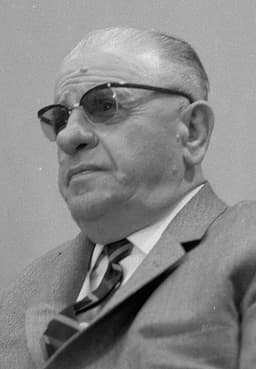
Cevdet Sunay
General · Modern
45.4Total

Napoleon Bonaparte
General · Modern
70.9Total
Basic Information
Born
1899
1769
Died
1982
1821
Era
Modern
Modern
Nationality
Turkey
France
Occupation
General
General
Civilization
Middle Eastern
Western
Score Comparison
Military (10%)
50.0
94.0
Political (20%)
43.7
72.0
Influence (20%)
53.3
40.0
Legacy (20%)
40.8
80.0
Leadership (15%)
40.0
78.0
Strategy (15%)
43.7
90.0
TOTAL
45.4
70.9
Cevdet Sunay — Complete Timeline
1960 AD
Appointment as Chief of General StaffPolitical Action◆ Major
Cevdet Sunay was appointed Chief of the Turkish General Staff in 1960, following the 1960 coup. He served in this role until 1966, overseeing the military's role in the post-coup political landscape.
Turkish MilitaryChief of StaffPost-Coup
Impact: national
1966 AD
Election as President of TurkeyPolitical Action◆ Major
Cevdet Sunay was elected the fifth President of Turkey by the Grand National Assembly on March 28, 1966, succeeding Cemal G
Turkish PresidencyMilitary PresidentStability
Impact: nationalconstructive
1971 AD
1971 Military MemorandumPolitical Action◆ Major
During Sunay's presidency, the Turkish military issued a memorandum on March 12, 1971, demanding a stronger government to combat political violence and economic crisis. The memorandum led to the resignation of Prime Minister S
1971 MemorandumTurkish MilitaryPolitical Crisis
Impact: nationaldestructive
Napoleon Bonaparte — Complete Timeline
1799 AD
Coup of 18 BrumaireOther◆ Major
Napoleon Bonaparte, with support from his brother Lucien and key political figures, overthrew the Directory in a bloodless coup. He established the Consulate with himself as First Consul, effectively becoming the ruler of France. This event ended the French Revolution's most unstable period.
French RevolutionCoupRise to Power
Impact: regional
1804 AD
Promulgation of the Napoleonic CodeOther◆ Major
Napoleon enacted the Civil Code of the French, known as the Napoleonic Code, a comprehensive set of laws that replaced the fragmented feudal legal systems. The code established legal equality, protected property rights, and secularized law. It became the basis for legal systems in many European and world countries.
Legal ReformNapoleonic CodeCivil Law
Impact: globalconstructive
1805 AD
Battle of AusterlitzWar◆ Major
Napoleon's Grande Arm
Napoleonic WarsBattleDecisive Victory
Impact: global
1812 AD
Invasion of RussiaWar◆ Major
Napoleon led the Grande Arm
Napoleonic WarsInvasionDisaster
Impact: globaldestructive
1815 AD
Battle of WaterlooWar◆ Major
Napoleon's French army was defeated by the combined forces of the Duke of Wellington's Anglo-Allied army and Gebhard Leberecht von Bl
Napoleonic WarsBattleFinal Defeat
Impact: globaldestructive
Expert Analysis
cevdet-sunay-vs-napoleon-bonaparte
### The Conqueror and the Custodian
History offers few pairings as stark as Napoleon Bonaparte and Cevdet Sunay. One set Europe ablaze, redrew borders, and forged a legal code that still echoes in courtrooms today. The other, a Turkish general turned president, steered a fragile republic through the icy politics of the Cold War. On paper, their scores tell a clear story: Napoleon’s military genius (94) crushes Sunay’s (45.5); Sunay’s leadership (88.5) edges out Napoleon’s (80). But numbers flatten the messy truth. Why did one man die in exile, a prisoner of his own ambition, while the other retired as a respected elder statesman? The answer lies not in their talents, but in the cages their eras built for them.
### Origins
Napoleon was born on August 15, 1769, on Corsica, an island France had just purchased from Genoa. His family were minor nobles with a chip on their shoulder. He spoke French with an Italian accent and was mocked at military school. This outsider’s rage—against the French aristocracy, against the British, against anyone who looked down on him—became the engine of his life. The French Revolution, which erupted when he was 20, blew open every door. A man of talent could rise, not by birth, but by will. Napoleon seized that opening with both hands.
Cevdet Sunay entered the world in 1899 in Trabzon, on the Black Sea coast of a crumbling Ottoman Empire. His childhood was shadowed by war—the Balkan Wars, World War I, the Turkish War of Independence. He joined the Ottoman army as a young officer, then fought under Mustafa Kemal Atatürk in the campaign to forge a new nation. Where Napoleon saw a world to conquer, Sunay saw a world to defend. His generation’s task was not expansion, but survival. He was molded by institutional loyalty, not personal ambition. Atatürk’s revolution had remade Turkey from the top down, and Sunay was a product of that remaking: disciplined, secular, and deeply suspicious of chaos.
### Rise to Power
Napoleon’s ascent was a thunderstorm. At 24, he drove the British out of Toulon and was promoted to brigadier general. At 26, he crushed a royalist uprising in Paris with a “whiff of grapeshot.” By 30, he had conquered Italy and Egypt, and the Directory—France’s corrupt, flailing government—was terrified of him. In 1799, he staged a coup and made himself First Consul. Five years later, he crowned himself Emperor. Every step was a gamble, a calculated defiance of fate.
Sunay’s path was a staircase. He rose methodically through the ranks of the Turkish Army, commanding units, attending staff college, earning respect. In 1960, after a military coup ousted the civilian government, he was appointed Chief of the General Staff. That was his turning point—not a battlefield, but a desk. Six years later, on March 28, 1966, the Grand National Assembly elected him the fifth President of Turkey. He succeeded Cemal Gürsel, another general-turned-president. The pattern was clear: when democracy faltered, the military stepped in, not to conquer, but to stabilize.
### Leadership & Governance
Napoleon governed like a storm. He centralized the state, created the Bank of France, and negotiated the Concordat with the Pope to tame the Catholic Church. His Napoleonic Code swept away feudal privileges and enshrined equality before the law—for men, at least. He built roads, canals, and a network of lycées to train future bureaucrats. But his genius was also his curse. He could not stop. He appointed his brothers as puppet kings, divorced Joséphine to marry a Habsburg princess, and invaded Russia in 1812 with 600,000 men. Only 100,000 came back. His strategy score of 93 could not save him from his own hubris.
Sunay governed like a firebreak. His presidency (1966–1973) was a tense balancing act. Turkey was a fragile democracy, caught between leftist unrest and right-wing violence. In 1971, the military issued a memorandum demanding a stronger government to curb “anarchy.” Sunay did not resist. He accepted the resignation of Prime Minister Süleyman Demirel and oversaw a period of technocratic rule. He was not a reformer like Napoleon; he was a custodian. His political score of 72 reflects this: he kept the system running, but he did not rebuild it. His leadership score of 88.5, however, suggests something deeper: the trust he commanded from both soldiers and politicians.
### Triumph & Tragedy
Napoleon’s greatest moment was Austerlitz in 1805, where he destroyed the combined armies of Russia and Austria in a single day. His worst was Waterloo in 1815, where he lost everything. He died in 1821 on Saint Helena, a British prison island in the South Atlantic. The man who had crowned himself Emperor of Europe ended his days dictating memoirs and playing chess.
Sunay’s triumph was quieter. He presided over a decade of relative stability in a region that saw coups in Greece, Cyprus, and the Middle East. His tragedy was that stability came at a cost. The 1971 memorandum deepened the military’s role in Turkish politics, a pattern that would repeat in 1980 and 1997. He did not cause this, but he did not stop it either. He died in 1982, at home, in his bed. No exile. No legend. Just a footnote.
### Character & Destiny
Napoleon was a creature of will. He once said, “Impossible is a word to be found only in the dictionary of fools.” He believed he could bend reality to his ambition. And for a time, he did. But his personality—restless, arrogant, incapable of compromise—ultimately destroyed him. He could not share power, could not stop fighting, could not accept limits.
Sunay was a creature of duty. He believed the state was fragile and must be protected. His personality—patient, cautious, institutional—kept him from glory but also from ruin. He did not dream of conquering Europe. He dreamed of a stable Turkey. And he achieved it, for a while.
### Legacy
Napoleon’s legacy is a mountain. The Napoleonic Code shapes civil law from France to Brazil to Japan. His campaigns are studied in every military academy. He is remembered as a titan, a tyrant, a genius. His total score of 82.4 reflects this outsized impact.
Sunay’s legacy is a whisper. He is remembered, if at all, as a transitional figure in Turkey’s long struggle between democracy and military guardianship. His total score of 66.9 is modest. But that modesty is itself a statement. In a century of dictators and demagogues, Sunay chose the quiet path. He did not rewrite the world. He held the line.
### Conclusion
Standing in the Hall of Mirrors at Versailles, Napoleon once told his generals, “There is no limit to the power of a man who wills to achieve.” Cevdet Sunay would have disagreed. He knew that power is not just will; it is context, timing, and the weight of history. Napoleon’s tragedy was that he could not stop. Sunay’s quiet success was that he knew when to hold. One conquered an empire and lost it. The other inherited a republic and kept it. In the end, the question is not who was greater. It is what greatness means.
Rankings
🥇
Napoleon BonaparteLeader
Mil: 94.0Pol: 72.0Inf: 40.0
70.9
🥈
Cevdet Sunay
Mil: 50.0Pol: 43.7Inf: 53.3
45.4
+25.5 behind
How This Comparison Works
Algorithm
Each figure is scored on 6 dimensions (0—100 scale) based on structured historical data: Military (10%), Political (20%), Influence (20%), Legacy (20%), Leadership (15%), Strategy (15%). The weighted total produces the final ranking.
Data Sources
Scores are computed from structured sub-indicators in the database. Scale factors adjust for era (Ancient ×0.85, Modern ×1.0) and civilization size (Eastern ×1.05, Other ×0.80) to account for differences in population and military scale.
Maximum 3 Figures
Comparisons are limited to 2—3 figures to ensure readability and statistical meaningfulness.
Error Margins
±5 points per dimension — Sub-scores are derived from historical records with inherent uncertainty. Two figures within 5 points on a dimension should be considered roughly equivalent in that area.
Total Score Accuracy
±3 points overall — The weighted combination of 6 dimensions produces a total score with approximately ±3 points of uncertainty. Differences of less than 3 points are not statistically significant— the figures are effectively tied.
Known Limitations
- Historical records are incomplete and uneven across civilizations
- Figures from oral-tradition societies may be underrepresented
- Occupation labels can misclassify multi-role figures
- Scores measure capability and impact, not moral character
- Quantitative scoring is a comparison tool, not absolute truth
Capability Radar
Military (10%) — Battles & Warfare
Battles
20
95
Win Rate
20
90
Expansion
10
95
Political (20%) — Governance & Reform
Reform
30
95
Diplomacy
40
80
Economy
20
85
Influence (20%) — Cultural & Global Reach
Cultural
15
85
Global
15
90
Legacy (20%) — Historical Impact
Historical
20
95
Longevity
15
90
Leadership (15%) — Power & Stability
Tenure
55
85
Stability
40
70
Strategy (15%) — Tactics & Innovation
Strategy
20
95
Tactics
20
98
Reform
15
92
Similar Comparisons
Comments & Discussion
Napoleon'sShadow6/17/2026
Napoleon was a tactical genius who abused his talents for personal glory. Sunay was a guardian, not a conqueror. The comparison isn't fair. Military brilliance without restraint becomes a blight, not a legacy. Sunay's score in leadership isn't a fluke; it's earned by stabilizing a nation amid Cold War chaos. Napoleon died alone on a rock because his ambition ate itself. Sunay retired respected because he knew power's limits.
战略先生6/17/2026
拿破仑的军事分数是天赋,但也是诅咒。他93分的战场智慧把他送到滑铁卢,还让他死在圣赫勒拿。西奈的45.5分看起来少,但这是系统的结果——土耳其军官的职责不是征服,是保卫。数字骗人:拿破仑的荣耀是个人化,西奈的稳固是国家化。我选后者,因为真正的领袖知道何时收剑。