Loading...
This comparison has not been analyzed yet.
One-time AI generation (~1 minute). Scores and timeline are already available below.
Charles II of Spain vs Philip of Hesse
Philip of Hesse leads by 4.5 pts · 2 figures compared
…
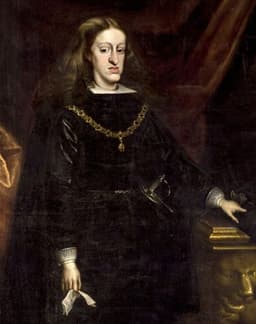
Charles II of Spain
Emperor · Modern
44.9Total
Philip of Hesse
Emperor · Modern
49.4Total
Basic Information
Born
1661
1504
Died
1700
1567
Era
Modern
Modern
Nationality
Spain
Hesse
Occupation
Emperor
Emperor
Civilization
Western
Western
Score Comparison
Military (10%)
15.0
10.0
Political (20%)
26.4
62.7
Influence (20%)
53.3
60.0
Legacy (20%)
52.0
50.0
Leadership (15%)
48.4
53.2
Strategy (15%)
58.4
35.0
TOTAL
44.9
49.4
Charles II of Spain — Complete Timeline
1661 AD
Suffered from Severe Physical and Mental DisabilitiesOther◆ Major
Charles II was born with numerous health problems due to Habsburg inbreeding, including a deformed jaw, epilepsy, and intellectual disabilities. He was unable to walk until age eight and was considered unfit to rule, leading to a regency throughout his life.
InbreedingDisabilityHabsburg Dynasty
Impact: nationaltragic
1665 AD
Became King of SpainPolitical Action
Charles II inherited the Spanish throne at age four upon the death of his father Philip IV. His reign was marked by severe physical and mental disabilities due to generations of inbreeding, leading to a regency government.
SuccessionHabsburg DynastyRegency
Impact: global
1697 AD
Signed the Treaty of RyswickPolitical Action
Charles II's government signed the Treaty of Ryswick, ending the Nine Years' War with France. Spain ceded territories in the Caribbean and Europe to France, but the treaty temporarily stabilized relations before the succession crisis.
TreatyNine Years' WarDiplomacy
Impact: regional
1700 AD
Death Without Heir Triggered War of Spanish SuccessionPolitical Action
Charles II died without an heir, leaving his throne to Philip of Anjou (grandson of Louis XIV) in his will. This sparked the War of Spanish Succession (1701-1714) as European powers contested the Bourbon succession to the Spanish throne.
Succession CrisisWar of Spanish SuccessionBourbon Dynasty
Impact: global
Philip of Hesse — Complete Timeline
1524 AD
Introduced the Reformation in HesseReform◆ Major
Philip introduced the Protestant Reformation in the Landgraviate of Hesse, adopting Lutheran doctrines and dissolving monasteries. He established a state church under his control, making Hesse a center of the Reformation and a model for other Protestant territories.
ReformationLutheranism
Impact: regionalprogressive
1527 AD
Founded the University of MarburgCultural◆ Major
Philip founded the University of Marburg, the first Protestant university in the world. It became a leading center for Lutheran theology and humanist studies, training clergy and scholars for the Reformation movement across Germany.
UniversityEducation
Impact: regionalconstructive
1531 AD
Organized the Schmalkaldic LeaguePolitical Action◆ Major
Philip was a key organizer of the Schmalkaldic League, a defensive alliance of Protestant princes and cities within the Holy Roman Empire. The league aimed to protect Lutheran territories from the Catholic Emperor Charles V, and it became the main military force of the Reformation.
Schmalkaldic LeagueProtestant Alliance
Impact: regional
1540 AD
Married Margarethe von der Saale in BigamyPolitical Action◆ Major
Philip entered into a bigamous marriage with Margarethe von der Saale, with the consent of Martin Luther and other reformers. This scandal weakened his political standing and gave his enemies, including Charles V, leverage against him, leading to his eventual imprisonment.
BigamyScandal
Impact: regionaldestructive
1547 AD
Captured at the Battle of MühlbergWar◆ Major
Philip was captured by Imperial forces at the Battle of M
Schmalkaldic WarDefeat
Impact: regionaltragic
1552 AD
Released from ImprisonmentPolitical Action◆ Major
Philip was released from Imperial captivity after the Treaty of Passau, which granted religious toleration to Lutherans. His release was part of a broader settlement that recognized the Protestant faith in the Empire, paving the way for the Peace of Augsburg.
Treaty of PassauRelease
Impact: regionalconstructive
This comparison has not been analyzed yet.
One-time AI generation (~1 minute). Scores and timeline are already available below.
Rankings
🥇
Philip of HesseLeader
Mil: 10.0Pol: 62.7Inf: 60.0
49.4
🥈
Charles II of Spain
Mil: 15.0Pol: 26.4Inf: 53.3
44.9
+4.5 behind
How This Comparison Works
Algorithm
Each figure is scored on 6 dimensions (0—100 scale) based on structured historical data: Military (10%), Political (20%), Influence (20%), Legacy (20%), Leadership (15%), Strategy (15%). The weighted total produces the final ranking.
Data Sources
Scores are computed from structured sub-indicators in the database. Scale factors adjust for era (Ancient ×0.85, Modern ×1.0) and civilization size (Eastern ×1.05, Other ×0.80) to account for differences in population and military scale.
Maximum 3 Figures
Comparisons are limited to 2—3 figures to ensure readability and statistical meaningfulness.
Error Margins
±5 points per dimension — Sub-scores are derived from historical records with inherent uncertainty. Two figures within 5 points on a dimension should be considered roughly equivalent in that area.
Total Score Accuracy
±3 points overall — The weighted combination of 6 dimensions produces a total score with approximately ±3 points of uncertainty. Differences of less than 3 points are not statistically significant— the figures are effectively tied.
Known Limitations
- Historical records are incomplete and uneven across civilizations
- Figures from oral-tradition societies may be underrepresented
- Occupation labels can misclassify multi-role figures
- Scores measure capability and impact, not moral character
- Quantitative scoring is a comparison tool, not absolute truth
Capability Radar
Military (10%) — Battles & Warfare
Battles
37
45
Win Rate
41
50
Expansion
45
35
Political (20%) — Governance & Reform
Reform
5
55
Diplomacy
10
65
Economy
5
50
Influence (20%) — Cultural & Global Reach
Cultural
10
55
Global
40
45
Legacy (20%) — Historical Impact
Historical
60
60
Longevity
50
50
Leadership (15%) — Power & Stability
Tenure
35
60
Stability
5
40
Strategy (15%) — Tactics & Innovation
Strategy
45
45
Tactics
50
40
Reform
49
30
Similar Comparisons
Comments & Discussion
No comments yet. Be the first to share your thoughts!