Loading...
Charles Theodore of Sulzbach vs Napoleon Bonaparte
Napoleon Bonaparte leads by 26.1 pts · 2 figures compared
…
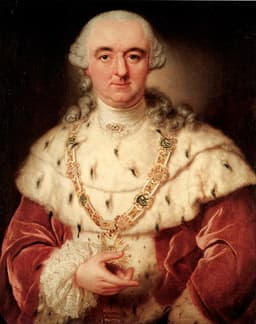
Charles Theodore of Sulzbach
Emperor · Modern
44.8Total

Napoleon Bonaparte
General · Modern
70.9Total
Basic Information
Born
1724
1769
Died
1799
1821
Era
Modern
Modern
Nationality
Sulzbach
France
Occupation
Emperor
General
Civilization
Western
Western
Score Comparison
Military (10%)
14.9
94.0
Political (20%)
46.6
72.0
Influence (20%)
48.6
40.0
Legacy (20%)
38.3
80.0
Leadership (15%)
67.0
78.0
Strategy (15%)
45.0
90.0
TOTAL
44.8
70.9
Charles Theodore of Sulzbach — Complete Timeline
1742 AD
Inherited the Electorate of the PalatinatePolitical Action◆ Major
Charles Theodore inherited the Electorate of the Palatinate and the Duchies of J
SuccessionElectorate
Impact: regional
1777 AD
Inherited the Electorate of BavariaPolitical Action
Upon the death of Elector Maximilian III Joseph of Bavaria, Charles Theodore inherited the Electorate of Bavaria. This inheritance united Bavaria with the Palatinate, creating a large Wittelsbach state, but also triggered the War of the Bavarian Succession.
SuccessionBavariaUnification
Impact: regional
1779 AD
Treaty of TeschenPolitical Action◆ Major
Charles Theodore signed the Treaty of Teschen, ending the War of the Bavarian Succession. The treaty confirmed his inheritance of Bavaria but ceded the Innviertel region to Austria, a compromise that preserved the territorial unity of his new domains.
TreatyWar of the Bavarian SuccessionTerritorial Cession
Impact: regional
Napoleon Bonaparte — Complete Timeline
1799 AD
Coup of 18 BrumaireOther◆ Major
Napoleon Bonaparte, with support from his brother Lucien and key political figures, overthrew the Directory in a bloodless coup. He established the Consulate with himself as First Consul, effectively becoming the ruler of France. This event ended the French Revolution's most unstable period.
French RevolutionCoupRise to Power
Impact: regional
1804 AD
Promulgation of the Napoleonic CodeOther◆ Major
Napoleon enacted the Civil Code of the French, known as the Napoleonic Code, a comprehensive set of laws that replaced the fragmented feudal legal systems. The code established legal equality, protected property rights, and secularized law. It became the basis for legal systems in many European and world countries.
Legal ReformNapoleonic CodeCivil Law
Impact: globalconstructive
1805 AD
Battle of AusterlitzWar◆ Major
Napoleon's Grande Arm
Napoleonic WarsBattleDecisive Victory
Impact: global
1812 AD
Invasion of RussiaWar◆ Major
Napoleon led the Grande Arm
Napoleonic WarsInvasionDisaster
Impact: globaldestructive
1815 AD
Battle of WaterlooWar◆ Major
Napoleon's French army was defeated by the combined forces of the Duke of Wellington's Anglo-Allied army and Gebhard Leberecht von Bl
Napoleonic WarsBattleFinal Defeat
Impact: globaldestructive
Expert Analysis
charles-theodore-of-sulzbach-vs-napoleon-bonaparte
### The Emperor Who Chose Peace
In the winter of 1777, two men stood at opposite ends of Europe’s chessboard, each holding a crown that would define an era. One was a young Corsican artillery officer, barely eight years old, whose name would one day thunder across a continent. The other was a fifty-three-year-old elector, Charles Theodore of Sulzbach, who had just inherited Bavaria and promptly decided that the best way to keep it was to give most of it away. Their paths never crossed, yet they embody the same historical question: what happens when ambition meets opportunity—or when caution does?
Napoleon Bonaparte and Charles Theodore of Sulzbach were both products of their time, but their times could not have been more different. Napoleon was born in 1769 on the rugged island of Corsica, a place of fierce independence and simmering resentment against French rule. His family was minor nobility, but they were poor, and young Napoleon was a prickly, ambitious outsider at French military academies. He absorbed the Enlightenment’s faith in reason and order, but also the Revolution’s intoxicating promise that a man could rise by talent alone. Charles Theodore, born in 1724, belonged to an older world. He was a Wittelsbach prince, raised in the comfortable certainty of hereditary rule. His education was about dynastic continuity, not revolutionary upheaval. He inherited his first electorate at eighteen, and by the time he was thirty, he had learned that the safest path was the one that avoided war, not the one that conquered it.
Their rise to power reveals the chasm between their worlds. Napoleon’s ascent was a whirlwind. In 1793, at age twenty-four, he drove the British out of Toulon with a brilliant artillery barrage. By 1796, he was commanding the Army of Italy, turning a ragged force into a conquering machine. The Italian campaign, with its lightning marches and crushing victories at Lodi and Arcole, made him a legend. He was not just a general; he was a phenomenon, a man who seemed to bend fortune to his will. Charles Theodore’s rise was the opposite: a quiet inheritance. In 1742, he became Elector of the Palatinate. In 1777, he inherited Bavaria. There was no battle, no drama—just a legal document and a shift in the map. He did not seize power; it was handed to him, and he accepted it with the same caution with which he had accepted everything else.
As leaders, they governed in fundamentally different keys. Napoleon was a whirlwind of action. He reorganized France into departments, centralized the tax system, and—most enduringly—codified the Napoleonic Code in 1804, a legal framework that enshrined equality before the law and property rights while rolling back revolutionary liberties for women and workers. He was a military genius, with a strategic score of 93 and a military score of 94, who redrew the map of Europe from the Battle of Austerlitz in 1805 to the disastrous invasion of Russia in 1812. Charles Theodore, by contrast, was a ruler of peace. His leadership score of 84.3 suggests competence, but his military score of 32.2 reveals a man who had no appetite for war. When the War of the Bavarian Succession erupted in 1778, he signed the Treaty of Teschen in 1779, ceding much of his inheritance to Austria in exchange for a quiet throne. He was not a coward; he was a pragmatist who knew that a small state could not survive a great-power struggle.
Their triumphs and tragedies are mirror images. Napoleon’s greatest moment was probably the Battle of Austerlitz in 1805, where he crushed the combined armies of Austria and Russia in a single day, a masterpiece of deception and timing. His worst was the retreat from Moscow in 1812, where the Russian winter and his own hubris destroyed the Grande Armée—half a million men lost. He was exiled to Elba, returned for the Hundred Days, and finally defeated at Waterloo in 1815. Charles Theodore’s greatest triumph was simply holding his throne for fifty-seven years, a quiet achievement in an age of upheaval. His tragedy was that he was remembered not for what he did, but for what he refused to do: he refused to fight for Bavaria, and the kingdom he could have built was given away at the negotiating table.
Character shaped their destinies. Napoleon was driven by an insatiable hunger for glory. “I live only for posterity,” he once said, and he meant it. He saw himself as a force of history, and he was—but that force consumed him. His arrogance, his refusal to compromise, and his belief that he could outrun the consequences of his own ambition led to his fall. Charles Theodore was driven by caution. He knew that the House of Wittelsbach could not stand against Prussia or Austria, so he bent. He made peace, kept his title, and died in 1799, still an elector, still safe. He was not a great man, but he was a survivor.
Their legacies are as different as their lives. Napoleon left behind the Napoleonic Code, the modern French state, and a legend that still inspires and terrifies. His influence score of 82 and legacy score of 78 reflect a man who reshaped Europe. Charles Theodore left behind a divided Bavaria, a reputation for timidity, and a legacy score of 52.4. He is a footnote in the history of the Holy Roman Empire, a cautionary tale about the price of peace.
In the end, these two men tell us something about the nature of power. Napoleon tried to conquer the world and lost everything. Charles Theodore tried to hold onto what he had and lost nothing except the chance to be remembered. Which is the greater failure? That is a question for the reader to decide. But one thing is certain: history belongs to the ambitious, even when they fall.
Rankings
🥇
Napoleon BonaparteLeader
Mil: 94.0Pol: 72.0Inf: 40.0
70.9
🥈
Charles Theodore of Sulzbach
Mil: 14.9Pol: 46.6Inf: 48.6
44.8
+26.1 behind
How This Comparison Works
Algorithm
Each figure is scored on 6 dimensions (0—100 scale) based on structured historical data: Military (10%), Political (20%), Influence (20%), Legacy (20%), Leadership (15%), Strategy (15%). The weighted total produces the final ranking.
Data Sources
Scores are computed from structured sub-indicators in the database. Scale factors adjust for era (Ancient ×0.85, Modern ×1.0) and civilization size (Eastern ×1.05, Other ×0.80) to account for differences in population and military scale.
Maximum 3 Figures
Comparisons are limited to 2—3 figures to ensure readability and statistical meaningfulness.
Error Margins
±5 points per dimension — Sub-scores are derived from historical records with inherent uncertainty. Two figures within 5 points on a dimension should be considered roughly equivalent in that area.
Total Score Accuracy
±3 points overall — The weighted combination of 6 dimensions produces a total score with approximately ±3 points of uncertainty. Differences of less than 3 points are not statistically significant— the figures are effectively tied.
Known Limitations
- Historical records are incomplete and uneven across civilizations
- Figures from oral-tradition societies may be underrepresented
- Occupation labels can misclassify multi-role figures
- Scores measure capability and impact, not moral character
- Quantitative scoring is a comparison tool, not absolute truth
Capability Radar
Military (10%) — Battles & Warfare
Battles
5
95
Win Rate
5
90
Expansion
10
95
Political (20%) — Governance & Reform
Reform
30
95
Diplomacy
40
80
Economy
30
85
Influence (20%) — Cultural & Global Reach
Cultural
20
85
Global
10
90
Legacy (20%) — Historical Impact
Historical
20
95
Longevity
20
90
Leadership (15%) — Power & Stability
Tenure
50
85
Stability
20
70
Strategy (15%) — Tactics & Innovation
Strategy
5
95
Tactics
5
98
Reform
5
92
Similar Comparisons
Comments & Discussion
TricolorTraitor6/17/2026
This comparison is absurd. Napoleon wasn't just an "artillery officer"—he revolutionized warfare with the corps system and mass conscription, while Charles Theodore literally traded his ancestral lands for a Habsburg pension. One man reshaped Europe; the other couldn't even hold onto Bavaria without a Prussian bailout. Calling them "both products of their time" is like comparing a hurricane to a mild drizzle.
战史考据狂6/17/2026
拿破仑在1796年意大利战役中靠快速机动以3万法军击败8万奥萨联军,这是军事史上以少胜多的经典。而卡尔·特奥多尔继承巴伐利亚后,在1778年巴伐利亚王位继承战争中几乎毫无作为,军队连基本的补给线都维持不了。拿这两人对比,要么是对拿破仑的侮辱,要么是对军事史的彻底无知。
EnlightenmentGhost6/17/2026
The deeper irony here is philosophical: Napoleon embodied the Enlightenment's radical potential—meritocracy, legal codes, secular governance—while Charles Theodore represented its failure, a fossilized prince who traded sovereignty for security. Napoleon's Civil Code still structures European law; Charles Theodore's main legacy is selling out his dynasty to Austria. One gave Europe a future; the other clung to a past that was already rotting.
数据粉碎机6/17/2026
所谓“选择和平”是美化无能。卡尔·特奥多尔统治下巴伐利亚的军费仅占预算的15%,而同期普鲁士占比超过60%。拿破仑在1805年乌尔姆战役中仅用两周就让3万奥军投降,这哪里是“选择”——卡尔·特奥多尔根本没能力打。拿平民懦夫和军事天才并列,数据上就是一场惨败。
ReductiveHistorian6/17/2026
Let's be honest: this framing is intellectually lazy. It reduces Napoleon to "ambition" and Charles Theodore to "caution," ignoring that Napoleon's ambition was forged by revolutionary chaos while Charles Theodore's caution was rational for a minor prince in a system of inherited thrones. The real tragedy is comparing apples to oranges to make a hollow philosophical point. History demands nuance, not forced parallels.