Loading...
This comparison has not been analyzed yet.
One-time AI generation (~1 minute). Scores and timeline are already available below.
Chen Yi vs Ludwig Beck
Chen Yi leads by 14.6 pts · 2 figures compared
…
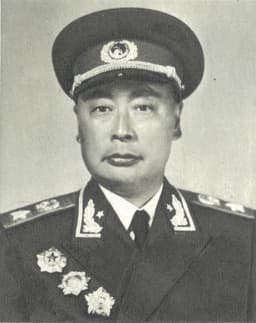
Chen Yi
General · Modern
57.5Total

Ludwig Beck
General · Modern
42.9Total
Basic Information
Born
1901
1880
Died
1972
1944
Era
Modern
Modern
Nationality
China
Germany
Occupation
General
General
Civilization
Eastern
Western
Score Comparison
Military (10%)
52.5
21.2
Political (20%)
68.0
33.6
Influence (20%)
57.2
51.8
Legacy (20%)
50.0
46.7
Leadership (15%)
62.0
43.8
Strategy (15%)
60.0
45.0
TOTAL
57.5
42.9
Chen Yi — Complete Timeline
1945 AD
Commander of the Third Field Army in the Chinese Civil WarWar◆ Major
Chen Yi commanded the Third Field Army, which played a key role in the Huaihai Campaign and the capture of Nanjing and Shanghai. His forces were instrumental in the Communist victory in eastern China.
Chinese Civil WarMilitary Campaign
Impact: nationaldestructive
1949 AD
First Mayor of Communist ShanghaiPolitical Action◆ Major
Chen Yi was appointed the first mayor of Shanghai after the Communist takeover. He oversaw the transition of China's largest city from Nationalist to Communist control, implementing economic stabilization and political consolidation.
GovernmentShanghaiCommunist China
Impact: nationalconstructive
1955 AD
Appointed Marshal of the People's Liberation ArmyPolitical Action◆ Major
Chen Yi was appointed as one of the ten marshals of the People's Liberation Army. This honor recognized his military leadership during the civil war and his role in the Communist victory.
Military HonorPLA
Impact: nationalconstructive
1958 AD
Minister of Foreign Affairs of the People's Republic of ChinaPolitical Action◆ Major
Chen Yi was appointed Minister of Foreign Affairs, serving until 1972. He represented China at international conferences, including the Geneva Conference on Laos, and advocated for the Bandung principles of non-alignment.
DiplomacyForeign Policy
Impact: global
Ludwig Beck — Complete Timeline
1935 AD
Appointed Chief of the Army General StaffPolitical Action◆ Major
Beck was appointed Chief of the Army General Staff on July 1, 1935. He oversaw the rearmament and expansion of the German army in violation of the Treaty of Versailles. He became increasingly critical of Hitler's aggressive foreign policy.
German ArmyRearmamentGeneral Staff
Impact: global
1938 AD
Resigned as Chief of Staff in ProtestPolitical Action◆ Major
Beck resigned as Chief of the Army General Staff on August 18, 1938, in protest against Hitler's plan to invade Czechoslovakia. He argued the invasion would lead to a war Germany could not win. His resignation was a significant act of military opposition.
German ResistanceCzechoslovakiaResignation
Impact: national
1944 AD
Designated Head of State in the July 20 PlotPolitical Action◆ Major
Beck was designated by the conspirators to become the provisional head of state (Reichsverweser) after Hitler's assassination. He was to lead a new government and negotiate an end to the war. He was arrested at the Bendlerblock on July 20.
July 20 PlotHead of StateCoup Plan
Impact: national
Executed at Plötzensee PrisonPolitical Action◆ Major
Beck was arrested after the failure of the July 20 plot. He was allowed to attempt suicide but failed. He was then executed by firing squad at Pl
July 20 PlotExecutionPlötzensee
Impact: nationaltragic
This comparison has not been analyzed yet.
One-time AI generation (~1 minute). Scores and timeline are already available below.
Rankings
🥇
Chen YiLeader
Mil: 52.5Pol: 68.0Inf: 57.2
57.5
🥈
Ludwig Beck
Mil: 21.2Pol: 33.6Inf: 51.8
42.9
+14.6 behind
How This Comparison Works
Algorithm
Each figure is scored on 6 dimensions (0—100 scale) based on structured historical data: Military (10%), Political (20%), Influence (20%), Legacy (20%), Leadership (15%), Strategy (15%). The weighted total produces the final ranking.
Data Sources
Scores are computed from structured sub-indicators in the database. Scale factors adjust for era (Ancient ×0.85, Modern ×1.0) and civilization size (Eastern ×1.05, Other ×0.80) to account for differences in population and military scale.
Maximum 3 Figures
Comparisons are limited to 2—3 figures to ensure readability and statistical meaningfulness.
Error Margins
±5 points per dimension — Sub-scores are derived from historical records with inherent uncertainty. Two figures within 5 points on a dimension should be considered roughly equivalent in that area.
Total Score Accuracy
±3 points overall — The weighted combination of 6 dimensions produces a total score with approximately ±3 points of uncertainty. Differences of less than 3 points are not statistically significant— the figures are effectively tied.
Known Limitations
- Historical records are incomplete and uneven across civilizations
- Figures from oral-tradition societies may be underrepresented
- Occupation labels can misclassify multi-role figures
- Scores measure capability and impact, not moral character
- Quantitative scoring is a comparison tool, not absolute truth
Capability Radar
Military (10%) — Battles & Warfare
Battles
55
10
Win Rate
60
5
Expansion
40
5
Political (20%) — Governance & Reform
Reform
50
20
Diplomacy
55
25
Economy
45
10
Influence (20%) — Cultural & Global Reach
Cultural
40
20
Global
35
20
Legacy (20%) — Historical Impact
Historical
50
40
Longevity
40
30
Leadership (15%) — Power & Stability
Tenure
60
30
Stability
50
10
Strategy (15%) — Tactics & Innovation
Strategy
55
30
Tactics
50
20
Reform
30
40
Similar Comparisons
Comments & Discussion
No comments yet. Be the first to share your thoughts!