Loading...
Christian IX of Denmark vs Napoleon Bonaparte
Napoleon Bonaparte leads by 13.1 pts · 2 figures compared
…
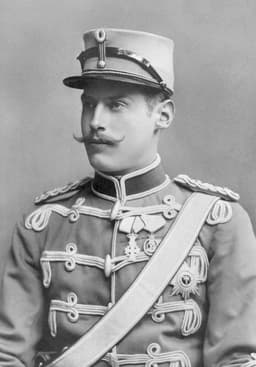
Christian IX of Denmark
Emperor · Modern
57.8Total

Napoleon Bonaparte
General · Modern
70.9Total
Basic Information
Born
1818
1769
Died
1906
1821
Era
Modern
Modern
Nationality
Denmark
France
Occupation
Emperor
General
Civilization
Western
Western
Score Comparison
Military (10%)
22.0
94.0
Political (20%)
68.0
72.0
Influence (20%)
61.0
40.0
Legacy (20%)
54.0
80.0
Leadership (15%)
72.0
78.0
Strategy (15%)
58.2
90.0
TOTAL
57.8
70.9
Christian IX of Denmark — Complete Timeline
1863 AD
Accession to the thronePolitical Action◆ Major
Christian IX became King of Denmark on November 15, 1863, after the death of King Frederick VII. His accession occurred during a period of political crisis over the Schleswig-Holstein question.
AccessionSuccession
Impact: national
Marriage alliances of his childrenPolitical Action◆ Major
Christian IX's children married into European royal families: Alexandra married Edward VII of the UK, Dagmar married Tsar Alexander III of Russia, and George became King of Greece. This earned him the nickname 'Father-in-law of Europe'.
Marriage AlliancesRoyal DiplomacyDynastic Strategy
Impact: globalconstructive
1864 AD
Second Schleswig WarWar◆ Major
Denmark under Christian IX fought the Second Schleswig War against Prussia and Austria. The war ended in Danish defeat, leading to the loss of Schleswig, Holstein, and Lauenburg, permanently reducing Danish territory.
WarDefeatTerritorial Loss
Impact: regionaltragic
1866 AD
Signing of the Danish Constitution of 1866Reform
Christian IX signed a revised constitution in 1866 that reorganized the Danish parliament (Rigsdag) and strengthened the powers of the monarchy and the upper house. This followed the political upheaval after the 1864 war.
ConstitutionPolitical Reform
Impact: national
1901 AD
Establishment of the Danish monarchy as a constitutional monarchyReform◆ Major
In 1901, Christian IX accepted the principle of parliamentary rule by appointing a government based on the majority in the Folketing (lower house). This effectively established constitutional monarchy in Denmark, limiting royal power.
Constitutional ReformParliamentary System
Impact: nationalconstructive
Napoleon Bonaparte — Complete Timeline
1799 AD
Coup of 18 BrumaireOther◆ Major
Napoleon Bonaparte, with support from his brother Lucien and key political figures, overthrew the Directory in a bloodless coup. He established the Consulate with himself as First Consul, effectively becoming the ruler of France. This event ended the French Revolution's most unstable period.
French RevolutionCoupRise to Power
Impact: regional
1804 AD
Promulgation of the Napoleonic CodeOther◆ Major
Napoleon enacted the Civil Code of the French, known as the Napoleonic Code, a comprehensive set of laws that replaced the fragmented feudal legal systems. The code established legal equality, protected property rights, and secularized law. It became the basis for legal systems in many European and world countries.
Legal ReformNapoleonic CodeCivil Law
Impact: globalconstructive
1805 AD
Battle of AusterlitzWar◆ Major
Napoleon's Grande Arm
Napoleonic WarsBattleDecisive Victory
Impact: global
1812 AD
Invasion of RussiaWar◆ Major
Napoleon led the Grande Arm
Napoleonic WarsInvasionDisaster
Impact: globaldestructive
1815 AD
Battle of WaterlooWar◆ Major
Napoleon's French army was defeated by the combined forces of the Duke of Wellington's Anglo-Allied army and Gebhard Leberecht von Bl
Napoleonic WarsBattleFinal Defeat
Impact: globaldestructive
Expert Analysis
christian-ix-of-denmark-vs-napoleon-bonaparte
**The Emperor and the Father-in-Law**
On a cold December morning in 1805, Napoleon Bonaparte stood on a hill overlooking the frozen fields of Austerlitz, watching his Grande Armée crush the combined forces of Russia and Austria. The sun rose brilliantly that day—the “Sun of Austerlitz,” he would call it—and by its light, he redrew the map of Europe with the stroke of a sword. Half a century later, another monarch, Christian IX of Denmark, would reshape Europe not through cannon fire but through the careful marriages of his children, earning the quiet title “Father-in-Law of Europe.” One man conquered nations; the other married into them. What drove these two figures to such different destinies?
**Origins**
Napoleon was born in 1769 on the island of Corsica, a place that had only recently become French. His family was minor nobility, poor and resentful of the mainland. From childhood, he carried the outsider’s hunger—a sense that he had to prove himself twice as capable as any Parisian aristocrat. The French Revolution, which erupted when he was twenty, shattered the old order and opened paths that birth alone could never have granted. For a young artillery officer with genius and ambition, the chaos was an invitation.
Christian IX, born in 1818, came from a different world entirely. He was a prince of the House of Oldenburg, but a minor one—the fourth son of a cadet branch, never expected to rule. His family lived quietly in the provincial town of Gottorp, far from the glitter of Copenhagen. Where Napoleon’s world was one of revolution and upheaval, Christian’s was one of dynastic calculation and survival. The Napoleonic Wars had already swept through Denmark, leaving it bankrupt and diminished. Christian grew up knowing that the old certainties of monarchy were fragile, and that a king’s power could vanish in a single defeat.
**Rise to Power**
Napoleon’s ascent was meteoric. At twenty-four, he drove the British out of Toulon. At twenty-six, he crushed a royalist uprising in Paris with a “whiff of grapeshot.” At thirty, he conquered Italy and Egypt. Each victory was a stepping stone, and by 1804, he crowned himself Emperor of the French in Notre Dame, taking the crown from the Pope’s hands and placing it on his own head—a gesture that said everything about his belief in self-made destiny.
Christian’s rise was a slow, patient climb. When the Danish king Frederick VII died childless in 1863, the succession fell to Christian, then forty-five years old. He had spent decades as a minor prince, watching his children make brilliant matches—Alexandra to the Prince of Wales (the future Edward VII of Britain), Dagmar to the future Tsar Alexander III of Russia, and his son William to the Greek throne as King George I. These were not accidents. Christian and his wife, Princess Louise, had calculated every alliance with the precision of chess players. By the time he took the throne, his children already sat on the thrones of Europe’s great powers.
**Leadership & Governance**
Napoleon ruled by force and genius. His military campaigns were masterpieces of speed, deception, and concentration of power. At Austerlitz in 1805, he lured the Allies into attacking his deliberately weakened right flank, then smashed their center with a hidden reserve. His leadership score of 80 and strategy score of 93 reflect a commander who could read a battlefield like a book. But his political score of 75 hints at a flaw: he could conquer, but he could not consolidate. The Napoleonic Code reformed French law and inspired legal systems across Europe, yet his endless wars bled France dry. He treated nations as chess pieces, and when he overreached—invading Russia in 1812 with 600,000 men, only to return with 30,000—the pieces turned against him.
Christian governed by patience and compromise. The Second Schleswig War of 1864, fought against Prussia and Austria, was a disaster—Denmark lost a third of its territory. But Christian learned from defeat. In 1866, he signed a revised constitution that strengthened the Danish parliament, and in 1901, he accepted the principle of parliamentary rule, effectively making Denmark a constitutional monarchy. Where Napoleon imposed order through the sword, Christian yielded power to preserve his throne. His political score of 75 matches Napoleon’s, but it was a different kind of politics: the quiet art of knowing when to bend.
**Triumph & Tragedy**
Napoleon’s greatest triumph was Austerlitz, where he destroyed a larger army and forced Austria to sue for peace. His greatest tragedy was Waterloo in 1815, where a combination of Prussian reinforcements, bad weather, and his own hesitation led to final defeat. He died in exile on Saint Helena, a prisoner of the British, still dreaming of glory.
Christian’s triumph was subtler. By the time of his death in 1906, his descendants sat on the thrones of Denmark, Britain, Russia, Greece, and Norway. His tragedy was the Second Schleswig War—a national humiliation that could have ended his reign. But he turned it into a lesson, using defeat to secure the monarchy’s future through constitutional reform. Where Napoleon’s tragedy was the result of overreach, Christian’s was the result of weakness—and he learned from it.
**Character & Destiny**
Napoleon was a man of fire: restless, brilliant, and ultimately self-destructive. “Impossible is a word to be found only in the dictionary of fools,” he once said. He believed that will alone could reshape the world, and for a time, it did. But his personality—arrogant, impatient, contemptuous of limits—drove him to overreach. He could not stop.
Christian was a man of water: patient, adaptable, and enduring. He understood that a small nation could not fight the great powers, but it could marry them. His strategy was not conquest but connection. “A king is only as strong as his alliances,” he might have said. His personality—cautious, diplomatic, self-effacing—allowed him to survive where Napoleon fell.
**Legacy**
Napoleon’s legacy is written in stone and law. The Napoleonic Code, the French administrative system, the metric system—these endure. He is remembered as a military genius and a tyrant, a liberator and a conqueror. His influence score of 82 places him among history’s giants, but his legacy is contested: a hero to some, a monster to others.
Christian’s legacy is written in bloodlines. His descendants include the current kings of Denmark, Norway, and the United Kingdom, and the former tsars of Russia. He is remembered as the “Father-in-Law of Europe,” a man who secured his dynasty not through war but through marriage. His legacy score of 67.6 is lower than Napoleon’s, but it is more peaceful. He gave his country a stable constitutional monarchy that survives to this day, while Napoleon’s empire crumbled in a generation.
**Conclusion**
Standing at the end of their stories, one cannot help but reflect on the strange arithmetic of history. Napoleon conquered Europe with a sword and died in exile; Christian married into Europe and died in his bed. Both shaped their eras, but in opposite ways. Napoleon believed that power came from the barrel of a cannon; Christian knew it came from the cradle. Perhaps the true measure of a leader is not how much they take, but how much they leave behind. Napoleon left a legend; Christian left a family. In the end, the Father-in-Law of Europe may have understood something the Emperor never did: that the strongest bonds are not forged in battle, but in quiet, patient love.
Rankings
🥇
Napoleon BonaparteLeader
Mil: 94.0Pol: 72.0Inf: 40.0
70.9
🥈
Christian IX of Denmark
Mil: 22.0Pol: 68.0Inf: 61.0
57.8
+13.1 behind
How This Comparison Works
Algorithm
Each figure is scored on 6 dimensions (0—100 scale) based on structured historical data: Military (10%), Political (20%), Influence (20%), Legacy (20%), Leadership (15%), Strategy (15%). The weighted total produces the final ranking.
Data Sources
Scores are computed from structured sub-indicators in the database. Scale factors adjust for era (Ancient ×0.85, Modern ×1.0) and civilization size (Eastern ×1.05, Other ×0.80) to account for differences in population and military scale.
Maximum 3 Figures
Comparisons are limited to 2—3 figures to ensure readability and statistical meaningfulness.
Error Margins
±5 points per dimension — Sub-scores are derived from historical records with inherent uncertainty. Two figures within 5 points on a dimension should be considered roughly equivalent in that area.
Total Score Accuracy
±3 points overall — The weighted combination of 6 dimensions produces a total score with approximately ±3 points of uncertainty. Differences of less than 3 points are not statistically significant— the figures are effectively tied.
Known Limitations
- Historical records are incomplete and uneven across civilizations
- Figures from oral-tradition societies may be underrepresented
- Occupation labels can misclassify multi-role figures
- Scores measure capability and impact, not moral character
- Quantitative scoring is a comparison tool, not absolute truth
Capability Radar
Military (10%) — Battles & Warfare
Battles
35
95
Win Rate
41
90
Expansion
40
95
Political (20%) — Governance & Reform
Reform
30
95
Diplomacy
75
80
Economy
40
85
Influence (20%) — Cultural & Global Reach
Cultural
40
85
Global
55
90
Legacy (20%) — Historical Impact
Historical
60
95
Longevity
55
90
Leadership (15%) — Power & Stability
Tenure
60
85
Stability
65
70
Strategy (15%) — Tactics & Innovation
Strategy
43
95
Tactics
47
98
Reform
53
92
Similar Comparisons
Comments & Discussion
CorsicanThunder6/17/2026
Look, comparing a battlefield emperor to a marriage-broker king is like comparing a lion to a matchmaker. Napoleon didn't need dynastic luck—he built his empire by crushing the Prussians at Jena in six weeks flat. Christian IX just sat back and let his daughter Alexandra marry the future Edward VII. One man earned his legend at Austerlitz; the other earned a wedding album. Give me the emperor, every time.
数据拆解师6/17/2026
拿数据说话,拿破仑横扫欧洲靠的是75场胜仗和60万大军的后勤神话,还搞了《拿破仑法典》这个制度遗产。克里斯蒂安九世呢?他靠的是4个孩子的婚事,纯属运气爆棚的基因彩票。别拿皇室红娘和历史巨人相提并论,数据上根本不是一个量级。
AntiqueRhetor6/17/2026
The comparison is elegant but misleading. Napoleon’s ambition was Promethean—he told Goethe, “Politics is fate.” Christian IX’s influence was glacial, seeping through drawing rooms rather than battlefields. Yet both understood the same truth: Europe’s chessboard moves on multiple axes. The Emperor won checkmate in decades; the Father-in-Law played a patient gambit that lasted generations. One reshaped laws, the other bloodlines. Neither was passive, but one roared while the other whispered.
旧式史官6/17/2026
两位都算是欧洲格局的塑造者,但路径天差地别。拿破仑在1812年俄国寒冬里折戟,输掉了60万大军;克里斯蒂安九世却在1864年普丹战争中眼睁睁看着石勒苏益格-荷尔施泰因被俾斯麦吞并,毫无还手之力。一个死于流放中的野心膨胀,一个葬在罗斯基勒大教堂的宁静墓穴。这不是同一级别的棋手,一个下的是生死棋,一个下的是家族牌。
QuietDynast6/17/2026
Everyone romanticizes Napoleon’s cannon smoke, but Christian IX’s strategy was subtler—and arguably more permanent. By marrying his daughter Dagmar to Tsar Alexander III, he linked Denmark to Russian power. By installing his son as King George I of Greece, he planted a dynasty in the Balkans that lasted until 1974. Napoleon’s empire crumbled in a decade; Christian’s network held for over a century. Which legacy would you rather bet your throne on?