Loading...
Cipriano Castro vs Napoleon Bonaparte
Napoleon Bonaparte leads by 27.0 pts · 2 figures compared
…
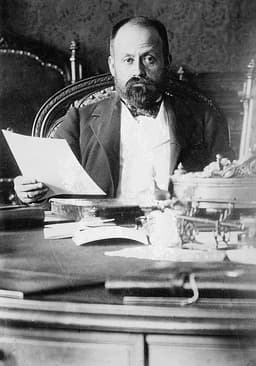
Cipriano Castro
General · Modern
43.9Total

Napoleon Bonaparte
General · Modern
70.9Total
Basic Information
Born
1858
1769
Died
1924
1821
Era
Modern
Modern
Nationality
Venezuela
France
Occupation
General
General
Civilization
Western
Western
Score Comparison
Military (10%)
38.3
94.0
Political (20%)
35.1
72.0
Influence (20%)
51.0
40.0
Legacy (20%)
39.2
80.0
Leadership (15%)
54.2
78.0
Strategy (15%)
41.7
90.0
TOTAL
43.9
70.9
Cipriano Castro — Complete Timeline
1899 AD
Seizure of Power in VenezuelaPolitical Action◆ Major
Castro led a successful invasion from Colombia, seizing power in Venezuela. He established a dictatorship and ruled with an iron fist, suppressing opposition and centralizing authority.
CoupDictatorshipInvasion
Impact: nationaldestructive
1901 AD
Suppression of the Libertadora RevolutionWar◆ Major
Castro suppressed the Libertadora Revolution, a major uprising led by his political opponents. The rebellion was crushed after a long and bloody civil war, but it weakened Castro's regime and led to widespread destruction.
Civil WarSuppressionLibertadora Revolution
Impact: nationaldestructive
1902 AD
Venezuelan Blockade CrisisWar◆ Major
Castro's refusal to pay foreign debts led to a naval blockade of Venezuela by Britain, Germany, and Italy. The blockade forced Castro to negotiate and submit to international arbitration, damaging Venezuela's sovereignty.
BlockadeDebt CrisisInternational Conflict
Impact: globaldestructive
1908 AD
Exile and DeathPolitical Action◆ Major
Castro was overthrown by his vice president, Juan Vicente G
OverthrowExileDeath
Impact: nationaltragic
Napoleon Bonaparte — Complete Timeline
1799 AD
Coup of 18 BrumaireOther◆ Major
Napoleon Bonaparte, with support from his brother Lucien and key political figures, overthrew the Directory in a bloodless coup. He established the Consulate with himself as First Consul, effectively becoming the ruler of France. This event ended the French Revolution's most unstable period.
French RevolutionCoupRise to Power
Impact: regional
1804 AD
Promulgation of the Napoleonic CodeOther◆ Major
Napoleon enacted the Civil Code of the French, known as the Napoleonic Code, a comprehensive set of laws that replaced the fragmented feudal legal systems. The code established legal equality, protected property rights, and secularized law. It became the basis for legal systems in many European and world countries.
Legal ReformNapoleonic CodeCivil Law
Impact: globalconstructive
1805 AD
Battle of AusterlitzWar◆ Major
Napoleon's Grande Arm
Napoleonic WarsBattleDecisive Victory
Impact: global
1812 AD
Invasion of RussiaWar◆ Major
Napoleon led the Grande Arm
Napoleonic WarsInvasionDisaster
Impact: globaldestructive
1815 AD
Battle of WaterlooWar◆ Major
Napoleon's French army was defeated by the combined forces of the Duke of Wellington's Anglo-Allied army and Gebhard Leberecht von Bl
Napoleonic WarsBattleFinal Defeat
Impact: globaldestructive
Expert Analysis
cipriano-castro-vs-napoleon-bonaparte
# The Emperor and the Caudillo: Two Paths to Power, Two Ends of Glory
In the winter of 1815, Napoleon Bonaparte stood on the deck of the *Bellerophon*, watching the coast of France dissolve into the gray Atlantic mist. He was fifty-one days short of his forty-sixth birthday, and his empire had crumbled into exile on a remote Atlantic rock. Half a world away and nearly a century later, in the summer of 1908, Cipriano Castro boarded a ship for Europe, seeking medical treatment for a mysterious ailment. He never saw Venezuela again. Both men seized power through military force, both defied the great powers of their age, and both ended their careers in exile. But where Napoleon reshaped the legal and political foundations of Europe, Castro left behind a country bankrupt, blockaded, and begging for stability. What separated the genius from the gambler?
Origins
Napoleon was born in 1769 on the rugged island of Corsica, a territory only recently annexed by France. His family was minor nobility, but they were poor, and young Napoleon entered a military academy at age nine, a scholarship boy among the sons of aristocrats. He was small, intense, and fiercely ambitious—a provincial outsider who read Plutarch’s lives of ancient heroes and dreamed of conquest. The French Revolution, which erupted when he was twenty, shattered the old order and opened every door to talent. In that chaos, a Corsican artillery officer with a gift for mathematics and a hunger for glory could rise as fast as his cannon could fire.
Cipriano Castro was born in 1858 in the Andean state of Táchira, Venezuela, into a family of cattle ranchers and coffee growers. The Venezuelan he knew was a patchwork of regional strongmen, a country that had gained independence from Spain in 1821 only to fracture into decades of civil war. Castro studied law but never graduated; he preferred the life of a caudillo—a local warlord who commanded loyalty through personal charisma, family connections, and a ready pistol. If Napoleon was shaped by the rational, revolutionary ideals of Enlightenment France, Castro was forged in the raw, personal politics of the Latin American *caudillaje*, where power was not an office but a man on horseback.
Rise to Power
Napoleon’s ascent was a masterpiece of timing and talent. He first proved himself at the Siege of Toulon in 1793, where his artillery plan drove the British from the harbor. By 1796, at twenty-six, he was given command of the French army in Italy. In a series of lightning campaigns, he defeated the Austrians and their allies, forcing peace treaties that made him a national hero. His 1798 Egyptian campaign was a military failure but a propaganda triumph, and by 1799 he returned to a France desperate for order. In the coup of 18 Brumaire, he seized power as First Consul. He was thirty years old. The path was paved by the Revolution’s collapse into corruption and violence—a vacuum that only a general with a sword and a vision could fill.
Castro’s rise was narrower and more violent. In 1899, at age forty-one, he led a small army of Táchira mountaineers across the border from Colombia into Venezuela. The national government was weak, divided, and despised. Castro’s forces marched on Caracas with the momentum of a landslide, and by October he had installed himself as president. There was no grand ideology, no reform of the state—only the simple logic of the caudillo: he who controls the capital, controls the country. His seizure of power was a *coup d'état* dressed as a revolution, and he ruled with a personalist dictatorship that lasted until his overthrow in 1908.
Leadership & Governance
Napoleon governed as he fought: with speed, clarity, and a belief that order was the highest virtue. His Napoleonic Code, enacted in 1804, standardized French law, abolished feudal privileges, and established legal equality before the state. It spread across Europe as his armies marched, planting the seeds of modern civil law in Germany, Italy, and Poland. He reformed education, created the Bank of France, and built roads and canals that tied his empire together. His military genius was undeniable—his 1805 victory at Austerlitz remains a textbook example of battlefield brilliance, with a strategy score of 93. But his political wisdom was uneven. He crowned himself emperor in 1804, alienated the republicans who had lifted him to power, and repeatedly provoked wars he could have avoided.
Castro ruled Venezuela with a far cruder hand. He suppressed the Libertadora Revolution in 1901, crushing a major uprising led by his political opponents. But his governance was defined less by reform than by recklessness. He refused to pay foreign debts, and in 1902, Britain, Germany, and Italy imposed a naval blockade on Venezuela—a humiliating demonstration that Castro’s defiance had no army or navy to back it. He spent lavishly on his personal lifestyle and his military, while the economy stagnated. His political score of 72 matches Napoleon’s 75, but that number masks a crucial difference: Napoleon built institutions that outlasted him; Castro built a personality cult that collapsed the moment he left the country.
Triumph & Tragedy
Napoleon’s greatest triumph was Austerlitz, where he destroyed the combined armies of Russia and Austria in a single day. His greatest tragedy was the 1812 invasion of Russia, where he lost half a million men to winter, hunger, and scorched-earth tactics. His final defeat at Waterloo in 1815 was a close-run thing—a matter of hours and miscommunications—but it sealed his fate. He died in 1821 on Saint Helena, a prisoner of the British, writing memoirs that would transform him into a legend.
Castro’s triumph was simply seizing and holding power for nine years—a feat in a country where presidents often lasted months. His tragedy was that his rule left Venezuela weaker than he found it. The 1902 blockade forced him to submit to international arbitration, and his refusal to modernize the economy or the military ensured that his regime rested entirely on his own health. In 1908, when he sailed to Europe for medical treatment, his vice president Juan Vicente Gómez staged a coup. Castro never returned. He died in exile in 1924, a bitter footnote in Venezuelan history.
Character & Destiny
Napoleon was a man of boundless energy and self-belief. He once said, “Impossible is a word to be found only in the dictionary of fools.” That confidence drove him to conquer Europe, but it also drove him to overreach. He could not stop. His character was a double-edged sword: the same ambition that lifted him from Corsica to the Tuileries also led him to Moscow and Waterloo.
Castro was a man of narrow vision and personal grievance. He saw power as a prize, not a responsibility. His defiance of the European powers was less a strategic calculation than a stubborn refusal to bend. He once declared, “Venezuela is not a colony of Europe,” but he had no plan to make that independence sustainable. His character was that of a provincial strongman, not a statesman—and his destiny was to be remembered, if at all, as a prelude to the far more brutal dictatorship of Gómez.
Legacy
Napoleon’s legacy is carved into the bedrock of the modern world. His legal code, his administrative reforms, and his military tactics influenced every subsequent European power. His total score of 82.4 reflects a man who changed the course of history, for better and for worse. He is studied, debated, and mythologized—a figure who still stirs passion two centuries after his death.
Castro’s legacy is a whisper in the archives. His total score of 63.6 places him as a minor figure in a turbulent era. In Venezuela, he is remembered as a chaotic precursor to the Gómez dictatorship, a man who squandered opportunity and left his country more vulnerable than he found it. Outside of specialized academic circles, his name is unknown.
Conclusion
The difference between Napoleon and Castro is not simply a matter of scale. It is a difference of vision. Napoleon dreamed of a unified Europe under a rational legal order, and though he failed, his dream outlived him. Castro dreamed only of ruling Venezuela, and when he lost it, nothing remained. Both men rose through violence, both fell through overreach, but one built a cathedral of laws and the other built a house of cards. In the end, history remembers those who built for the ages, not those who ruled for themselves.
Rankings
🥇
Napoleon BonaparteLeader
Mil: 94.0Pol: 72.0Inf: 40.0
70.9
🥈
Cipriano Castro
Mil: 38.3Pol: 35.1Inf: 51.0
43.9
+27.0 behind
How This Comparison Works
Algorithm
Each figure is scored on 6 dimensions (0—100 scale) based on structured historical data: Military (10%), Political (20%), Influence (20%), Legacy (20%), Leadership (15%), Strategy (15%). The weighted total produces the final ranking.
Data Sources
Scores are computed from structured sub-indicators in the database. Scale factors adjust for era (Ancient ×0.85, Modern ×1.0) and civilization size (Eastern ×1.05, Other ×0.80) to account for differences in population and military scale.
Maximum 3 Figures
Comparisons are limited to 2—3 figures to ensure readability and statistical meaningfulness.
Error Margins
±5 points per dimension — Sub-scores are derived from historical records with inherent uncertainty. Two figures within 5 points on a dimension should be considered roughly equivalent in that area.
Total Score Accuracy
±3 points overall — The weighted combination of 6 dimensions produces a total score with approximately ±3 points of uncertainty. Differences of less than 3 points are not statistically significant— the figures are effectively tied.
Known Limitations
- Historical records are incomplete and uneven across civilizations
- Figures from oral-tradition societies may be underrepresented
- Occupation labels can misclassify multi-role figures
- Scores measure capability and impact, not moral character
- Quantitative scoring is a comparison tool, not absolute truth
Capability Radar
Military (10%) — Battles & Warfare
Battles
30
95
Win Rate
35
90
Expansion
25
95
Political (20%) — Governance & Reform
Reform
20
95
Diplomacy
25
80
Economy
15
85
Influence (20%) — Cultural & Global Reach
Cultural
15
85
Global
20
90
Legacy (20%) — Historical Impact
Historical
25
95
Longevity
10
90
Leadership (15%) — Power & Stability
Tenure
45
85
Stability
10
70
Strategy (15%) — Tactics & Innovation
Strategy
30
95
Tactics
25
98
Reform
20
92
Similar Comparisons
Comments & Discussion
NapoleonFanboy426/17/2026
Look, Castro was a two-bit caudillo with a drinking problem and a talent for borrowing money he couldn't pay back. Napoleon conquered most of Europe, redrew borders, and created the Napoleonic Code that still shapes modern law. Castro's biggest achievement? Getting his country blockaded by everyone and dying in exile with zero legacy. You cannot compare a demigod of military strategy to a provincial thug who couldn't even hold his own army together. Next.
历史毒舌家6/17/2026
拿破仑好歹在奥斯特里茨战役中以少胜多,打出教科书级的歼灭战。卡斯特罗呢?他唯一像样点的战果是跟哥伦比亚打了一场毫无意义的边境冲突,最后还把国库掏空去赔款。这也能叫军事天才?笑死,他连拿破仑的影子都摸不着,顶多算个二流土匪头子。
DataSkeptic996/17/2026
Sure, Napoleon's stats look impressive on paper—60+ battles, tactical innovations, permanent legal reforms. But look at the cost: nearly 1 million French soldiers dead, economies wrecked across Europe, and he ended up on St. Helena with zero actual political durability. Castro at least managed to hold onto power for nearly a decade without bankrupting his entire continent. Napoleon was just a more efficient destroyer with better PR.
法科学生6/17/2026
比法律遗产?拿破仑法典是现代民法之父,至今法国、德国、意大利还在用它。卡斯特罗留下啥?一个被外国军舰堵在港口的烂摊子,连国内商人都恨他。他连基本税务改革都没搞明白,只会印钞票和扣押外国油轮。这人也配跟民法典的奠基人放在一起?省省吧。