Loading...
Constantius I vs Tuoba Gui
Tuoba Gui leads by 3.7 pts · 2 figures compared
…
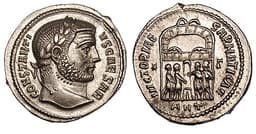
Constantius I
Emperor · Ancient
57.8Total

Tuoba Gui
Emperor · Ancient
61.5Total
Basic Information
Born
250
371
Died
306
409
Era
Ancient
Ancient
Nationality
Roman Empire
Northern Wei
Occupation
Emperor
Emperor
Civilization
Western
Eastern
Score Comparison
Military (10%)
50.0
72.0
Political (20%)
68.0
72.0
Influence (20%)
54.9
58.3
Legacy (20%)
50.0
56.0
Leadership (15%)
74.0
53.2
Strategy (15%)
52.5
69.1
TOTAL
57.8
61.5
Constantius I — Complete Timeline
296 AD
Recovery of Britain from Carausius and AllectusWar◆ Major
Constantius I led an invasion to reclaim Britain from the usurper Allectus, who had succeeded Carausius. His forces landed near London and defeated Allectus, restoring Britain to the Roman Empire and ending the breakaway Britannic Empire.
BritainReconquestUsurper
Impact: regionalconstructive
298 AD
Campaign against the AlemanniWar◆ Major
Constantius I defeated the Alemanni at the Battle of Lingones (modern Langres) and later at Vindonissa. These victories secured the Rhine frontier and earned him the title Germanicus Maximus, strengthening his reputation as a capable military commander.
CampaignAlemanniRhine Frontier
Impact: regional
305 AD
Elevation to AugustusPolitical Action◆ Major
Upon the abdication of Diocletian and Maximian, Constantius I became the senior Augustus of the Western Roman Empire as part of the Tetrarchy. He ruled jointly with Galerius in the East, but his reign was short-lived as he died the following year.
TetrarchySuccessionAugustus
Impact: global
306 AD
Death at Eboracum (York)Other◆ Major
Constantius I died at Eboracum (modern York) while on campaign against the Picts in northern Britain. His son Constantine was proclaimed Augustus by the troops, setting the stage for Constantine's eventual rise to sole emperor.
DeathSuccessionConstantine
Impact: global
Toleration of Christians (Edict of Milan precursor)Political Action
Constantius I, unlike his co-emperor Galerius, was tolerant of Christians and did not enforce the Diocletianic persecution in his territories. This policy of religious tolerance foreshadowed the Edict of Milan issued by his son Constantine.
ToleranceChristianityReligion
Impact: regionalconstructive
Tuoba Gui — Complete Timeline
386 AD
Foundation of the Northern Wei dynastyPolitical Action◆ Major
Tuoba Gui declared himself Prince of Dai, later Emperor Daowu of Northern Wei, founding the Northern Wei dynasty. He united the Tuoba Xianbei tribes and established a capital at Shengle (modern Inner Mongolia), beginning a dynasty that would rule northern China for nearly 150 years.
Dynasty FoundationNorthern Wei
Impact: regionalconstructive
395 AD
Battle of Canhe SlopeWar◆ Major
Tuoba Gui defeated the Later Yan army at the Battle of Canhe Slope. The victory was decisive, with massive casualties on the Later Yan side. This battle broke the power of Later Yan and allowed Northern Wei to expand into central Hebei.
BattleNorthern Wei Expansion
Impact: regionaldestructive
398 AD
Conquest of the Later Yan capitalWar◆ Major
Tuoba Gui captured the Later Yan capital of Zhongshan (modern Dingzhou, Hebei). He annexed the Later Yan territories and moved the Northern Wei capital to Pingcheng (modern Datong), establishing a strong base for further conquests.
ConquestNorthern Wei Expansion
Impact: regionaldestructive
400 AD
Implementation of the 'equal-field' land systemReform◆ Major
Tuoba Gui introduced the 'equal-field' (juntian) land system, distributing land to peasants based on the number of able-bodied laborers. This reform increased agricultural productivity, stabilized tax revenues, and reduced the power of landed aristocrats.
Land ReformEconomic Policy
Impact: regionalconstructive
409 AD
Assassination of Tuoba GuiPolitical Action◆ Major
Tuoba Gui was assassinated by his son Tuoba Shao in a palace coup. The assassination stemmed from Tuoba Gui's increasingly erratic and paranoid behavior in his later years. His death led to a succession crisis, but his son Tuoba Si eventually took the throne.
AssassinationSuccession Crisis
Impact: regionaltragic
Expert Analysis
Origins
Constantius I (c. 250–306 AD) was born in Illyria (modern Balkans) to a noble family, possibly related to Emperor Claudius Gothicus. He rose through the military ranks under Emperor Aurelian and later served as a praetorian prefect. His early career was marked by competence and loyalty, traits that caught the attention of Diocletian, who appointed him as Caesar (junior emperor) in 293 AD. Constantius's background was firmly Roman, with a focus on military administration.
Tuoba Gui (371–409 AD) was born into the Tuoba clan of the Xianbei nomads, a confederation that dominated the steppes north of China. His grandfather was the chief of the Tuoba, but the clan was fractured after his grandfather's death. Tuoba Gui was raised in exile under the protection of the Former Qin dynasty, where he learned Chinese administrative practices. His early life was shaped by the need to reunite the Tuoba tribes and assert independence from the Later Yan.
Rise to Power
Constantius I was appointed Caesar by Diocletian in 293 AD as part of the Tetrarchy, a system of four co-emperors. His domain included Gaul, Britain, and Spain. His first major challenge was the usurper Carausius, who had declared himself emperor in Britain and northern Gaul. Constantius's forces recaptured Boulogne in 293 AD, and after Carausius's assassination by his treasurer Allectus, Constantius launched a successful invasion of Britain in 296 AD, landing near London and defeating Allectus. This secured the western provinces and demonstrated his military competence. Upon the abdication of Diocletian and Maximian in 305 AD, Constantius became the senior Augustus of the West, ruling from Trier.
Tuoba Gui's rise began in 386 AD when he declared himself Prince of Dai, reviving the title of his ancestors. He initially allied with the Later Yan dynasty to defeat the rival Xianbei tribes. His turning point came in 395 AD at the Battle of Canhe Slope, where he annihilated a Later Yan army, reportedly killing 60,000–70,000 soldiers. This victory allowed him to capture the Later Yan capital, Zhongshan, in 397 AD, annexing their territories. By 398 AD, he had moved his capital to Pingcheng (modern Datong) and proclaimed himself Emperor Daowu of Northern Wei, founding a dynasty that would dominate northern China.
Leadership & Governance
Constantius I governed as a traditional Roman emperor, focusing on frontier defense and administrative stability. He was known for his moderation, especially in religious matters. Unlike his co-emperor Galerius, Constantius did not enforce the Diocletianic persecution of Christians in his territories, allowing them to worship freely. This policy earned him a reputation for tolerance and foreshadowed the Edict of Milan (313 AD) issued by his son Constantine. In military affairs, he campaigned effectively against the Alemanni at the Battles of Lingones (298 AD) and Vindonissa, securing the Rhine frontier. His leadership style was collegial within the Tetrarchy, but he maintained authority through competence rather than terror.
Tuoba Gui's governance blended Xianbei tribal traditions with Chinese bureaucratic models. He implemented the 'equal-field' land system (juntian) in 485 AD, which distributed land to peasants based on the number of able-bodied laborers, tying them to the land and ensuring tax revenue. This reform was revolutionary for its time and later adopted by the Sui and Tang dynasties. He also established a centralized administration with Chinese-style offices, while retaining the Xianbei tribal structure for military organization. However, his later years were marked by paranoia and cruelty, as he suspected his family and officials of plotting against him. He executed many, including his own son Tuoba Shao, which ultimately led to his assassination in 409 AD.
Triumph & Tragedy
Constantius I's greatest triumph was the recovery of Britain from the usurper Allectus in 296 AD, which restored Roman control over the island and secured the western provinces. His victory at the Battle of Lingones against the Alemanni also reinforced the Rhine frontier. His tragic failure was his inability to fully stabilize the Tetrarchy; his death in 306 AD at Eboracum (York) triggered a succession crisis as his son Constantine was proclaimed Augustus by the troops, leading to a series of civil wars that ultimately ended the Tetrarchy.
Tuoba Gui's triumph was the foundation of the Northern Wei dynasty, which unified northern China after the chaos of the Sixteen Kingdoms period. His military victories, especially at Canhe Slope, eliminated the Later Yan as a rival. The equal-field system boosted agricultural productivity and state revenues. His tragedy was his descent into paranoia, which led to the assassination of his son and ultimately his own murder at the hands of Tuoba Shao. This internal instability temporarily weakened the dynasty, though it recovered under his successors.
Character & Destiny
Constantius I was described by ancient sources as a mild and capable ruler, highly regarded by his subjects. His decision to tolerate Christians was pragmatic, as his territories had fewer Christians than the East, but it also reflected a broader tolerance. His character of moderation and competence allowed him to maintain stability in the West. His destiny was to die naturally, but his greatest legacy was his son, Constantine the Great, who would transform the Roman Empire.
Tuoba Gui was a brilliant military strategist and reformer, scoring 69.1 in strategy compared to Constantius's 52.5. However, his personality was volatile: he could be magnanimous in victory but increasingly paranoid in peace. His character of ambition and ruthlessness enabled him to found a dynasty, but his instability led to his violent end. His destiny was cut short at age 38, leaving a mixed legacy.
Legacy
Constantius I's legacy is often overshadowed by his son Constantine, but his own achievements were significant. He secured the Rhine and British frontiers, and his religious tolerance set a precedent for his son's Edict of Milan. He is remembered as a capable administrator and military leader who upheld the Tetrarchy. His overall score of 57.8 reflects a solid but not exceptional career.
Tuoba Gui's legacy is more profound: he founded the Northern Wei, which ruled northern China for nearly 150 years and laid the foundation for the reunification of China under the Sui and Tang. The equal-field system influenced Chinese land policy for centuries. His military conquests reshaped the political map of East Asia. His total score of 61.5 reflects his greater impact, especially in military (72.0 vs 50.0) and political (72.0 vs 68.0) categories.
Conclusion
Tuoba Gui had a greater impact than Constantius I. While Constantius was a competent Roman emperor who secured frontiers and enabled his son's rise, Tuoba Gui founded a dynasty that unified northern China, implemented a revolutionary land system, and shaped Chinese history for centuries. In military conquests, Tuoba Gui scored 72.0 against Constantius's 50.0, and in political innovation, his equal-field reform was more transformative than Constantius's religious tolerance. Constantius's legacy is largely tied to his son, whereas Tuoba Gui's achievements stand on their own. Thus, Tuoba Gui emerges as the more consequential historical figure.
Rankings
🥇
Tuoba GuiLeader
Mil: 72.0Pol: 72.0Inf: 58.3
61.5
🥈
Constantius I
Mil: 50.0Pol: 68.0Inf: 54.9
57.8
+3.7 behind
How This Comparison Works
Algorithm
Each figure is scored on 6 dimensions (0—100 scale) based on structured historical data: Military (10%), Political (20%), Influence (20%), Legacy (20%), Leadership (15%), Strategy (15%). The weighted total produces the final ranking.
Data Sources
Scores are computed from structured sub-indicators in the database. Scale factors adjust for era (Ancient ×0.85, Modern ×1.0) and civilization size (Eastern ×1.05, Other ×0.80) to account for differences in population and military scale.
Maximum 3 Figures
Comparisons are limited to 2—3 figures to ensure readability and statistical meaningfulness.
Error Margins
±5 points per dimension — Sub-scores are derived from historical records with inherent uncertainty. Two figures within 5 points on a dimension should be considered roughly equivalent in that area.
Total Score Accuracy
±3 points overall — The weighted combination of 6 dimensions produces a total score with approximately ±3 points of uncertainty. Differences of less than 3 points are not statistically significant— the figures are effectively tied.
Known Limitations
- Historical records are incomplete and uneven across civilizations
- Figures from oral-tradition societies may be underrepresented
- Occupation labels can misclassify multi-role figures
- Scores measure capability and impact, not moral character
- Quantitative scoring is a comparison tool, not absolute truth
Capability Radar
Military (10%) — Battles & Warfare
Battles
45
75
Win Rate
50
80
Expansion
35
85
Political (20%) — Governance & Reform
Reform
45
72
Diplomacy
55
68
Economy
50
60
Influence (20%) — Cultural & Global Reach
Cultural
30
65
Global
40
55
Legacy (20%) — Historical Impact
Historical
55
70
Longevity
60
60
Leadership (15%) — Power & Stability
Tenure
50
65
Stability
55
55
Strategy (15%) — Tactics & Innovation
Strategy
60
82
Tactics
55
78
Reform
40
70
Similar Comparisons
Comments & Discussion
No comments yet. Be the first to share your thoughts!