Loading...
This comparison has not been analyzed yet.
One-time AI generation (~1 minute). Scores and timeline are already available below.
Decentius vs Theodosius the Great
Theodosius the Great leads by 24.6 pts · 2 figures compared
…
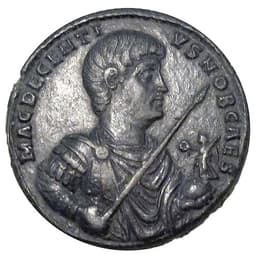
Decentius
Emperor · Ancient
44.9Total
Theodosius the Great
Emperor · Ancient
69.5Total
Basic Information
Born
290
347
Died
353
395
Era
Ancient
Ancient
Nationality
Roman Empire
Roman Empire
Occupation
Emperor
Emperor
Civilization
Western
Western
Score Comparison
Military (10%)
45.0
65.0
Political (20%)
39.4
65.0
Influence (20%)
56.4
75.0
Legacy (20%)
39.2
75.0
Leadership (15%)
45.0
68.0
Strategy (15%)
38.3
55.0
TOTAL
44.9
69.5
Decentius — Complete Timeline
350 AD
Appointed Caesar by MagnentiusPolitical Action◆ Major
After Magnentius usurped the Western Roman throne, he appointed his brother Decentius as Caesar. Decentius was given command of Gaul and tasked with defending the Rhine frontier against Germanic tribes.
Imperial AppointmentUsurpationMagnentius
Impact: regional
352 AD
Failed to defend Gaul against AlemanniWar◆ Major
Decentius's forces failed to prevent Alemanni incursions into Gaul, leading to significant devastation. This military failure weakened Magnentius's position and undermined confidence in the usurper regime.
Military DefeatGermanic InvasionGaul
Impact: regionaldestructive
353 AD
Committed suicide after Magnentius's defeatOther◆ Major
After Magnentius was defeated by Constantius II at the Battle of Mons Seleucus, Decentius hanged himself. His suicide ended the usurper dynasty and restored the Western Roman Empire to Constantius II's control.
SuicideUsurpationConstantius II
Impact: regionaltragic
Theodosius the Great — Complete Timeline
380 AD
Edict of ThessalonicaReform
Theodosius issued the Edict of Thessalonica, declaring Nicene Christianity the official state religion of the Roman Empire. All other Christian sects were deemed heretical, and pagan practices were increasingly suppressed.
ChristianityReligious PolicyState Religion
Impact: globalprogressive
390 AD
Massacre of ThessalonicaPolitical Action◆ Major
Theodosius ordered a massacre in Thessalonica after a riot killed a Roman official. Thousands of citizens were killed in the circus. Bishop Ambrose of Milan excommunicated Theodosius until he performed public penance.
MassacreChurch-State RelationsAmbrose
Impact: regionaldestructive
394 AD
Battle of the FrigidusWar◆ Major
Theodosius defeated the usurper Eugenius and his general Arbogast at the Battle of the Frigidus. The victory reunited the Roman Empire under Theodosius's rule for the last time before its permanent division.
Civil WarReunificationEugenius
Impact: national
395 AD
Division of the Roman EmpirePolitical Action
Upon his death, Theodosius divided the Roman Empire between his sons: Arcadius received the East and Honorius the West. This division became permanent, leading to the separate development of the Byzantine and Western Roman Empires.
Imperial DivisionSuccessionByzantine Empire
Impact: global
This comparison has not been analyzed yet.
One-time AI generation (~1 minute). Scores and timeline are already available below.
Rankings
🥇
Theodosius the GreatLeader
Mil: 65.0Pol: 65.0Inf: 75.0
69.5
🥈
Decentius
Mil: 45.0Pol: 39.4Inf: 56.4
44.9
+24.6 behind
How This Comparison Works
Algorithm
Each figure is scored on 6 dimensions (0—100 scale) based on structured historical data: Military (10%), Political (20%), Influence (20%), Legacy (20%), Leadership (15%), Strategy (15%). The weighted total produces the final ranking.
Data Sources
Scores are computed from structured sub-indicators in the database. Scale factors adjust for era (Ancient ×0.85, Modern ×1.0) and civilization size (Eastern ×1.05, Other ×0.80) to account for differences in population and military scale.
Maximum 3 Figures
Comparisons are limited to 2—3 figures to ensure readability and statistical meaningfulness.
Error Margins
±5 points per dimension — Sub-scores are derived from historical records with inherent uncertainty. Two figures within 5 points on a dimension should be considered roughly equivalent in that area.
Total Score Accuracy
±3 points overall — The weighted combination of 6 dimensions produces a total score with approximately ±3 points of uncertainty. Differences of less than 3 points are not statistically significant— the figures are effectively tied.
Known Limitations
- Historical records are incomplete and uneven across civilizations
- Figures from oral-tradition societies may be underrepresented
- Occupation labels can misclassify multi-role figures
- Scores measure capability and impact, not moral character
- Quantitative scoring is a comparison tool, not absolute truth
Capability Radar
Military (10%) — Battles & Warfare
Battles
10
65
Win Rate
5
70
Expansion
0
50
Political (20%) — Governance & Reform
Reform
0
85
Diplomacy
5
75
Economy
0
60
Influence (20%) — Cultural & Global Reach
Cultural
0
85
Global
0
85
Legacy (20%) — Historical Impact
Historical
5
90
Longevity
0
95
Leadership (15%) — Power & Stability
Tenure
5
70
Stability
0
55
Strategy (15%) — Tactics & Innovation
Strategy
5
75
Tactics
10
60
Reform
0
55
Similar Comparisons
Comments & Discussion
No comments yet. Be the first to share your thoughts!