Loading...
Deng Ai vs Du Yu
Du Yu leads by 6.1 pts · 2 figures compared
…

Deng Ai
General · Ancient
50.7Total
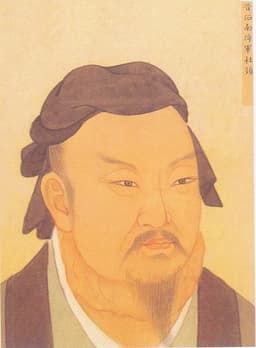
Du Yu
General · Ancient
56.8Total
Basic Information
Born
197
222
Died
264
285
Era
Ancient
Ancient
Nationality
China
China
Occupation
General
General
Civilization
Eastern
Eastern
Score Comparison
Military (10%)
75.0
77.5
Political (20%)
32.1
43.7
Influence (20%)
56.4
53.3
Legacy (20%)
52.0
47.5
Leadership (15%)
30.0
65.0
Strategy (15%)
68.0
75.0
TOTAL
50.7
56.8
Deng Ai — Complete Timeline
255 AD
Defeated Jiang Wei at the Battle of TaoxiWar◆ Major
Deng Ai defeated Jiang Wei's Shu forces at Taoxi, inflicting heavy casualties and forcing Jiang Wei to retreat. This victory solidified Deng Ai's reputation as a capable commander.
Northern ExpeditionsJiang WeiBattle
Impact: regionalconstructive
263 AD
Led the surprise attack through the Yinping MountainsWar
Deng Ai led a force of 10,000 troops on a daring march through the treacherous Yinping Mountains, bypassing Shu's main defenses. The surprise attack directly threatened Chengdu, leading to Shu's surrender.
Conquest of ShuMilitary StrategySurprise Attack
Impact: nationalconstructive
264 AD
Executed after being accused of treasonPolitical Action◆ Major
After the conquest of Shu, Deng Ai was accused of plotting rebellion by Zhong Hui and was arrested. He was executed on the orders of the Wei court, though the charges were later deemed false.
Wei DynastyPolitical PurgeExecution
Impact: nationaltragic
Du Yu — Complete Timeline
279 AD
Appointed as commander of the Jin invasion of WuPolitical Action◆ Major
Du Yu was appointed as the overall commander of the Jin forces for the invasion of Eastern Wu, following Yang Hu's recommendation. He was given command of the central army group.
Jin DynastyEastern WuMilitary Command
Impact: nationalconstructive
280 AD
Led the conquest of Eastern WuWar
Du Yu's forces captured key Wu cities, including Jiangling, and advanced toward the Wu capital Jianye. The campaign culminated in the surrender of Wu's emperor Sun Hao, ending the Three Kingdoms period.
Conquest of WuJin DynastyUnification
Impact: globalconstructive
Authored the 'Commentary on the Spring and Autumn Annals'Cultural◆ Major
Du Yu wrote a comprehensive commentary on the Confucian classic 'Spring and Autumn Annals', which became a standard reference for later scholars. His work influenced Chinese historiography.
ScholarshipConfucianismHistoriography
Impact: nationalconstructive
Expert Analysis
Origins
Deng Ai (c. 197–264) was born in Yiyang, Henan, during the waning years of the Han dynasty. Orphaned early, he worked as a farmer before gaining a minor post as a grain inspector. His talent for military engineering and logistics caught the attention of Sima Yi, who promoted him. Deng lacked formal education but compensated with practical ingenuity.
Du Yu (222–285) hailed from a scholarly family in Wei's capital, Luoyang. His father was a high official, and Du excelled in classical studies, mastering the Confucian classics. He served as a civil administrator before being drawn into military affairs. His academic background distinguished him from most generals of the era.
Rise to Power
Deng Ai rose through Wei's military ranks by demonstrating tactical acumen. In 255, he repelled an invasion by Shu's Jiang Wei at the Battle of Didao, earning the rank of General Who Guards the West. His defining moment came in 263, when he proposed a risky plan to invade Shu via the Yinping Mountains. Sima Zhao approved, and Deng led 10,000 elite troops on a 700-li (about 350 km) march through treacherous terrain, emerging behind Shu's defenses. This forced Shu's surrender.
Du Yu's ascent came through administrative competence. He served as a military advisor to Sima Zhao and later to Sima Yan (Emperor Wu of Jin). In 278, following Yang Hu's death, Du was appointed commander of the Jin invasion of Eastern Wu. He advocated for a coordinated multi-pronged attack, overcoming court opposition. In 280, he launched the campaign that conquered Wu.
Leadership & Governance
Deng Ai led by example, sharing hardships with his troops during the Yinping march. He was hands-on and decisive but lacked political finesse. After conquering Shu, he alienated fellow generals by acting autonomously, issuing orders without consulting superiors. This arrogance led to his downfall.
Du Yu combined military command with scholarly governance. He implemented strict discipline, rewarded merit, and ensured minimal disruption to civilians during the Wu campaign. After victory, he restored order, reopened trade, and integrated Wu's administration into Jin. His leadership style earned him respect from both soldiers and officials.
Triumph & Tragedy
Deng Ai's greatest triumph was the conquest of Shu, a feat achieved with only 10,000 men through audacious strategy. His military score of 75.0 reflects this, though his political score of 32.1 reveals his fatal weakness. Accused of treason by rival Zhong Hui, Deng was arrested and executed in 264, his accomplishments overshadowed by his tragic end.
Du Yu's triumph was the complete subjugation of Eastern Wu in 280, unifying China under Jin. His military score of 77.5 and strategy score of 75.0 underscore his effectiveness. He also authored the influential "Commentary on the Spring and Autumn Annals," a scholarly legacy. However, his political maneuvering was limited; he died peacefully in 285, his reputation intact.
Character & Destiny
Deng Ai was bold, innovative, but politically naive. His daring at Yinping showed brilliance but also a tendency to overreach. His unwillingness to share credit or defer to authority led to isolation and death. Historical assessments note that his execution was unjust, but his own arrogance contributed.
Du Yu was cautious, methodical, and diplomatically astute. He balanced military and civil roles, leveraging his scholarly reputation to gain trust. His careful planning minimized risks. His character allowed him to succeed where Deng failed: he secured his position and lived to enjoy his victories.
Legacy
Deng Ai's legacy is the legendary Yinping march, a classic example of strategic surprise studied in military academies. His daring inspired later generals, but his tragic death made him a cautionary tale. His influence score of 56.4 reflects this mixed remembrance.
Du Yu's legacy is twofold: as the general who completed the unification of China and as a scholar who preserved Confucian texts. His commentary shaped Chinese historiography for centuries. His legacy score of 47.5 is modest, but his impact on governance and culture was profound. He is remembered as a model civil-military official.
Conclusion
Du Yu had greater overall impact. His military score (77.5) edges Deng's (75.0), but his political (43.7 vs 32.1) and leadership (65.0 vs 30.0) scores are decisively higher. Du's conquest was more significant—unifying all of China under Jin—and his scholarly work provided enduring cultural value. Deng's feat was spectacular but fleeting; his failure to capitalize on victory and his premature death limited his influence. While Deng's daring is celebrated, Du's balanced leadership and lasting contributions make him the more effective figure.
Rankings
🥇
Du YuLeader
Mil: 77.5Pol: 43.7Inf: 53.3
56.8
🥈
Deng Ai
Mil: 75.0Pol: 32.1Inf: 56.4
50.7
+6.1 behind
How This Comparison Works
Algorithm
Each figure is scored on 6 dimensions (0—100 scale) based on structured historical data: Military (10%), Political (20%), Influence (20%), Legacy (20%), Leadership (15%), Strategy (15%). The weighted total produces the final ranking.
Data Sources
Scores are computed from structured sub-indicators in the database. Scale factors adjust for era (Ancient ×0.85, Modern ×1.0) and civilization size (Eastern ×1.05, Other ×0.80) to account for differences in population and military scale.
Maximum 3 Figures
Comparisons are limited to 2—3 figures to ensure readability and statistical meaningfulness.
Error Margins
±5 points per dimension — Sub-scores are derived from historical records with inherent uncertainty. Two figures within 5 points on a dimension should be considered roughly equivalent in that area.
Total Score Accuracy
±3 points overall — The weighted combination of 6 dimensions produces a total score with approximately ±3 points of uncertainty. Differences of less than 3 points are not statistically significant— the figures are effectively tied.
Known Limitations
- Historical records are incomplete and uneven across civilizations
- Figures from oral-tradition societies may be underrepresented
- Occupation labels can misclassify multi-role figures
- Scores measure capability and impact, not moral character
- Quantitative scoring is a comparison tool, not absolute truth
Capability Radar
Military (10%) — Battles & Warfare
Battles
75
70
Win Rate
80
85
Expansion
70
75
Political (20%) — Governance & Reform
Reform
20
55
Diplomacy
30
60
Economy
25
50
Influence (20%) — Cultural & Global Reach
Cultural
50
40
Global
40
30
Legacy (20%) — Historical Impact
Historical
65
55
Longevity
55
40
Leadership (15%) — Power & Stability
Tenure
40
65
Stability
20
55
Strategy (15%) — Tactics & Innovation
Strategy
85
80
Tactics
95
75
Reform
30
60
Similar Comparisons
Comments & Discussion
No comments yet. Be the first to share your thoughts!