Loading...
Dungar Singh of Bikaner vs Napoleon Bonaparte
Napoleon Bonaparte leads by 22.3 pts · 2 figures compared
…
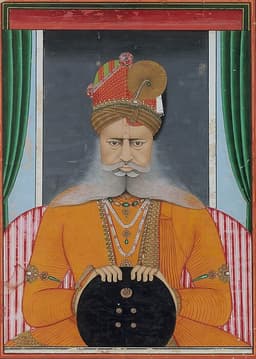
Dungar Singh of Bikaner
Emperor · Modern
48.6Total

Napoleon Bonaparte
General · Modern
70.9Total
Basic Information
Born
1854
1769
Died
1887
1821
Era
Modern
Modern
Nationality
India
France
Occupation
Emperor
General
Civilization
Indian
Western
Score Comparison
Military (10%)
21.2
94.0
Political (20%)
68.0
72.0
Influence (20%)
50.2
40.0
Legacy (20%)
40.0
80.0
Leadership (15%)
68.0
78.0
Strategy (15%)
35.7
90.0
TOTAL
48.6
70.9
Dungar Singh of Bikaner — Complete Timeline
1880 AD
Construction of the Junagarh Fort additionsCultural◆ Major
Dungar Singh oversaw the construction of new additions to the Junagarh Fort in Bikaner, including the Anup Mahal and the Karan Mahal. These structures featured intricate mirror work, frescoes, and carved marble, enhancing the fort's architectural grandeur.
ArchitectureFortPatronage
Impact: regionalconstructive
1885 AD
Modernization of Bikaner's infrastructureReform◆ Major
Dungar Singh initiated modernization projects in Bikaner, including the construction of roads, a telegraph system, and a water supply network. These improvements connected Bikaner to broader colonial infrastructure and improved urban living conditions.
InfrastructureModernizationUrban Development
Impact: regionalconstructive
1887 AD
Establishment of the Bikaner State MuseumCultural
Dungar Singh founded the Bikaner State Museum within the Junagarh Fort, housing a collection of artifacts, manuscripts, and weapons. The museum preserved the cultural heritage of Bikaner and made it accessible to the public.
MuseumCultural PreservationEducation
Impact: regionalconstructive
Napoleon Bonaparte — Complete Timeline
1799 AD
Coup of 18 BrumaireOther◆ Major
Napoleon Bonaparte, with support from his brother Lucien and key political figures, overthrew the Directory in a bloodless coup. He established the Consulate with himself as First Consul, effectively becoming the ruler of France. This event ended the French Revolution's most unstable period.
French RevolutionCoupRise to Power
Impact: regional
1804 AD
Promulgation of the Napoleonic CodeOther◆ Major
Napoleon enacted the Civil Code of the French, known as the Napoleonic Code, a comprehensive set of laws that replaced the fragmented feudal legal systems. The code established legal equality, protected property rights, and secularized law. It became the basis for legal systems in many European and world countries.
Legal ReformNapoleonic CodeCivil Law
Impact: globalconstructive
1805 AD
Battle of AusterlitzWar◆ Major
Napoleon's Grande Arm
Napoleonic WarsBattleDecisive Victory
Impact: global
1812 AD
Invasion of RussiaWar◆ Major
Napoleon led the Grande Arm
Napoleonic WarsInvasionDisaster
Impact: globaldestructive
1815 AD
Battle of WaterlooWar◆ Major
Napoleon's French army was defeated by the combined forces of the Duke of Wellington's Anglo-Allied army and Gebhard Leberecht von Bl
Napoleonic WarsBattleFinal Defeat
Impact: globaldestructive
Expert Analysis
dungar-singh-of-bikaner-vs-napoleon-bonaparte
# The Emperor and the Maharaja
In the winter of 1815, Napoleon Bonaparte stood on a muddy field near Waterloo, watching his Imperial Guard crumble under British and Prussian fire. Half a world away and seventy years later, Maharaja Dungar Singh of Bikaner sat in the cool shade of his newly completed Anup Mahal, reviewing plans for a telegraph system that would connect his desert kingdom to the British Empire. These two men, born into vastly different worlds, both sought to reshape their domains—but one conquered continents while the other built museums. What drove such different paths?
Origins
Napoleon Bonaparte was born in 1769 on the island of Corsica, a rugged Mediterranean territory that France had acquired only a year earlier. His family belonged to the minor nobility, but they were poor and spoke Italian, not French. From the start, Napoleon was an outsider, fiercely ambitious, and deeply conscious that he had something to prove. The French Revolution, which erupted when he was twenty, shattered the old aristocratic order and opened a path for talent over birth. A young artillery officer could now become a general—if he was brilliant enough, ruthless enough, and lucky enough.
Dungar Singh, born in 1854, entered a world where the old order was not shattering but slowly eroding. His kingdom of Bikaner lay in the Thar Desert of Rajasthan, a princely state under British suzerainty. His ancestors had been Rajput warriors who fought Mughals and Marathas, but by Dungar Singh’s time, the real power in India belonged to the British Raj. He inherited a throne, but not true sovereignty. His challenge was not to conquer, but to survive—and perhaps to modernize.
Rise to Power
Napoleon’s rise was a whirlwind of gunpowder and ambition. At age twenty-four, he drove the British out of Toulon. At twenty-six, he crushed a royalist uprising in Paris with a “whiff of grapeshot.” At twenty-seven, he led a ragged army across the Alps into Italy and won six victories in as many months. By thirty, he was First Consul of France. By thirty-five, he crowned himself Emperor. His path was forged in battle, each victory a stepping stone, each defeat a lesson he refused to learn.
Dungar Singh’s rise was quieter. He became Maharaja in 1872 at age eighteen, inheriting a state that was poor, isolated, and dependent on British goodwill. He had no armies to lead into battle, no revolutions to exploit. Instead, he learned to navigate a world of colonial bureaucracy and diplomatic subtlety. His key turning point came not on a battlefield, but in the dusty corridors of the British Residency, where he negotiated for the right to modernize his state without provoking imperial suspicion.
Leadership & Governance
Napoleon governed like he fought—with speed, audacity, and total control. His Napoleonic Code standardized French law, abolished feudal privileges, and established meritocratic principles. He built roads, canals, and a centralized education system. But he also suppressed dissent, censored newspapers, and placed his brothers on European thrones. His military genius was undeniable: a score of 94 in military and 93 in strategy reflects his ability to outmaneuver larger armies and inspire fanatical loyalty. Yet his political score of 75 reveals a fatal flaw: he could conquer, but he could not consolidate.
Dungar Singh governed as a reformer within constraints. His military score of 20 reflects not incompetence, but the reality of a princely state under British paramountcy. Instead of raising armies, he raised buildings. In 1880, he ordered new additions to Junagarh Fort—the Anup Mahal, with its intricate mirror work and painted ceilings, became a symbol of Bikaner’s cultural pride. In 1885, he initiated infrastructure projects: roads to connect villages, a telegraph system to link his capital with British India, and a hospital for his subjects. These were not grand Napoleonic reforms, but they were practical and lasting.
Triumph & Tragedy
Napoleon’s greatest moment was Austerlitz in 1805, where he destroyed the combined armies of Austria and Russia. His worst was the invasion of Russia in 1812, where he lost half a million men to winter, disease, and guerrilla warfare. The tragedy of Napoleon is that his ambition had no limits. He could not stop, could not compromise, could not accept that even genius has boundaries.
Dungar Singh’s triumphs were quieter. In 1887, he founded the Bikaner State Museum within Junagarh Fort, housing manuscripts, artifacts, and natural history collections. It was one of the first museums in princely India—a gesture not of conquest, but of preservation. His tragedy was that he died young, at thirty-three, in 1887, leaving his reforms incomplete. His successor, Ganga Singh, would build on his foundations, but Dungar Singh himself never saw the full fruits of his labor.
Character & Destiny
Napoleon’s character was forged in fire: restless, brilliant, contemptuous of limits. He once said, “Impossible is a word to be found only in the dictionary of fools.” This belief drove him to the heights of power and to the depths of exile on Saint Helena. His destiny was to be a force of nature—magnificent, destructive, and ultimately unsustainable.
Dungar Singh’s character was shaped by sand and stone: patient, pragmatic, aware of what could and could not be changed. He understood that in a world of empires, a small kingdom survives not by fighting, but by adapting. His destiny was to be a builder, not a destroyer—to leave behind walls and roads and museums rather than battlefields and ruins.
Legacy
Napoleon remade Europe. His legal codes, administrative systems, and military tactics influenced generations. His legacy score of 78 reflects both his achievements and the wars that devastated the continent. Today, he is remembered as a genius and a tyrant, a liberator and a conqueror—a figure who cannot be reduced to simple judgment.
Dungar Singh’s legacy is local but enduring. The Junagarh Fort additions remain a tourist attraction. The Bikaner State Museum still houses its collections. His modernization projects laid the groundwork for Bikaner’s development. But his total score of 58.5 reflects a life cut short and a reign constrained by colonial realities. He is remembered in Rajasthan, not in world history books.
Conclusion
What separates the emperor from the maharaja is not talent or ambition, but context. Napoleon was born into revolution, when the old world was collapsing and a man of genius could reshape the new one. Dungar Singh was born into empire, when the rules were already written and the only choice was how to play the game. One tried to conquer history; the other tried to survive it. Both succeeded, in their own ways, and both failed, in ways that remind us that even the most brilliant lives are shaped by forces beyond their control.
Rankings
🥇
Napoleon BonaparteLeader
Mil: 94.0Pol: 72.0Inf: 40.0
70.9
🥈
Dungar Singh of Bikaner
Mil: 21.2Pol: 68.0Inf: 50.2
48.6
+22.3 behind
How This Comparison Works
Algorithm
Each figure is scored on 6 dimensions (0—100 scale) based on structured historical data: Military (10%), Political (20%), Influence (20%), Legacy (20%), Leadership (15%), Strategy (15%). The weighted total produces the final ranking.
Data Sources
Scores are computed from structured sub-indicators in the database. Scale factors adjust for era (Ancient ×0.85, Modern ×1.0) and civilization size (Eastern ×1.05, Other ×0.80) to account for differences in population and military scale.
Maximum 3 Figures
Comparisons are limited to 2—3 figures to ensure readability and statistical meaningfulness.
Error Margins
±5 points per dimension — Sub-scores are derived from historical records with inherent uncertainty. Two figures within 5 points on a dimension should be considered roughly equivalent in that area.
Total Score Accuracy
±3 points overall — The weighted combination of 6 dimensions produces a total score with approximately ±3 points of uncertainty. Differences of less than 3 points are not statistically significant— the figures are effectively tied.
Known Limitations
- Historical records are incomplete and uneven across civilizations
- Figures from oral-tradition societies may be underrepresented
- Occupation labels can misclassify multi-role figures
- Scores measure capability and impact, not moral character
- Quantitative scoring is a comparison tool, not absolute truth
Capability Radar
Military (10%) — Battles & Warfare
Battles
10
95
Win Rate
10
90
Expansion
10
95
Political (20%) — Governance & Reform
Reform
60
95
Diplomacy
40
80
Economy
50
85
Influence (20%) — Cultural & Global Reach
Cultural
30
85
Global
10
90
Legacy (20%) — Historical Impact
Historical
30
95
Longevity
20
90
Leadership (15%) — Power & Stability
Tenure
50
85
Stability
55
70
Strategy (15%) — Tactics & Innovation
Strategy
15
95
Tactics
15
98
Reform
30
92
Similar Comparisons
Comments & Discussion
创意昵称6/17/2026
数据控老王|zh|从数据看,拿破仑的滑铁卢战役中法军伤亡超25000人,而Dungar Singh统治时期Bikaner大概率没有一场战役伤亡过百。战功维度上差距太明显了。不过有趣的是,Dungar Singh在位期间引进了铁路和电报,而拿破仑到死都没用上电报——科技树点法完全不同。所以别吵谁更伟大,他俩根本不在一个赛道比赛。
创意昵称6/17/2026
墙头草终结者|zh|说句得罪人的大实话:这俩放在一起比就是硬蹭。拿破仑是横跨欧亚非的传奇,Dungar Singh不过是英帝国体系下一个小藩王。你看他引进电报、修博物馆,本质上是给殖民者当模范生。而拿破仑虽然最后输了,但自己打下来的江山够吹两百年。别拿“文化传承”当遮羞布,敢不敢比一比军队规模和征服领土?
OldWarhorse6/17/2026
WaterlooCorsican|en|Comparing Dungar Singh to Napoleon is like comparing a museum curator to a volcano. Napoleon redrew the map of Europe in blood, personally leading 60+ battles and conquering from Madrid to Moscow. Dungar Singh built a telegraph line and some palaces under British protection. Let's be honest: one man changed world history forever, the other was a well-meaning administrator in a desert. Napoleonic ambition vs Rajput compliance—not a contest.
SiegeTowerView6/17/2026
SanskritScholar|en|You miss the Rajput code of honor entirely. Napoleon was a brilliant opportunist who crowned himself emperor, broke alliances, and exiled rivals. Dungar Singh upheld dharma—he modernized without betraying his tradition, built the Anup Mahal library to preserve manuscripts, not burn them like Napoleon did in Moscow. One measured success by territory conquered, the other by cultural continuity. I know which legacy I'd rather claim for humanity.
DiplomaticHistorian6/17/2026
DesertCorsair|en|Both were reformers trapped by their eras. Napoleon's Civil Code reshaped European law; Dungar Singh's telegraph and railway modernized Bikaner's economy. The difference? Napoleon fought seven coalitions and died on a remote island; Dungar Singh died in bed at 30, his reforms incomplete. One burned too bright, the other never got the chance to burn at all. Tragic symmetry, actually.