Loading...
Edmund Ironside vs Nezahualcoyotl
Nezahualcoyotl leads by 15.9 pts · 2 figures compared
…
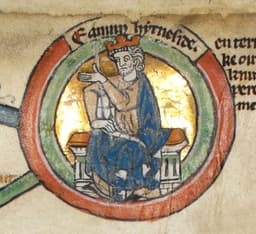
Edmund Ironside
Emperor · Medieval
41.6Total

Nezahualcoyotl
Emperor · Medieval
57.5Total
Basic Information
Born
990
1402
Died
1016
1472
Era
Medieval
Medieval
Nationality
England
Texcoco
Occupation
Emperor
Emperor
Civilization
Western
Western
Score Comparison
Military (10%)
20.0
50.0
Political (20%)
27.9
60.0
Influence (20%)
52.5
60.0
Legacy (20%)
42.5
50.0
Leadership (15%)
38.1
72.0
Strategy (15%)
60.0
52.5
TOTAL
41.6
57.5
Edmund Ironside — Complete Timeline
1016 AD
Battle of PenselwoodWar◆ Major
Edmund Ironside defeated Cnut the Great at Penselwood in Somerset. This victory was part of a series of battles as Edmund fought to defend his claim to the English throne after his father Ethelred's death.
BattleVictoryCivil War
Impact: national
Battle of SherstonWar
Edmund fought Cnut to a draw at Sherston in Wiltshire. The battle was indecisive, with both sides suffering heavy casualties, and neither gaining a strategic advantage.
BattleStalemateCivil War
Impact: national
Battle of AssandunWar◆ Major
Cnut decisively defeated Edmund at Assandun (possibly Ashingdon in Essex). The defeat forced Edmund to negotiate a partition of England with Cnut.
BattleDefeatCivil War
Impact: nationaldestructive
Treaty of OlneyPolitical Action◆ Major
Edmund and Cnut agreed to divide England: Edmund ruled Wessex, Cnut ruled the rest. The treaty also stipulated that if one died, the other would inherit the entire kingdom.
TreatyPartitionPeace
Impact: national
Death of Edmund IronsidePolitical Action◆ Major
Edmund died on November 30, 1016, shortly after the Treaty of Olney. His death allowed Cnut to become sole king of England, ending Anglo-Saxon resistance.
DeathSuccessionEnd of Resistance
Impact: nationaltragic
Nezahualcoyotl — Complete Timeline
1430 AD
Construction of the Albarrada de NezahualcoyotlOther◆ Major
Nezahualcoyotl ordered the construction of a 16-kilometer dike across Lake Texcoco to separate fresh water from salt water and prevent flooding in Tenochtitlan. The structure, completed around 1430, functioned as an aqueduct and flood control system, demonstrating advanced engineering.
EngineeringFlood ControlTexcoco
Impact: regionalconstructive
1431 AD
Restoration of Texcoco as a City-StatePolitical Action◆ Major
After the death of his father Ixtlilxochitl I and a period of exile, Nezahualcoyotl reclaimed the throne of Texcoco with support from Tenochtitlan. He reestablished Texcoco as a major city-state within the Triple Alliance, initiating a period of cultural and political revival.
RestorationTriple AllianceTexcoco
Impact: regionalconstructive
1445 AD
Military Campaign against ChalcoWar
Nezahualcoyotl led Texcoco forces in a campaign against the city-state of Chalco, a rival in the Valley of Mexico. The war ended with the defeat of Chalco and its incorporation into the Triple Alliance sphere, expanding Texcoco's influence.
ConquestChalcoTriple Alliance
Impact: regional
1450 AD
Creation of the Texcoco CodexCultural◆ Major
Nezahualcoyotl established a library and sponsored the compilation of historical and legal texts, including the Codex Xolotl and other works. These codices recorded the history, laws, and poetry of Texcoco, preserving pre-Columbian knowledge.
LibraryCodexPreservation
Impact: regionalconstructive
Composition of 'Icuic Nezahualcoyotl'Cultural◆ Major
Nezahualcoyotl composed several poems in Nahuatl, including 'Icuic Nezahualcoyotl' (Song of Nezahualcoyotl), which reflect on the transience of life and the search for truth. These works are among the few surviving pre-Columbian literary texts from Mesoamerica.
PoetryNahuatl LiteraturePhilosophy
Impact: regionalconstructive
1465 AD
Construction of the Chapultepec AqueductOther◆ Major
Nezahualcoyotl oversaw the construction of a second aqueduct from Chapultepec to Tenochtitlan, supplementing the existing one. This project improved the water supply for the Aztec capital, using a dual-pipe system that allowed maintenance without interrupting flow.
EngineeringWater SupplyTenochtitlan
Impact: regionalconstructive
Expert Analysis
Origins
Edmund Ironside, born circa 990, was the son of King Æthelred the Unready and his first wife, Ælfgifu of York. His epithet 'Ironside' likely derives from his resilience in battle. He grew up amidst the Danish invasions that plagued England, with his father's ineffective leadership fueling internal strife. Edmund's early life was marked by exile and conflict, as he rebelled against his father in 1015, seizing control of the Danelaw region.
Nezahualcoyotl (1402-1472), whose name means 'Fasting Coyote,' was born in Texcoco, a city-state in the Valley of Mexico. He was the son of King Ixtlilxochitl I and a noblewoman. His childhood was disrupted by the expansionist ambitions of the Tepanec Empire, which led to his father's death in 1418 and forced Nezahualcoyotl into exile. He spent years in hiding, learning the politics and warfare of the region.
Rise to Power
Edmund's path to power was chaotic. In 1015, he raised a rebellion against his father, gaining support from the northern earldoms. After Æthelred's death in April 1016, the Londoners proclaimed Edmund king, while the Witan elected Cnut. Edmund then fought a series of battles to secure his claim. At the Battle of Penselwood in 1016, he defeated Cnut, but the victory was not decisive. The Battle of Sherston ended in a draw. His greatest setback came at the Battle of Assandun in October 1016, where Cnut decisively defeated him. This forced Edmund to negotiate the Treaty of Olney, dividing England: Edmund kept Wessex, while Cnut ruled the rest. The treaty also stipulated that if one died, the other would inherit the entire kingdom.
Nezahualcoyotl's rise was a story of perseverance. After his father's death, he sought refuge in Tenochtitlan and Tlaxcala. With the support of the Mexica (Aztecs) under Itzcoatl, he began reconquering Texcoco. In 1428, he allied with Tenochtitlan and Tlacopan to defeat the Tepanecs, a conflict known as the Tepanec War. Nezahualcoyotl's strategic acumen and political alliances were key. He reclaimed the throne of Texcoco in 1431, establishing it as a major power in the Aztec Triple Alliance.
Leadership & Governance
Edmund's leadership was focused on military resistance. He had little time for governance, as his reign lasted only about seven months in 1016. His political score of 27.9 reflects his limited administrative impact. He relied on the support of nobles like Eadric Streona, who betrayed him at Assandun. Edmund's approach was reactive, responding to Cnut's invasions. He lacked the opportunity to enact reforms or build institutions.
Nezahualcoyotl, with a political score of 60.0, was a transformative ruler. He oversaw the restoration of Texcoco as a cultural and legal center. He codified laws, established a judicial system, and sponsored the compilation of the Texcoco Codex, including the Codex Xolotl. His leadership score of 72.0 reflects his ability to govern effectively. He commissioned major engineering projects: the Albarrada de Nezahualcoyotl, a 16-kilometer dike across Lake Texcoco to control flooding and separate fresh from salt water, and the Chapultepec Aqueduct, which improved water supply to Tenochtitlan.
Triumph & Tragedy
Edmund's triumph was his temporary success in rallying English resistance against Cnut. His victory at Penselwood and the draw at Sherston showed his military capability. However, his tragedy was his early death on November 30, 1016, just weeks after the Treaty of Olney. His death allowed Cnut to become sole king of England, ending Anglo-Saxon resistance. Edmund's failure to secure a lasting peace or dynasty left his legacy incomplete.
Nezahualcoyotl's triumphs include his military victories in the Tepanec War, scoring 50.0 in military, and his cultural contributions as a poet. His poem 'Icuic Nezahualcoyotl' reflects on the transience of life. His engineering projects improved the lives of thousands. However, his tragedy lies in the eventual fall of Texcoco and the Aztec world to Spanish conquistadors in 1521, decades after his death. His works and city were largely destroyed, though some texts survived.
Character & Destiny
Edmund was known for his bravery, earning the name 'Ironside.' His decision to fight rather than submit shaped his destiny. He trusted Eadric Streona, whose betrayal at Assandun was a critical factor in his defeat. His character was that of a warrior king, but his short reign prevented him from demonstrating broader statesmanship.
Nezahualcoyotl was a philosopher-king, combining military prowess with intellectual pursuits. He was known for his wisdom and piety, constructing temples and promoting the arts. His character allowed him to build alliances and govern effectively. His destiny was to create a flourishing city-state that became a beacon of culture in pre-Columbian America.
Legacy
Edmund's legacy is minimal in England's history. He is remembered as a brief interlude in the Danish conquest. His total score of 41.6 reflects his limited impact. The Treaty of Olney is his main political achievement, but it quickly unraveled. He is often overshadowed by Cnut and later Anglo-Saxon kings.
Nezahualcoyotl's legacy is more substantial. He is remembered as a poet, engineer, and lawgiver. His influence score of 60.0 and legacy score of 50.0 reflect his enduring cultural impact. The dike and aqueduct stand as engineering marvels. His poetry is studied as a window into pre-Columbian thought. However, much was lost to Spanish conquest.
Conclusion
Nezahualcoyotl had greater impact than Edmund Ironside. With a total score of 57.5 versus Edmund's 41.6, the difference is clear. Nezahualcoyotl's contributions to governance, engineering, and culture were more lasting and influential. Edmund's brief reign and military focus produced no enduring institutions. While Edmund fought valiantly, Nezahualcoyotl built a legacy that survived centuries.
Rankings
🥇
NezahualcoyotlLeader
Mil: 50.0Pol: 60.0Inf: 60.0
57.5
🥈
Edmund Ironside
Mil: 20.0Pol: 27.9Inf: 52.5
41.6
+15.9 behind
How This Comparison Works
Algorithm
Each figure is scored on 6 dimensions (0—100 scale) based on structured historical data: Military (10%), Political (20%), Influence (20%), Legacy (20%), Leadership (15%), Strategy (15%). The weighted total produces the final ranking.
Data Sources
Scores are computed from structured sub-indicators in the database. Scale factors adjust for era (Ancient ×0.85, Modern ×1.0) and civilization size (Eastern ×1.05, Other ×0.80) to account for differences in population and military scale.
Maximum 3 Figures
Comparisons are limited to 2—3 figures to ensure readability and statistical meaningfulness.
Error Margins
±5 points per dimension — Sub-scores are derived from historical records with inherent uncertainty. Two figures within 5 points on a dimension should be considered roughly equivalent in that area.
Total Score Accuracy
±3 points overall — The weighted combination of 6 dimensions produces a total score with approximately ±3 points of uncertainty. Differences of less than 3 points are not statistically significant— the figures are effectively tied.
Known Limitations
- Historical records are incomplete and uneven across civilizations
- Figures from oral-tradition societies may be underrepresented
- Occupation labels can misclassify multi-role figures
- Scores measure capability and impact, not moral character
- Quantitative scoring is a comparison tool, not absolute truth
Capability Radar
Military (10%) — Battles & Warfare
Battles
45
45
Win Rate
50
50
Expansion
30
45
Political (20%) — Governance & Reform
Reform
15
75
Diplomacy
30
70
Economy
20
65
Influence (20%) — Cultural & Global Reach
Cultural
15
65
Global
10
35
Legacy (20%) — Historical Impact
Historical
25
55
Longevity
20
50
Leadership (15%) — Power & Stability
Tenure
20
70
Stability
25
60
Strategy (15%) — Tactics & Innovation
Strategy
50
60
Tactics
55
55
Reform
20
40
Similar Comparisons
Comments & Discussion
No comments yet. Be the first to share your thoughts!