Loading...
Ly Thai To vs Nezahualcoyotl
Nezahualcoyotl leads by 2.9 pts · 2 figures compared
…
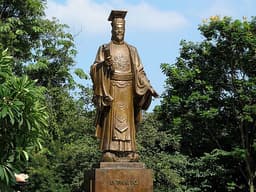
Ly Thai To
Emperor · Medieval
54.6Total

Nezahualcoyotl
Emperor · Medieval
57.5Total
Basic Information
Born
974
1402
Died
1028
1472
Era
Medieval
Medieval
Nationality
Vietnam
Texcoco
Occupation
Emperor
Emperor
Civilization
Eastern
Western
Score Comparison
Military (10%)
45.0
50.0
Political (20%)
68.0
60.0
Influence (20%)
61.0
60.0
Legacy (20%)
58.0
50.0
Leadership (15%)
40.0
72.0
Strategy (15%)
41.7
52.5
TOTAL
54.6
57.5
Ly Thai To — Complete Timeline
1009 AD
Foundation of the Ly DynastyPolitical Action
Ly Cong Uan, later known as Ly Thai To, was proclaimed emperor after the death of the last Le dynasty ruler. He founded the Ly dynasty, which would rule Vietnam for over 200 years. His accession was supported by Buddhist monks and the court.
Dynasty FoundingLy DynastyBuddhist Influence
Impact: nationalconstructive
1010 AD
Move of the Capital to Thang Long (Hanoi)Political Action
Ly Thai To moved the capital from Hoa Lu to Dai La, renaming it Thang Long (Rising Dragon), now Hanoi. The move was intended to centralize power and promote economic development. Thang Long became the political and cultural center of Vietnam for centuries.
Capital MoveThang LongHanoi
Impact: nationalconstructive
Promotion of Buddhism and EducationCultural◆ Major
Ly Thai To promoted Buddhism as the state religion and built many pagodas and temples. He also established the first Vietnamese university, the Quoc Tu Giam, to educate scholars in Confucian classics. These policies laid the foundation for Vietnamese culture and governance.
BuddhismEducationCultural Development
Impact: nationalconstructive
Nezahualcoyotl — Complete Timeline
1430 AD
Construction of the Albarrada de NezahualcoyotlOther◆ Major
Nezahualcoyotl ordered the construction of a 16-kilometer dike across Lake Texcoco to separate fresh water from salt water and prevent flooding in Tenochtitlan. The structure, completed around 1430, functioned as an aqueduct and flood control system, demonstrating advanced engineering.
EngineeringFlood ControlTexcoco
Impact: regionalconstructive
1431 AD
Restoration of Texcoco as a City-StatePolitical Action◆ Major
After the death of his father Ixtlilxochitl I and a period of exile, Nezahualcoyotl reclaimed the throne of Texcoco with support from Tenochtitlan. He reestablished Texcoco as a major city-state within the Triple Alliance, initiating a period of cultural and political revival.
RestorationTriple AllianceTexcoco
Impact: regionalconstructive
1445 AD
Military Campaign against ChalcoWar
Nezahualcoyotl led Texcoco forces in a campaign against the city-state of Chalco, a rival in the Valley of Mexico. The war ended with the defeat of Chalco and its incorporation into the Triple Alliance sphere, expanding Texcoco's influence.
ConquestChalcoTriple Alliance
Impact: regional
1450 AD
Creation of the Texcoco CodexCultural◆ Major
Nezahualcoyotl established a library and sponsored the compilation of historical and legal texts, including the Codex Xolotl and other works. These codices recorded the history, laws, and poetry of Texcoco, preserving pre-Columbian knowledge.
LibraryCodexPreservation
Impact: regionalconstructive
Composition of 'Icuic Nezahualcoyotl'Cultural◆ Major
Nezahualcoyotl composed several poems in Nahuatl, including 'Icuic Nezahualcoyotl' (Song of Nezahualcoyotl), which reflect on the transience of life and the search for truth. These works are among the few surviving pre-Columbian literary texts from Mesoamerica.
PoetryNahuatl LiteraturePhilosophy
Impact: regionalconstructive
1465 AD
Construction of the Chapultepec AqueductOther◆ Major
Nezahualcoyotl oversaw the construction of a second aqueduct from Chapultepec to Tenochtitlan, supplementing the existing one. This project improved the water supply for the Aztec capital, using a dual-pipe system that allowed maintenance without interrupting flow.
EngineeringWater SupplyTenochtitlan
Impact: regionalconstructive
Expert Analysis
Origins
Ly Thai To was born as Ly Cong Uan in 974 in Co Phap village (now Bac Ninh Province), Vietnam. He was raised in a Buddhist temple under the tutelage of the patriarch Van Hanh, which shaped his spiritual and administrative outlook. His early life was marked by the decline of the Le dynasty, and he rose through the ranks as a court official.
Nezahualcoyotl was born in 1402 in Texcoco, the son of King Ixtlilxochitl I. His name means "Fasting Coyote" in Nahuatl. He received a privileged education in law, history, and poetry, but his youth was disrupted by the expansionist wars of the Tepanec Empire, which forced him into exile after his father's death.
Rise to Power
Ly Thai To's rise began in 1009 when the last Le ruler died without an heir. The court and Buddhist clergy, led by Van Hanh, orchestrated Ly Cong Uan's accession. He was proclaimed emperor in 1010, establishing the Ly dynasty that would rule for over 200 years. His legitimacy was bolstered by a fabricated prophecy and the support of key officials.
Nezahualcoyotl's path was more turbulent. After his father's murder by the Tepanecs in 1418, he fled into exile. For years, he lived in hiding, gathering support from allied city-states. With crucial aid from Tenochtitlan, he defeated the Tepanecs in 1428 and reclaimed the throne of Texcoco, becoming the tlatoani (ruler) of a restored kingdom.
Leadership & Governance
Ly Thai To governed through centralized bureaucracy and Buddhist ideology. He moved the capital from Hoa Lu to Dai La, renaming it Thang Long (Hanoi) in 1010, a strategic shift that centralized power and promoted commerce. He established the Quoc Tu Giam, Vietnam's first university, in 1076, emphasizing Confucian education alongside Buddhism. His reign saw the promotion of agricultural reforms and the construction of pagodas.
Nezahualcoyotl ruled Texcoco as a constitutional monarch, codifying laws in the Codex Xolotl and establishing a council of nobles. He implemented water management projects, including a 16-kilometer dike (albarrada) across Lake Texcoco to separate fresh and salt water, and a second aqueduct from Chapultepec to Tenochtitlan. He also founded a library and sponsored the arts, composing poetry that explored the ephemeral nature of life.
Triumph & Tragedy
Ly Thai To's greatest triumph was founding the Ly dynasty, which brought stability and cultural flourishing to Vietnam. The move to Thang Long created a lasting capital. However, his reign saw limited military expansion; his military score of 45.0 reflects a focus on internal consolidation over conquest. He also failed to fully integrate the southern Champa territories, leaving border tensions.
Nezahualcoyotl's triumphs include the engineering feats of the dike and aqueduct, which protected Tenochtitlan from floods and provided fresh water. His cultural legacy as a poet and lawgiver is significant. However, his alliance with Tenochtitlan made Texcoco a junior partner in the Aztec Triple Alliance, limiting its autonomy. The construction projects also required heavy tribute from commoners, leading to social strain.
Character & Destiny
Ly Thai To was pragmatic and religious, using Buddhism to legitimize his rule. He was cautious in military affairs, preferring diplomacy and infrastructure. His character shaped a stable but unambitious reign, setting a precedent for future Ly rulers.
Nezahualcoyotl was a polymath: warrior, engineer, poet, and philosopher. His resilience in exile and strategic alliance with Tenochtitlan restored his kingdom. Yet his artistic sensitivity may have tempered his ruthlessness, as he avoided direct conflict when possible. His legacy as a wise king is tempered by the eventual absorption of Texcoco into the Aztec empire.
Legacy
Ly Thai To's dynasty lasted until 1225, overseeing Vietnam's independence from Chinese suzerainty. The capital Hanoi remains Vietnam's political center. The Quoc Tu Giam laid the foundation for a Confucian civil service. His influence score of 61.0 reflects his role in shaping Vietnamese identity.
Nezahualcoyotl's dike and aqueduct remained functional for centuries. His legal codes influenced later Nahua governance. His poetry is still studied as a masterpiece of Nahuatl literature. However, Texcoco's legacy is overshadowed by the Aztec capital Tenochtitlan. His legacy score of 50.0 indicates a more localized impact.
Conclusion
While both rulers were foundational figures, Nezahualcoyotl's more diverse achievements in engineering, law, and poetry give him a slight edge in overall impact. His total score of 57.5 surpasses Ly Thai To's 54.6, driven by higher leadership (72.0 vs 40.0) and strategy (52.5 vs 41.7). Ly Thai To's political score (68.0) is higher, but Nezahualcoyotl's multifaceted legacy—combining governance, infrastructure, and culture—resonates more broadly. Nezahualcoyotl had greater impact due to his innovative solutions to urban and environmental challenges, which remain relevant.
Rankings
🥇
NezahualcoyotlLeader
Mil: 50.0Pol: 60.0Inf: 60.0
57.5
🥈
Ly Thai To
Mil: 45.0Pol: 68.0Inf: 61.0
54.6
+2.9 behind
How This Comparison Works
Algorithm
Each figure is scored on 6 dimensions (0—100 scale) based on structured historical data: Military (10%), Political (20%), Influence (20%), Legacy (20%), Leadership (15%), Strategy (15%). The weighted total produces the final ranking.
Data Sources
Scores are computed from structured sub-indicators in the database. Scale factors adjust for era (Ancient ×0.85, Modern ×1.0) and civilization size (Eastern ×1.05, Other ×0.80) to account for differences in population and military scale.
Maximum 3 Figures
Comparisons are limited to 2—3 figures to ensure readability and statistical meaningfulness.
Error Margins
±5 points per dimension — Sub-scores are derived from historical records with inherent uncertainty. Two figures within 5 points on a dimension should be considered roughly equivalent in that area.
Total Score Accuracy
±3 points overall — The weighted combination of 6 dimensions produces a total score with approximately ±3 points of uncertainty. Differences of less than 3 points are not statistically significant— the figures are effectively tied.
Known Limitations
- Historical records are incomplete and uneven across civilizations
- Figures from oral-tradition societies may be underrepresented
- Occupation labels can misclassify multi-role figures
- Scores measure capability and impact, not moral character
- Quantitative scoring is a comparison tool, not absolute truth
Capability Radar
Military (10%) — Battles & Warfare
Battles
20
45
Win Rate
25
50
Expansion
30
45
Political (20%) — Governance & Reform
Reform
60
75
Diplomacy
50
70
Economy
55
65
Influence (20%) — Cultural & Global Reach
Cultural
55
65
Global
30
35
Legacy (20%) — Historical Impact
Historical
60
55
Longevity
55
50
Leadership (15%) — Power & Stability
Tenure
55
70
Stability
60
60
Strategy (15%) — Tactics & Innovation
Strategy
25
60
Tactics
20
55
Reform
30
40
Similar Comparisons
Comments & Discussion
No comments yet. Be the first to share your thoughts!