Loading...
Edward the Confessor vs Hisham ibn Abd al-Malik
Hisham ibn Abd al-Malik leads by 20.4 pts · 2 figures compared
…
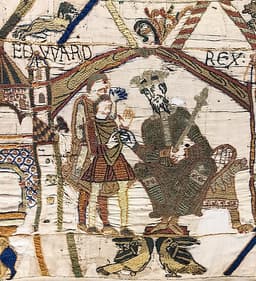
Edward the Confessor
Emperor · Medieval
50.2Total
Hisham ibn Abd al-Malik
Emperor · Medieval
70.6Total
Basic Information
Born
1003
691
Died
1066
743
Era
Medieval
Medieval
Nationality
England
Umayyad Caliphate
Occupation
Emperor
Emperor
Civilization
Western
Middle Eastern
Score Comparison
Military (10%)
20.0
74.7
Political (20%)
45.1
78.0
Influence (20%)
57.2
72.0
Legacy (20%)
52.0
58.0
Leadership (15%)
64.0
80.0
Strategy (15%)
45.0
69.1
TOTAL
50.2
70.6
Edward the Confessor — Complete Timeline
1043 AD
Coronation of Edward the ConfessorPolitical Action◆ Major
Edward was crowned king of England at Winchester Cathedral on April 3, 1043. His reign marked the restoration of the Anglo-Saxon monarchy after 27 years of Danish rule.
CoronationRestorationAnglo-Saxon
Impact: nationalconstructive
1045 AD
Construction of Westminster AbbeyCultural◆ Major
Edward began rebuilding Westminster Abbey in the Norman Romanesque style. The abbey was consecrated in 1065, just before his death, and became the coronation church of English monarchs.
ArchitectureReligionLegacy
Impact: nationalconstructive
1051 AD
Conflict with Godwin of WessexPolitical Action◆ Major
Edward exiled Earl Godwin and his sons after a dispute over the treatment of Norman favorites. Godwin returned with a fleet in 1052, forcing Edward to restore their lands and power.
ExilePower StruggleGodwin
Impact: nationaldestructive
Promise of Throne to William of NormandyPolitical Action◆ Major
Edward allegedly promised the English throne to his cousin William, Duke of Normandy, during a visit by William to England. This promise later became the basis for William's claim to the throne.
SuccessionNorman ClaimPromise
Impact: regional
1066 AD
Death of Edward the ConfessorPolitical Action
Edward died on January 5, 1066, at Westminster. His death without a clear heir triggered a succession crisis, leading to the Norman Conquest of England later that year.
DeathSuccession CrisisNorman Conquest
Impact: globaltragic
Hisham ibn Abd al-Malik — Complete Timeline
724 AD
Accession as CaliphPolitical Action◆ Major
Hisham ibn Abd al-Malik became the Umayyad caliph after the death of his brother, Yazid II. His reign was the longest of the later Umayyads, lasting 19 years.
SuccessionCaliphate
Impact: global
726 AD
Military campaigns against the ByzantinesWar◆ Major
Hisham launched annual raids into Byzantine Anatolia, capturing several fortresses. These campaigns were costly but maintained pressure on the Byzantine Empire, though they did not achieve decisive conquest.
Byzantine WarsRaidsAnatolia
Impact: regional
730 AD
Administrative and economic reformsReform◆ Major
Hisham implemented administrative reforms to improve tax collection and centralize control over the provinces. He also invested in irrigation projects in Iraq, boosting agricultural productivity.
AdministrationEconomyAgriculture
Impact: globalconstructive
732 AD
Defeat at the Battle of ToursWar
Umayyad forces under Hisham's reign were defeated by the Franks under Charles Martel at the Battle of Tours. This halted the northward expansion of the Umayyad Caliphate into Western Europe.
BattleDefeatFranks
Impact: global
Expert Analysis
Origins
Edward the Confessor was born around 1003 in Islip, Oxfordshire, to King Æthelred the Unready and Emma of Normandy. His early years were marked by Danish invasions; after his father's death in 1016, Edward and his family fled to Normandy, where he spent 25 years under Norman protection. This exile shaped his cultural and religious outlook, fostering a deep piety and Norman sympathies.
Hisham ibn Abd al-Malik was born in 691 in Damascus, the son of Caliph Abd al-Malik and a member of the Umayyad dynasty. He received a princely education in administration and military affairs. His early life was overshadowed by the achievements of his father and brother, but he rose to prominence as a capable governor and military commander.
Rise to Power
Edward returned to England in 1041 after the death of his half-brother Harthacnut. He was crowned king on April 3, 1043 at Winchester Cathedral, restoring the House of Wessex after 27 years of Danish rule. His accession was supported by the powerful Earl Godwin of Wessex, whose daughter Edith he married in 1045. Edward's reliance on Norman advisors, however, created tensions with the English nobility.
Hisham became caliph in 724 after the death of his brother Yazid II. Unlike Edward, Hisham inherited an established empire. His rise was smooth due to his administrative experience and the support of the Umayyad family. He faced immediate challenges: ongoing wars with the Byzantine Empire and internal revolts, particularly from the Kharijites and Abbasid partisans.
Leadership & Governance
Edward's leadership was marked by piety and a hands-off approach. He delegated much governance to Earl Godwin and his sons, leading to a power struggle. In 1051, Edward exiled Godwin after a dispute, but Godwin returned with a fleet in 1052, forcing Edward to restore him. This event demonstrated Edward's political weakness; he scored only 45.1 in political leadership. His main achievement was the construction of Westminster Abbey, consecrated in 1065, which became the coronation church of English monarchs.
Hisham was a centralized administrator. He reformed tax collection, improved irrigation in Iraq and Syria, and standardized coinage. His military strategy was aggressive: he launched annual raids into Byzantine Anatolia, capturing fortresses like Tyana and Ancyra. His political score of 78.0 reflects effective control over a vast empire. However, his campaigns were costly; the defeat at Tours in 732 (scored 74.7 military) halted northward expansion into Frankish territory.
Triumph & Tragedy
Edward's triumph was his piety and the building of Westminster Abbey, which cemented his legacy as a saintly king. His tragedy was the succession crisis: his childless marriage and alleged promise of the throne to William of Normandy led directly to the Norman Conquest after his death on January 5, 1066. This event reshaped English history.
Hisham's triumph was the stability and prosperity of the Umayyad Caliphate during his 19-year reign. He suppressed multiple revolts and maintained pressure on Byzantium. His tragedy was the failure to prevent the rise of the Abbasid movement; his heavy-handed policies alienated non-Arab Muslims, especially Persians, sowing the seeds for the Abbasid Revolution that toppled his dynasty after his death.
Character & Destiny
Edward was known for his religious devotion, earning the epithet "Confessor." He was more interested in hunting and church-building than governance. His character—pious, indecisive, and overly trusting of Normans—directly caused the power vacuum that led to conquest. His legacy score of 52.0 reflects his saintly reputation but limited political impact.
Hisham was a capable administrator and commander, but his severity and tax burdens made him unpopular. He was a micromanager, which improved efficiency but bred resentment. His character—pragmatic, relentless, but inflexible—delayed the empire's collapse but could not prevent it. His influence score of 72.0 shows his role as the last strong Umayyad.
Legacy
Edward's legacy is paradoxical: he was venerated as a saint (canonized in 1161), but his political legacy was the end of Anglo-Saxon rule. Westminster Abbey remains his enduring monument. The Norman Conquest, directly triggered by his death, transformed English language, law, and architecture.
Hisham's legacy is the consolidation of Islamic administrative practices. His reforms influenced later caliphates, but his dynasty was overthrown within decades. He is remembered as the last great Umayyad, a ruler who held the empire together against internal and external threats.
Conclusion
Hisham ibn Abd al-Malik had greater impact. His total score of 70.6 surpasses Edward's 50.2 by 20.4 points. Hisham governed a larger, more complex empire, implemented lasting administrative reforms, and maintained military pressure on Byzantium. Edward's reign was a prelude to catastrophe; his death triggered a conquest that ended his dynasty. While Edward's saintly reputation persists, Hisham's effective rule shaped the Islamic world's governance structures. The data supports Hisham as the more consequential figure.
Rankings
🥇
Hisham ibn Abd al-MalikLeader
Mil: 74.7Pol: 78.0Inf: 72.0
70.6
🥈
Edward the Confessor
Mil: 20.0Pol: 45.1Inf: 57.2
50.2
+20.4 behind
How This Comparison Works
Algorithm
Each figure is scored on 6 dimensions (0—100 scale) based on structured historical data: Military (10%), Political (20%), Influence (20%), Legacy (20%), Leadership (15%), Strategy (15%). The weighted total produces the final ranking.
Data Sources
Scores are computed from structured sub-indicators in the database. Scale factors adjust for era (Ancient ×0.85, Modern ×1.0) and civilization size (Eastern ×1.05, Other ×0.80) to account for differences in population and military scale.
Maximum 3 Figures
Comparisons are limited to 2—3 figures to ensure readability and statistical meaningfulness.
Error Margins
±5 points per dimension — Sub-scores are derived from historical records with inherent uncertainty. Two figures within 5 points on a dimension should be considered roughly equivalent in that area.
Total Score Accuracy
±3 points overall — The weighted combination of 6 dimensions produces a total score with approximately ±3 points of uncertainty. Differences of less than 3 points are not statistically significant— the figures are effectively tied.
Known Limitations
- Historical records are incomplete and uneven across civilizations
- Figures from oral-tradition societies may be underrepresented
- Occupation labels can misclassify multi-role figures
- Scores measure capability and impact, not moral character
- Quantitative scoring is a comparison tool, not absolute truth
Capability Radar
Military (10%) — Battles & Warfare
Battles
5
75
Win Rate
5
70
Expansion
5
75
Political (20%) — Governance & Reform
Reform
40
90
Diplomacy
45
70
Economy
40
85
Influence (20%) — Cultural & Global Reach
Cultural
30
70
Global
55
65
Legacy (20%) — Historical Impact
Historical
70
75
Longevity
60
60
Leadership (15%) — Power & Stability
Tenure
60
80
Stability
35
75
Strategy (15%) — Tactics & Innovation
Strategy
5
80
Tactics
5
65
Reform
5
85
Similar Comparisons
Comments & Discussion
No comments yet. Be the first to share your thoughts!