Loading...
Emperor Go-Sanjo vs Harald Bluetooth
Harald Bluetooth leads by 14.8 pts · 2 figures compared
…

Emperor Go-Sanjo
Emperor · Medieval
44.5Total
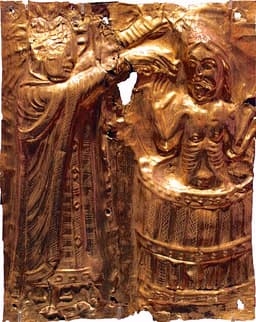
Harald Bluetooth
Emperor · Medieval
59.3Total
Basic Information
Born
1034
911
Died
1073
985
Era
Medieval
Medieval
Nationality
Japan
Denmark
Occupation
Emperor
Emperor
Civilization
Eastern
Western
Score Comparison
Military (10%)
52.9
40.0
Political (20%)
35.1
72.0
Influence (20%)
47.9
62.0
Legacy (20%)
41.7
56.0
Leadership (15%)
31.2
70.0
Strategy (15%)
68.6
45.0
TOTAL
44.5
59.3
Emperor Go-Sanjo — Complete Timeline
1068 AD
Attempt to rule directly without Fujiwara regentsPolitical Action◆ Major
Upon ascending the throne, Go-Sanjo sought to govern without a Fujiwara regent, breaking the tradition of Fujiwara control over the imperial succession. He appointed non-Fujiwara officials and issued edicts directly, challenging the regency system.
Fujiwara RegencyImperial AuthorityHeian Period
Impact: nationalconstructive
1069 AD
Reform of land and tax policiesReform◆ Major
Go-Sanjo implemented policies to reclaim tax-exempt lands held by temples and aristocrats, aiming to strengthen imperial finances. These reforms reduced the economic power of the Fujiwara and other noble houses, though they faced resistance.
Land ReformTaxationEconomic Policy
Impact: nationalconstructive
1072 AD
Establishment of the Insei (cloistered government) precedentPolitical Action
Go-Sanjo abdicated in favor of his son Shirakawa but continued to exert influence from retirement, laying the groundwork for the cloistered government system. This allowed retired emperors to rule behind the scenes, bypassing Fujiwara regents.
Insei SystemImperial PoliticsHeian Period
Impact: nationalconstructive
Harald Bluetooth — Complete Timeline
958 AD
Unified DenmarkPolitical Action◆ Major
Harald Bluetooth unified the Danish tribes into a single kingdom, consolidating power over Jutland, Zealand, and surrounding islands. This unification laid the foundation for the medieval Danish state and established the Gorm dynasty's rule.
UnificationDenmarkMedieval Kingdom
Impact: regionalconstructive
965 AD
Introduced Christianity to DenmarkCultural◆ Major
Harald Bluetooth converted to Christianity and mandated the conversion of Denmark. He erected the larger Jelling rune stone, which proclaims that he 'made the Danes Christian'. This event marked Denmark's entry into Christian Europe and aligned it with Latin Christendom.
ChristianizationReligionJelling Stones
Impact: regionalconstructive
Built the Jelling monumentsCultural◆ Major
Harald Bluetooth commissioned the Jelling rune stones and burial mounds in memory of his parents. The larger stone, often called 'Denmark's birth certificate', features a depiction of Christ and a runic inscription celebrating his unification of Denmark and Norway.
Jelling StonesMonumentsCultural Heritage
Impact: regionalconstructive
970 AD
Conquered NorwayWar◆ Major
Harald Bluetooth conquered Norway after defeating Earl Hakon Sigurdsson, bringing Norway under Danish rule. This expansion created a short-lived North Sea empire and demonstrated Danish military power in Scandinavia.
ConquestNorwayDanish Empire
Impact: regional
985 AD
Rebelled against by his son Sweyn ForkbeardPolitical Action◆ Major
Harald Bluetooth faced a rebellion led by his son Sweyn Forkbeard, who opposed his father's rule and Christianization policies. The rebellion forced Harald into exile, where he died shortly after, ending his reign and leading to Sweyn's ascension.
RebellionDynastic ConflictExile
Impact: regionaldestructive
Expert Analysis
Origins
Emperor Go-Sanjo (1034–1073) was born as the second son of Emperor Go-Suzaku. His mother was Princess Teishi, a daughter of Emperor Sanjo, giving him imperial lineage free of strong Fujiwara ties. Growing up, he witnessed the Fujiwara regents' dominance over the throne, which shaped his resolve to rule independently. He received a classical education in Chinese literature and Confucian governance.
Harald Bluetooth (c. 911–985/986) was born into the Danish royal family, son of King Gorm the Old and Thyra. Gorm had united Jutland, but Denmark was still fractured. Harald grew up in a pagan society, with Viking traditions of raiding and oral law. He likely learned leadership through military campaigns alongside his father.
Rise to Power
Go-Sanjo ascended the throne in 1068 after his older brother Go-Reizei died without heirs. Unlike previous emperors, he was adult (34) and had no Fujiwara regent appointed. The Fujiwara clan had controlled succession for decades, but Go-Sanjo's father-in-law was not a Fujiwara, allowing him to bypass their influence. In 1069, he established the Records Office to audit land titles, challenging tax exemptions held by Fujiwara-backed temples and nobles.
Harald Bluetooth became king of Denmark around 958 after Gorm's death. He inherited a realm that included Jutland, Zealand, and Scania. His first major achievement was completing the unification of Denmark by subduing petty kings. He then turned to Norway, defeating Earl Hakon Sigurdsson and conquering the country around 970–975. This created a short-lived North Sea empire.
Leadership & Governance
Go-Sanjo's governance focused on imperial autonomy. He issued edicts to reclaim tax-exempt lands (shoen) and reduce Fujiwara wealth. He also promoted capable officials outside the Fujiwara clan, such as Minamoto no Takakuni. His political score of 35.1 reflects limited success due to entrenched aristocratic resistance. His strategy score of 68.6, however, shows shrewd long-term planning: he abdicated in 1072 to his son Shirakawa, intending to rule from retirement as a cloistered emperor—a precedent that later emperors used to assert power.
Harald Bluetooth's leadership score of 70.0 indicates effective coalition-building. He introduced Christianity as a unifying force, mandating conversion and building churches. The larger Jelling rune stone (c. 965) proclaims: "Harald, king of the Danes, who made the Danes Christian." This religious shift aligned Denmark with European Christendom, improving trade and diplomatic ties. His political score of 72.0 reflects his ability to centralize authority through religion and law.
Triumph & Tragedy
Go-Sanjo's greatest success was laying foundations for the Insei system, which allowed retired emperors to wield power. He also implemented land reforms that increased imperial revenue temporarily. However, his direct rule was short-lived; after his abdication, Fujiwara influence resurged. His failure to permanently weaken the Fujiwara is evident: his total score of 44.5 ranks below Harald's 59.3.
Harald's triumphs include unifying Denmark and converting it to Christianity, earning him the nickname "Bluetooth" (possibly from a tooth). The Jelling monuments stand as Denmark's "birth certificate." But his later years saw tragedy: his son Sweyn Forkbeard rebelled against him around 985, forcing Harald into exile. He died soon after, possibly in Jomsborg. The rebellion stemmed from opposition to Christianization and heavy taxes.
Character & Destiny
Go-Sanjo was determined and reform-minded, but his political inexperience led to limited gains. He scored 31.2 in leadership, indicating difficulty in commanding loyalty. His destiny was to be a transitional figure—his strategies realized by successors.
Harald Bluetooth was pragmatic and religiously adaptable. He used Christianity to consolidate power, but his heavy-handed conversion alienated traditionalists. His military score of 40.0 is modest, but his political acumen (72.0) secured his legacy. His destiny was to create a unified Danish identity that outlasted his reign.
Legacy
Go-Sanjo's legacy is indirect: the Insei system flourished under Emperor Shirakawa (1086–1129) and later emperors, reducing Fujiwara power. His land reforms influenced later Kamakura shogunate policies. He is remembered as a reformer who challenged aristocratic dominance.
Harald Bluetooth's legacy is tangible: the Jelling rune stones are UNESCO World Heritage, and his Christianization efforts established Denmark in European Christendom. The name "Bluetooth" lives on in wireless technology. His unification laid the groundwork for the medieval Danish kingdom.
Conclusion
Harald Bluetooth had greater impact. His unification of Denmark and introduction of Christianity fundamentally transformed a society, creating a centralized state that influenced Scandinavia. Go-Sanjo's efforts were significant within Japan's imperial court, but his reforms were partial and temporary. Harald's total score of 59.3 versus Go-Sanjo's 44.5 reflects this. While both faced rebellions, Harald's structural changes endured for centuries. Go-Sanjo's legacy is important but secondary to the transformations Harald achieved.
Rankings
🥇
Harald BluetoothLeader
Mil: 40.0Pol: 72.0Inf: 62.0
59.3
🥈
Emperor Go-Sanjo
Mil: 52.9Pol: 35.1Inf: 47.9
44.5
+14.8 behind
How This Comparison Works
Algorithm
Each figure is scored on 6 dimensions (0—100 scale) based on structured historical data: Military (10%), Political (20%), Influence (20%), Legacy (20%), Leadership (15%), Strategy (15%). The weighted total produces the final ranking.
Data Sources
Scores are computed from structured sub-indicators in the database. Scale factors adjust for era (Ancient ×0.85, Modern ×1.0) and civilization size (Eastern ×1.05, Other ×0.80) to account for differences in population and military scale.
Maximum 3 Figures
Comparisons are limited to 2—3 figures to ensure readability and statistical meaningfulness.
Error Margins
±5 points per dimension — Sub-scores are derived from historical records with inherent uncertainty. Two figures within 5 points on a dimension should be considered roughly equivalent in that area.
Total Score Accuracy
±3 points overall — The weighted combination of 6 dimensions produces a total score with approximately ±3 points of uncertainty. Differences of less than 3 points are not statistically significant— the figures are effectively tied.
Known Limitations
- Historical records are incomplete and uneven across civilizations
- Figures from oral-tradition societies may be underrepresented
- Occupation labels can misclassify multi-role figures
- Scores measure capability and impact, not moral character
- Quantitative scoring is a comparison tool, not absolute truth
Capability Radar
Military (10%) — Battles & Warfare
Battles
45
30
Win Rate
47
35
Expansion
51
45
Political (20%) — Governance & Reform
Reform
40
70
Diplomacy
30
65
Economy
20
50
Influence (20%) — Cultural & Global Reach
Cultural
15
60
Global
10
50
Legacy (20%) — Historical Impact
Historical
30
65
Longevity
20
55
Leadership (15%) — Power & Stability
Tenure
15
60
Stability
20
55
Strategy (15%) — Tactics & Innovation
Strategy
52
40
Tactics
60
25
Reform
61
20
Similar Comparisons
Comments & Discussion
No comments yet. Be the first to share your thoughts!