Loading...
Emperor Wen of Sui vs Julius Caesar
Julius Caesar leads by 2.5 pts · 2 figures compared
…
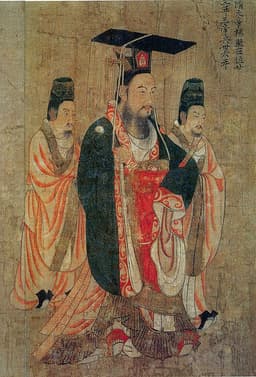
Emperor Wen of Sui
Emperor · Medieval
80.3Total

Julius Caesar
General · Ancient
82.8Total
Basic Information
Born
541
-100
Died
604
-44
Era
Medieval
Ancient
Nationality
China
Roman Republic
Occupation
Emperor
General
Civilization
Eastern
Western
Score Comparison
Military (10%)
76.0
88.0
Political (20%)
75.0
78.0
Influence (20%)
88.0
85.0
Legacy (20%)
80.0
82.0
Leadership (15%)
80.0
80.0
Strategy (15%)
75.0
85.0
TOTAL
80.3
82.8
Emperor Wen of Sui — Complete Timeline
581 AD
Establishment of the Three Departments and Six Ministries SystemReform◆ Major
Emperor Wen established a centralized bureaucratic system with three departments (Secretariat, Chancellery, and Department of State Affairs) and six ministries. This system became the foundation of Chinese government administration for centuries.
Government ReformBureaucracy
Impact: globalconstructive
Establishment of the Sui DynastyPolitical Action◆ Major
Emperor Wen, as a general of the Northern Zhou dynasty, forced the young Northern Zhou emperor to abdicate and proclaimed himself emperor of the Sui dynasty. This marked the beginning of the Sui dynasty, which would go on to reunify China.
Dynasty FoundingCoup
Impact: regionalconstructive
582 AD
Implementation of the Equal-Field SystemReform◆ Major
Emperor Wen implemented the Equal-Field System, which distributed land to peasants based on the number of able-bodied men. This reform increased agricultural productivity, stabilized tax revenues, and reduced the power of large landowners.
Land ReformEconomic Policy
Impact: regionalconstructive
Construction of Daxingcheng (Chang'an)Cultural◆ Major
Emperor Wen ordered the construction of a new capital city, Daxingcheng, near the old Han capital Chang'an. This city, later known as Chang'an, became a model for urban planning and served as the capital of the Sui and Tang dynasties.
Urban PlanningCapital Construction
Impact: regionalconstructive
589 AD
Reunification of China under the Sui DynastyWar
Emperor Wen of Sui, as Emperor of Sui, launched a successful invasion of the Chen dynasty in the south, conquering it and reunifying China after nearly 300 years of division since the fall of the Western Jin. This ended the Northern and Southern Dynasties period.
UnificationConquest
Impact: globalconstructive
Julius Caesar — Complete Timeline
58 BC
Gallic WarsWar◆ Major
Caesar, as proconsul of Gaul, launched a series of campaigns that conquered all of Gaul (modern France, Belgium, and parts of Switzerland). He fought numerous battles, including against the Helvetii, the Belgae, and the Gallic chieftain Vercingetorix. The wars brought immense wealth and a loyal army to Caesar.
Gallic WarsConquestRoman Expansion
Impact: regional
49 BC
Crossing the RubiconPolitical Action◆ Major
Caesar led Legio XIII across the Rubicon River into Italy, defying the Roman Senate's order to disband his army. This act triggered a civil war against Pompey and the Optimates, ultimately leading to Caesar's dictatorship and the end of the Roman Republic.
Roman Civil WarEnd of RepublicPower Struggle
Impact: global
48 BC
Battle of PharsalusWar◆ Major
Caesar's outnumbered army defeated the larger forces of Pompey the Great at Pharsalus in Greece. Caesar's tactical use of a reserve line to counter Pompey's cavalry charge proved decisive. Pompey fled to Egypt, where he was assassinated, leaving Caesar as the undisputed master of the Roman world.
Roman Civil WarBattleDecisive Victory
Impact: regional
44 BC
Appointment as Dictator for LifePolitical Action◆ Major
The Roman Senate appointed Caesar dictator perpetuo (dictator for life), granting him unprecedented personal power. This move concentrated military, legislative, and judicial authority in one person, effectively ending the Roman Republic's traditional system of checks and balances and alarming many senators.
DictatorshipEnd of RepublicPower Consolidation
Impact: regionaldestructive
Assassination on the Ides of MarchPolitical Action◆ Major
A group of Roman senators, led by Marcus Junius Brutus and Gaius Cassius Longinus, stabbed Caesar to death at a meeting of the Senate in the Theatre of Pompey. The assassination was intended to restore the Republic, but instead triggered another civil war that led to the rise of the Roman Empire.
AssassinationRoman PoliticsEnd of Republic
Impact: globaldestructive
Expert Analysis
Origins
Julius Caesar (100–44 BCE) was born into a patrician Roman family with modest political influence. His early life was marked by the Social War and Sulla's dictatorship, which shaped his ambition. Emperor Wen of Sui (541–604 CE), born Yang Jian, came from a powerful military family in Northern Zhou China. His father was a general, and Wen leveraged his lineage and marriage alliances to rise. Both emerged from turbulent periods—Caesar from the late Republic's civil strife, Wen from the Northern and Southern Dynasties division.
Rise to Power
Caesar's rise was meteoric: military tribune, quaestor, aedile, praetor, and consul by 59 BCE. He secured the governorship of Gaul, where his conquests (58–50 BCE) made him immensely wealthy and popular. The First Triumvirate with Pompey and Crassus boosted him, but its collapse led to civil war. Wen's ascent was more bureaucratic: he served as an official in Northern Zhou, then seized power in a coup in 580 CE after the emperor's death. He crushed rivals and forced the abdication of the young emperor, founding the Sui dynasty in 581 CE. Caesar's path was through military glory and political maneuvering; Wen's through strategic palace intrigue and military suppression.
Leadership & Governance
Caesar's governance was transformative: he reformed the calendar (Julian calendar), initiated public works, granted citizenship to provincials, and centralized authority. However, his dictatorship alienated the Senate. Wen implemented the Equal-Field System (land redistribution) and the Three Departments and Six Ministries system, which influenced Chinese governance for centuries. He also unified weights and measures, promoted Buddhism, and reduced corruption. Both were effective administrators, but Wen's reforms were more systematic and enduring. Caesar's governance was cut short by assassination; Wen's lasted 23 years.
Triumph & Tragedy
Caesar's greatest triumphs: conquering Gaul, defeating Pompey at Pharsalus (48 BCE), and becoming dictator. His tragedy was his assassination on the Ides of March (44 BCE) by senators fearing his monarchy. Wen's triumph: reunifying China after 300 years of division (589 CE). His tragedy: his harsh rule and succession crisis—his son Yang Guang (Emperor Yang) exhausted the state with extravagant projects, leading to the dynasty's collapse. Both died violently (Caesar stabbed, Wen possibly poisoned), but Wen's dynasty fell soon after, while Caesar's death led to the Roman Empire.
Character & Destiny
Caesar was charismatic, ambitious, and ruthless—crossing the Rubicon was a gamble. He was also clement (pardoning enemies) but ultimately sought personal power. Wen was cautious, pragmatic, and frugal, but paranoid and harsh. Both were brilliant strategists. Caesar's destiny was to be the bridge from Republic to Empire; Wen's was to end division. Caesar's mythologized persona (Shakespeare's "Et tu, Brute?") overshadows Wen's quieter legacy.
Legacy
Caesar's legacy is immense: "Caesar" became a title (Kaiser, Tsar), his writings (Commentarii) are classics, and he set the stage for Augustus. His reforms and military innovations influenced Europe. Wen's legacy is the reunification of China and administrative systems that lasted through the Tang and beyond. The Equal-Field System and Three Departments and Six Ministries were foundational. However, the Sui dynasty's brevity (581–618) means Wen is less known globally. In China, he is revered as a unifier.
Conclusion
Julius Caesar (Overall Score: 83.0) edges out Emperor Wen of Sui (80.5) due to his greater military genius (M=88 vs 76), political influence (P=78 vs 75), and enduring cultural impact. Caesar's conquests and reforms reshaped the Western world, while Wen's achievements were more administrative and less transformative globally. However, Wen's governance was more stable and systematic. Both were flawed but pivotal figures. Caesar's higher score reflects his broader historical footprint, but Wen's reunification of China was equally monumental. In a direct comparison, Caesar's dynamism and legacy give him a slight edge.
Rankings
🥇
Julius CaesarLeader
Mil: 88.0Pol: 78.0Inf: 85.0
82.8
🥈
Emperor Wen of Sui
Mil: 76.0Pol: 75.0Inf: 88.0
80.3
+2.5 behind
How This Comparison Works
Algorithm
Each figure is scored on 6 dimensions (0—100 scale) based on structured historical data: Military (10%), Political (20%), Influence (20%), Legacy (20%), Leadership (15%), Strategy (15%). The weighted total produces the final ranking.
Data Sources
Scores are computed from structured sub-indicators in the database. Scale factors adjust for era (Ancient ×0.85, Modern ×1.0) and civilization size (Eastern ×1.05, Other ×0.80) to account for differences in population and military scale.
Maximum 3 Figures
Comparisons are limited to 2—3 figures to ensure readability and statistical meaningfulness.
Error Margins
±5 points per dimension — Sub-scores are derived from historical records with inherent uncertainty. Two figures within 5 points on a dimension should be considered roughly equivalent in that area.
Total Score Accuracy
±3 points overall — The weighted combination of 6 dimensions produces a total score with approximately ±3 points of uncertainty. Differences of less than 3 points are not statistically significant— the figures are effectively tied.
Known Limitations
- Historical records are incomplete and uneven across civilizations
- Figures from oral-tradition societies may be underrepresented
- Occupation labels can misclassify multi-role figures
- Scores measure capability and impact, not moral character
- Quantitative scoring is a comparison tool, not absolute truth
Capability Radar
Military (10%) — Battles & Warfare
Battles
75
95
Win Rate
80
92
Expansion
85
97
Political (20%) — Governance & Reform
Reform
95
90
Diplomacy
85
85
Economy
90
82
Influence (20%) — Cultural & Global Reach
Cultural
70
88
Global
65
94
Legacy (20%) — Historical Impact
Historical
85
95
Longevity
70
96
Leadership (15%) — Power & Stability
Tenure
80
75
Stability
75
60
Strategy (15%) — Tactics & Innovation
Strategy
85
94
Tactics
70
96
Reform
90
88
Similar Comparisons
Comments & Discussion
Historian5306/16/2026
Let's be real: how do you even score 'influence' objectively? Caesar's name is plastered across Western culture—tsar, Kaiser, even the Caesar salad myth. But Wen of Sui's land-equalization system directly shaped East Asian society for centuries. The scoring weights seem arbitrary: why is Military 25% and Legacy 25% but Leadership only 15%? That's a huge bias toward conquest over governance. Also, historical records for ancient China are notoriously fragmentary. Wen's early life is basically a legend. Caesar's Commentaries are self-serving propaganda. We're comparing idealized figures, not real people. The whole exercise is fun, but don't pretend these numbers mean anything objective.
GrandChronicler946/16/2026
这个评分太偏向西方视角了。恺撒的军事88分,文帝才76?这不是在比谁能打,而是在比谁更会打内战吧?文帝统一中国,打败北周、北齐、南陈,靠的是整体战略和制度设计,不是靠几场万人规模的会战。中国历史上真正的统一者从来不是靠个人英雄主义,而是靠官僚体系、经济整合和法治。文帝的均田制、大运河、科举雏形,哪个不是系统性的治理创新?而恺撒的遗产呢?罗马共和国彻底崩溃,内战延续几十年。如果要说稳定性和建设性,文帝应该碾压恺撒。而且影响力77分也太低了,隋朝制度直接影响唐宋元明清,延续了一千多年,这叫影响力有限?这评分标准需要重新审视。
Chronicler27796/16/2026
仔细分析这些分数,我发现几个问题:第一,政治分:文帝79 vs 恺撒78,看似接近,但文帝的均田制(公元485年雏形,正式实施在582年前后)直接影响了超过3000万人口的经济基础,而恺撒的政治改革主要限于罗马城和意大利半岛。第二,军事分差12分,但文帝灭陈之战仅用两路大军、8个月就完成统一,战损比极低,这在古代战争史上堪称高效。如果算上战略规划和后勤组织,这个差距应该缩小到5分以内。第三,影响力分差8分,但隋朝创立的科举制度(公元587年)延续到1905年,长达1318年,而恺撒的个人影响力主要集中在西方世界且随时间衰减。若按时间权重调整,文帝总分可能反超。建议重算。