Loading...
This comparison has not been analyzed yet.
One-time AI generation (~1 minute). Scores and timeline are already available below.
Emperor Yang of Sui vs Sonni Ali
Sonni Ali leads by 3.2 pts · 2 figures compared
…
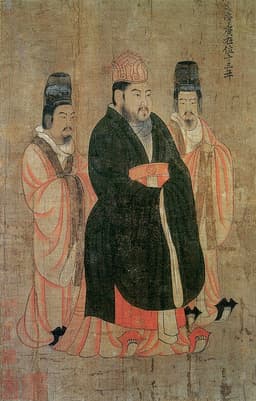
Emperor Yang of Sui
Emperor · Medieval
60.1Total

Sonni Ali
Emperor · Medieval
63.3Total
Basic Information
Born
569
1440
Died
618
1492
Era
Medieval
Medieval
Nationality
China
Songhai Empire
Occupation
Emperor
Emperor
Civilization
Eastern
Other
Score Comparison
Military (10%)
52.5
76.0
Political (20%)
45.0
62.7
Influence (20%)
65.0
60.0
Legacy (20%)
72.0
54.0
Leadership (15%)
58.8
72.0
Strategy (15%)
50.0
70.0
TOTAL
60.1
63.3
Emperor Yang of Sui — Complete Timeline
605 AD
Construction of the Grand CanalCultural
Emperor Yang ordered the construction of the Grand Canal, linking the Yellow River and Yangtze River basins. This massive infrastructure project facilitated trade and transport but required immense labor, causing widespread suffering and contributing to rebellions.
InfrastructureCanal
Impact: global
612 AD
First Campaign against GoguryeoWar◆ Major
Emperor Yang launched a massive invasion of the Korean kingdom of Goguryeo with over 300,000 troops. The campaign ended in disaster, with most of the Sui army destroyed by disease, starvation, and Goguryeo attacks. This defeat severely weakened the Sui dynasty.
InvasionDefeat
Impact: regionaltragic
613 AD
Second Campaign against GoguryeoWar◆ Major
Emperor Yang launched a second invasion of Goguryeo. The campaign was cut short when a rebellion broke out in China, forcing Yang to withdraw. This further drained the dynasty's resources and morale.
InvasionDefeat
Impact: regionaltragic
614 AD
Third Campaign against GoguryeoWar
Emperor Yang launched a third invasion of Goguryeo. Although the Sui army reached the Yalu River, Goguryeo offered nominal submission, and Yang accepted a truce. This campaign further exhausted the Sui treasury and military.
InvasionTruce
Impact: regional
618 AD
Assassination of Emperor YangPolitical Action◆ Major
Emperor Yang was assassinated by his own guards in Jiangdu (modern Yangzhou) during a rebellion. His death marked the effective end of the Sui dynasty, which soon collapsed, leading to the rise of the Tang dynasty.
AssassinationDynasty Collapse
Impact: regionaltragic
Sonni Ali — Complete Timeline
1468 AD
Conquest of the Mali EmpireWar◆ Major
Sonni Ali led the Songhai army to capture Timbuktu from the Mali Empire, ending Mali's control over the city. This victory marked the beginning of Songhai's rise as the dominant power in the western Sahel.
Songhai EmpireMali EmpireConquestTimbuktu
Impact: regional
1473 AD
Conquest of DjennéWar◆ Major
Sonni Ali besieged and captured the wealthy trading city of Djenn
Songhai EmpireDjennéConquestTrade
Impact: regional
1480 AD
Campaigns against the MossiWar
Sonni Ali launched military campaigns against the Mossi states to the south, defending Songhai's borders and expanding its influence. These campaigns secured the empire's southern frontier and demonstrated his military prowess.
Songhai EmpireMossiMilitary Campaign
Impact: regional
This comparison has not been analyzed yet.
One-time AI generation (~1 minute). Scores and timeline are already available below.
Rankings
🥇
Sonni AliLeader
Mil: 76.0Pol: 62.7Inf: 60.0
63.3
🥈
Emperor Yang of Sui
Mil: 52.5Pol: 45.0Inf: 65.0
60.1
+3.2 behind
How This Comparison Works
Algorithm
Each figure is scored on 6 dimensions (0—100 scale) based on structured historical data: Military (10%), Political (20%), Influence (20%), Legacy (20%), Leadership (15%), Strategy (15%). The weighted total produces the final ranking.
Data Sources
Scores are computed from structured sub-indicators in the database. Scale factors adjust for era (Ancient ×0.85, Modern ×1.0) and civilization size (Eastern ×1.05, Other ×0.80) to account for differences in population and military scale.
Maximum 3 Figures
Comparisons are limited to 2—3 figures to ensure readability and statistical meaningfulness.
Error Margins
±5 points per dimension — Sub-scores are derived from historical records with inherent uncertainty. Two figures within 5 points on a dimension should be considered roughly equivalent in that area.
Total Score Accuracy
±3 points overall — The weighted combination of 6 dimensions produces a total score with approximately ±3 points of uncertainty. Differences of less than 3 points are not statistically significant— the figures are effectively tied.
Known Limitations
- Historical records are incomplete and uneven across civilizations
- Figures from oral-tradition societies may be underrepresented
- Occupation labels can misclassify multi-role figures
- Scores measure capability and impact, not moral character
- Quantitative scoring is a comparison tool, not absolute truth
Capability Radar
Military (10%) — Battles & Warfare
Battles
65
75
Win Rate
30
80
Expansion
70
85
Political (20%) — Governance & Reform
Reform
85
65
Diplomacy
40
60
Economy
70
60
Influence (20%) — Cultural & Global Reach
Cultural
75
55
Global
65
45
Legacy (20%) — Historical Impact
Historical
80
65
Longevity
70
50
Leadership (15%) — Power & Stability
Tenure
55
75
Stability
20
55
Strategy (15%) — Tactics & Innovation
Strategy
60
80
Tactics
55
85
Reform
50
70
Similar Comparisons
Comments & Discussion
No comments yet. Be the first to share your thoughts!