Loading...
Evika Silina vs Jean-Claude Duvalier
Evika Silina leads by 0.5 pts · 2 figures compared
…
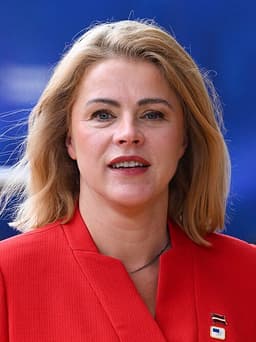
Evika Silina
Politician · Modern
39.5Total

Jean-Claude Duvalier
Politician · Modern
39.0Total
Basic Information
Born
1975
1951
Died
—
—
Era
Modern
Modern
Nationality
Latvia
Haiti
Occupation
Politician
Politician
Civilization
Western
Other
Score Comparison
Military (10%)
14.2
34.6
Political (20%)
43.7
30.7
Influence (20%)
47.9
45.5
Legacy (20%)
35.8
34.2
Leadership (15%)
51.9
48.4
Strategy (15%)
28.6
37.0
TOTAL
39.5
39.0
Evika Silina — Complete Timeline
2023 AD
Economic Reform EffortsReform
Silina's government pursued economic reforms including tax changes and measures to address inflation and energy costs. The reforms aimed to improve Latvia's competitiveness and fiscal stability.
EconomyTax ReformEnergy
Impact: nationalconstructive
Appointed Prime Minister of LatviaPolitical Action◆ Major
Silina became Prime Minister of Latvia, leading a coalition government formed by the New Unity party, the Union of Greens and Farmers, and the Progressives. She succeeded Kri
Prime MinisterCoalitionGovernment Formation
Impact: nationalconstructive
Continued Support for UkrainePolitical Action
Silina's government maintained Latvia's strong support for Ukraine, including military aid and hosting Ukrainian refugees. Latvia consistently advocated for EU sanctions against Russia.
UkraineForeign PolicySanctions
Impact: regionalconstructive
Jean-Claude Duvalier — Complete Timeline
1971 AD
Liberalization ReformsReform
Duvalier initially relaxed some of his father's repressive policies. He allowed some political exiles to return, reduced the power of the Tonton Macoute militia, and permitted a slightly freer press. These reforms were limited and did not establish democracy.
ReformLiberalizationHuman Rights
Impact: nationalconstructive
Inherited PresidencyPolitical Action◆ Major
Upon the death of his father Fran
SuccessionDictatorshipHaiti
Impact: national
1980 AD
Marriage to Michèle BennettCultural
Duvalier married Mich
MarriageScandalElite
Impact: national
1986 AD
Overthrow and ExilePolitical Action◆ Major
Massive protests and international pressure forced Duvalier to flee Haiti. He went into exile in France, taking millions of dollars allegedly stolen from the state. His departure ended 29 years of Duvalier family rule and led to a transition to democracy.
ExileRevolutionEnd of Dictatorship
Impact: nationaltragic
2011 AD
Return to HaitiPolitical Action◆ Major
After 25 years in exile, Duvalier unexpectedly returned to Haiti. He was arrested upon arrival and charged with corruption, human rights abuses, and embezzlement. However, he was never fully tried, and the case was eventually dropped due to statute of limitations issues.
ReturnArrestJustice
Impact: national
Expert Analysis
Origins
Evika Silina was born in 1975 in Riga, Latvia, then part of the Soviet Union. Growing up under Soviet rule shaped her political worldview. She studied law at the University of Latvia, graduating in 1998, and later pursued a career in public administration. Her early work included roles in the Ministry of Justice and as a legal advisor, focusing on European Union integration and legal reforms. Silina's background was in technocratic governance, not populism.
Jean-Claude Duvalier was born in 1951 in Port-au-Prince, Haiti, as the son of François Duvalier, the dictator known as "Papa Doc." He was raised in a privileged, isolated environment, groomed to inherit power. He studied at the University of Haiti but left without a degree. His formative experiences were shaped by the cult of personality around his father and the violent repression of the Tonton Macoute militia.
Rise to Power
Silina's rise was gradual and democratic. She joined the New Unity party and became a member of the Saeima (parliament) in 2014. She served as Minister of Justice from 2019 to 2022, where she gained recognition for anti-corruption efforts. In 2023, after a political crisis, she was appointed Prime Minister, leading a coalition government. Her ascent was marked by consensus-building and administrative competence, with no major turning point beyond her appointment.
Duvalier inherited power at age 19 upon his father's death in 1971. A constitutional amendment lowered the minimum age for president from 40 to 20, allowing him to take office. He was initially seen as a figurehead, but he consolidated control by maintaining the repressive apparatus. His marriage to Michèle Bennett in 1980 alienated the elite but solidified his image. Unlike Silina, his rise was dynastic and autocratic, not earned through elections.
Leadership & Governance
Silina's leadership style is pragmatic and coalition-oriented. She scores 51.9 in leadership, reflecting her ability to manage a diverse government. Her governance focuses on economic stability, NATO integration, and support for Ukraine. For example, her government implemented tax reforms to curb inflation and continued military aid to Ukraine, maintaining Latvia's stance against Russian aggression. She operates within democratic constraints, with limited personal power.
Duvalier's leadership was authoritarian and personalized. He scored 48.4 in leadership, but his governance was marked by corruption and human rights abuse. Initially, he relaxed some repressive policies, allowing exiles to return and reducing the Tonton Macoute's power. However, his regime remained dictatorial, with state violence and embezzlement. His marriage and lavish spending eroded support. His strategy score of 37.0 reflects poor long-term planning, leading to his overthrow.
Triumph & Tragedy
Silina's triumph is stabilizing Latvia during a period of regional tension. Her government maintained democratic norms and economic growth despite energy crises. Her tragedy is limited impact due to coalition constraints and short tenure. She has not achieved transformative reforms, and her legacy remains incomplete.
Duvalier's triumph was initially reducing political violence compared to his father. He also oversaw some economic development, such as the construction of the Péligre Dam. However, his tragedy is immense: massive corruption, human rights abuses, and economic decline. He fled with millions of dollars stolen from the state, leaving Haiti in chaos. His return in 2011 led to arrest but no conviction, highlighting impunity.
Character & Destiny
Silina is a technocrat, methodical and cautious. Her decision-making reflects legal training and democratic norms. She avoids populism and focuses on institutional processes. Her destiny is tied to Latvia's stability within the EU and NATO. She is unlikely to be remembered as a transformational figure but as a competent manager.
Duvalier was aloof and indulgent, relying on inherited power. His character combined arrogance with incompetence. He failed to adapt to changing political realities, underestimating public anger. His destiny was exile and infamy. Historians view him as a symbol of dynastic dictatorship and kleptocracy.
Legacy
Silina's legacy is modest but positive: she upheld democratic governance in a small Baltic state. Her influence score of 47.9 reflects Latvia's continued alignment with Western institutions. She will be remembered as a prime minister during a period of resilience against Russian aggression.
Duvalier's legacy is overwhelmingly negative. His influence score of 45.5 is higher than Silina's due to his notoriety, but his legacy score of 34.2 is low due to condemnation. He is remembered for corruption, human rights abuses, and economic ruin. His rule set back Haitian development for decades.
Conclusion
Evika Silina scores 39.5 overall, slightly higher than Duvalier's 39.0. However, impact must be measured beyond scores. Silina's governance was democratic and constructive, while Duvalier's was destructive. Silina's political score of 43.7 exceeds Duvalier's 30.7, reflecting her ability to lead within a democratic framework. Duvalier's military score of 34.6 is higher, but that reflects repression, not skill. In terms of positive impact, Silina clearly surpasses Duvalier. Her legacy, though smaller in scale, advances human freedom and stability. Duvalier's legacy is a cautionary tale of autocracy. Thus, Evika Silina had greater positive impact.
Rankings
🥇
Evika SilinaLeader
Mil: 14.2Pol: 43.7Inf: 47.9
39.5
🥈
Jean-Claude Duvalier
Mil: 34.6Pol: 30.7Inf: 45.5
39.0
+0.5 behind
How This Comparison Works
Algorithm
Each figure is scored on 6 dimensions (0—100 scale) based on structured historical data: Military (10%), Political (20%), Influence (20%), Legacy (20%), Leadership (15%), Strategy (15%). The weighted total produces the final ranking.
Data Sources
Scores are computed from structured sub-indicators in the database. Scale factors adjust for era (Ancient ×0.85, Modern ×1.0) and civilization size (Eastern ×1.05, Other ×0.80) to account for differences in population and military scale.
Maximum 3 Figures
Comparisons are limited to 2—3 figures to ensure readability and statistical meaningfulness.
Error Margins
±5 points per dimension — Sub-scores are derived from historical records with inherent uncertainty. Two figures within 5 points on a dimension should be considered roughly equivalent in that area.
Total Score Accuracy
±3 points overall — The weighted combination of 6 dimensions produces a total score with approximately ±3 points of uncertainty. Differences of less than 3 points are not statistically significant— the figures are effectively tied.
Known Limitations
- Historical records are incomplete and uneven across civilizations
- Figures from oral-tradition societies may be underrepresented
- Occupation labels can misclassify multi-role figures
- Scores measure capability and impact, not moral character
- Quantitative scoring is a comparison tool, not absolute truth
Capability Radar
Military (10%) — Battles & Warfare
Battles
25
20
Win Rate
25
25
Expansion
27
26
Political (20%) — Governance & Reform
Reform
30
5
Diplomacy
40
10
Economy
35
5
Influence (20%) — Cultural & Global Reach
Cultural
10
5
Global
15
5
Legacy (20%) — Historical Impact
Historical
15
10
Longevity
10
5
Leadership (15%) — Power & Stability
Tenure
15
30
Stability
30
10
Strategy (15%) — Tactics & Innovation
Strategy
31
33
Tactics
32
36
Reform
36
38
Similar Comparisons
Comments & Discussion
No comments yet. Be the first to share your thoughts!